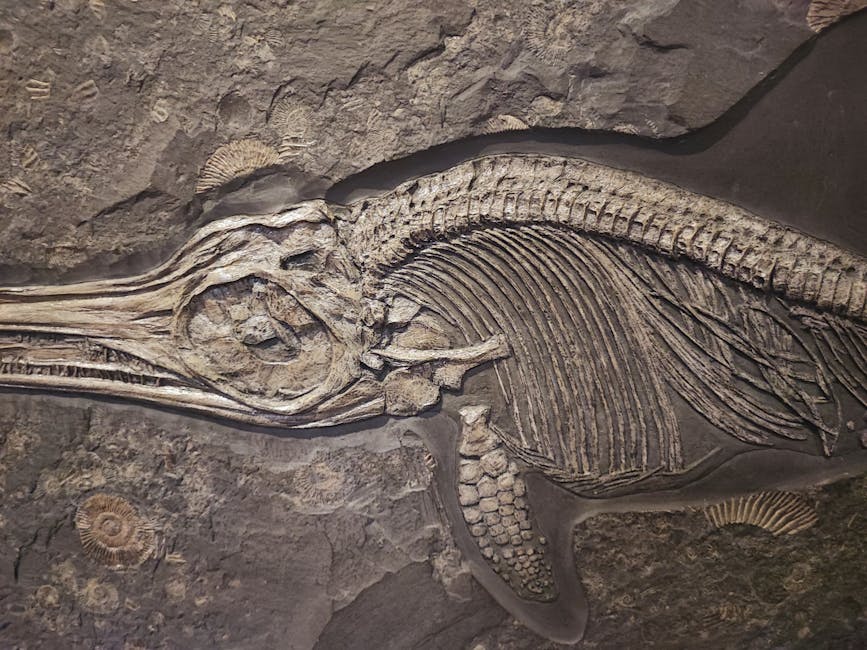
- Tylosaurus rex, a 43-foot-long mosasaur, ruled the oceans 80 million years ago as a massive predator.
- The discovery challenges the evolutionary timeline of mosasaurs, suggesting their enormous size appeared earlier and more abruptly than thought.
- Tylosaurus rex was a fully aquatic predator that evolved from terrestrial lizards, unlike dinosaurs which were land-dwellers.
- The massive jaws and razor-sharp teeth of Tylosaurus rex allowed it to tear through large prey, dominating the marine food web.
- The new species is forcing paleontologists to rethink the evolution of marine ecosystems during the Late Cretaceous period.
- → What is Tylosaurus rex, and how does it change our understanding of mosasaurs?
- → What fossil evidence supports the discovery of Tylosaurus rex?
- → Are there skeptics of the Tylosaurus rex classification?
- → What impact does Tylosaurus rex have on our understanding of ancient marine ecosystems?
- → What This Means For You
What if the most fearsome predator in Earth’s ancient oceans wasn’t a shark or a whale, but a scaled reptile the size of a school bus? That’s the startling reality emerging from a groundbreaking fossil discovery in Texas, where scientists have identified a colossal new species of marine reptile: Tylosaurus rex. At 43 feet long, this apex hunter ruled the Western Interior Seaway 80 million years ago, armed with massive jaws and razor-sharp teeth capable of tearing through large prey. But beyond its terrifying size, the discovery of Tylosaurus rex is forcing paleontologists to rethink the evolutionary timeline of mosasaurs—once thought to have gradually increased in size. Instead, this giant suggests that enormous predators appeared much earlier and more abruptly than expected, raising new questions about how marine ecosystems evolved during the Late Cretaceous period.
What is Tylosaurus rex, and how does it change our understanding of mosasaurs?

Tylosaurus rex is a newly identified species of mosasaur, an extinct group of marine reptiles that thrived during the Late Cretaceous period. Unlike dinosaurs, mosasaurs were not land-dwellers but fully aquatic predators that evolved from terrestrial lizards. The name ‘rex’—Latin for ‘king’—underscores its dominance in the marine food web. Fossils uncovered in North Texas, including a nearly complete skull and vertebrae, reveal that this creature reached lengths of up to 13 meters (43 feet), making it one of the largest mosasaurs ever discovered. What sets Tylosaurus rex apart isn’t just its size, but the timing of its existence: it lived approximately 80 million years ago, far earlier than other giant mosasaurs like Mosasaurus hoffmannii. This upends the long-standing assumption that mosasaurs slowly evolved into larger apex predators over tens of millions of years. Instead, Tylosaurus rex suggests that gigantism in these reptiles emerged rapidly, possibly in response to shifting ecological pressures or the availability of large prey such as ammonites, fish, and other marine reptiles.
What fossil evidence supports the discovery of Tylosaurus rex?

The identification of Tylosaurus rex is based on multiple fossil specimens collected over decades from the Austin Chalk deposits in Texas, a region renowned for its well-preserved marine fossils. The most complete specimen includes a 5-foot-long skull with conical, serrated teeth designed for gripping and slicing flesh, along with robust jaw muscles indicating a powerful bite force. Researchers led by paleontologists at Southern Methodist University conducted detailed morphological analyses, comparing the fossils to known mosasaur species. Key distinguishing features include a uniquely elongated snout, specialized jaw articulation, and vertebral structures adapted for fast, agile swimming. According to the study published in Nature Communications, these traits confirm Tylosaurus rex as a distinct, apex-tier predator. Isotopic analysis of the bones also suggests it occupied a high trophic level, feeding on large vertebrates rather than smaller organisms, reinforcing its role as a top predator in its ecosystem.
Are there skeptics of the Tylosaurus rex classification?

While the discovery has generated excitement, some paleontologists urge caution in interpreting Tylosaurus rex as a revolutionary evolutionary leap. Critics argue that the fossil record of mosasaurs remains incomplete, and what appears to be an abrupt emergence of gigantism could simply reflect sampling bias—large specimens are more likely to be preserved and discovered. Others suggest that the morphological differences used to define Tylosaurus rex may fall within the natural variation of already known species, such as Tylosaurus proriger. Dr. Michael Caldwell, a vertebrate paleontologist at the University of Alberta not involved in the study, noted in a ScienceDaily interview that “one must be careful not to over-split taxa based on fragmentary or geographically isolated material.” Additionally, the evolutionary mechanisms driving rapid size increases—whether ecological competition, climate shifts, or prey availability—remain speculative without broader comparative data from other regions. These counter-perspectives highlight the ongoing debate in paleontology about how to classify new species and interpret evolutionary patterns from limited fossil evidence.
What impact does Tylosaurus rex have on our understanding of ancient marine ecosystems?

The existence of Tylosaurus rex reshapes how scientists model ancient marine food webs. Its presence 80 million years ago suggests that complex, high-energy predator-prey dynamics were already well established long before the end of the Cretaceous period. Ecosystems in the Western Interior Seaway—once thought to be dominated by smaller predators—must have supported abundant large prey to sustain such a massive hunter. This implies a more intricate and resilient marine environment than previously assumed. Furthermore, the discovery underscores the importance of North America’s inland fossil deposits in reconstructing global paleobiology. Sites like the Austin Chalk may hold additional undiscovered species, offering a richer picture of marine biodiversity during the age of dinosaurs. The rise of Tylosaurus rex also parallels evolutionary patterns seen in modern apex predators like orcas and great white sharks, suggesting recurring ecological strategies across deep time.
What This Means For You
While Tylosaurus rex lived millions of years before humans, its discovery reminds us that Earth’s history is full of dramatic, unexpected turns. The way ecosystems evolve—especially the sudden rise of dominant species—can challenge long-held scientific assumptions. Understanding these ancient patterns helps scientists predict how modern marine life might respond to environmental changes, including climate change and overfishing. It also highlights the importance of fossil conservation and continued paleontological research in uncovering Earth’s deep past.
Now that Tylosaurus rex has rewritten part of evolutionary history, scientists are left with a compelling question: were there other giant predators lurking in ancient oceans that we haven’t found yet? And if so, what conditions triggered the repeated evolution of apex gigantism across different marine lineages? The search for answers continues, one fossil at a time.
Source: ScienceDaily