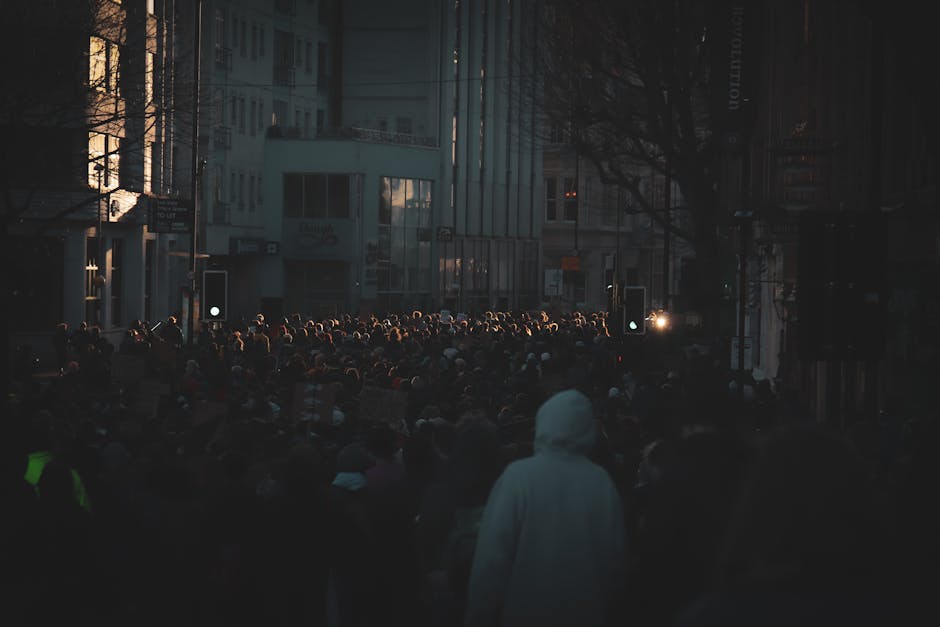
- Over 100,000 people gathered in Belgrade for an anti-government rally, driven by a demand for justice for the victims of the Novi Sad railway station tragedy.
- The protests, which began in late November, have grown from a few thousand to hundreds of thousands, with solidarity marches across Serbia.
- The movement, led by university students, has disrupted traffic, occupied public squares, and staged sit-ins outside government offices.
- Protesters accuse the ruling Serbian Progressive Party of systemic corruption, negligence, and stifling dissent.
- Demonstrators are calling for the dissolution of parliament and early elections under international supervision.
Belgrade pulsed with restless energy on a frigid winter evening as floodlights illuminated the Republic Square, casting long shadows over a sea of raised fists and handmade signs. Chants of “Resign!” and “Thieves!” echoed between the neoclassical facades of government buildings, where riot police stood in tight formation behind barricades. Tens of thousands had converged from across Serbia—students, teachers, engineers, pensioners—united not by party or ideology, but by grief and fury. At the center of the storm was a simple demand: justice for the 15 who died when a concrete canopy collapsed at the Novi Sad railway station in November 2024. What began as a localized outcry over a preventable tragedy had metastasized into the most formidable challenge to Aleksandar Vučić’s decade-long grip on power.
The Wave of Nationwide Demonstrations

Since late November, weekly protests have swelled from a few thousand to over 100,000 in Belgrade alone, with solidarity marches in Novi Sad, Niš, and Kragujevac. The movement, galvanized by university students, has disrupted traffic, occupied public squares, and staged sit-ins outside government offices. Protesters accuse the ruling Serbian Progressive Party (SNS) of systemic corruption, negligence, and stifling dissent. Key among their demands is the dissolution of parliament and early elections under international supervision. In December 2024, demonstrators briefly stormed the National Assembly building, leading to clashes with police and dozens of arrests. Despite government attempts to downplay the unrest, independent media and human rights groups confirm the protests represent the largest sustained opposition mobilization since the 2018–2020 protests. The European Union has called for dialogue, while the U.S. Embassy in Belgrade urged restraint and accountability.
From Tragedy to Uprising

The catalyst was the Novi Sad railway station collapse on November 15, 2024, when a newly renovated canopy gave way under snow accumulation, killing 15 and injuring over 50. Surveillance footage showed workers attempting to clear snow minutes before the structure failed—raising immediate questions about construction quality and oversight. Investigations revealed that the renovation contract, worth over €20 million, had been awarded to a firm with close ties to SNS officials. Whistleblowers alleged that safety inspections were falsified and engineers silenced. The government’s initial response—blaming weather and offering condolences without accountability—sparked outrage. Students at the University of Novi Sad organized a candlelight vigil that drew thousands. Within days, the movement spread to Belgrade’s Faculty of Philosophy, where activists launched a coordinated campaign using encrypted messaging apps and social media to organize nationwide strikes and marches.
The Faces Behind the Movement

At the forefront are students like Milica Jovanović, a 22-year-old architecture major from Novi Sad, and Marko Đorđević, a law student and spokesperson for the newly formed Civic Front for Accountability. Both have become symbols of a generation disillusioned by patronage politics and economic stagnation. Jovanović lost a cousin in the collapse and now speaks at rallies with a quiet intensity that belies her youth. “We didn’t choose this fight,” she told BBC News in December. “But if no one else will protect us, we must.” Their coalition includes labor unions, independent journalists, and former civil servants who say they were purged for refusing to comply with political directives. While the movement lacks a single leader, its decentralized structure has made it resilient to co-optation and repression, drawing inspiration from past uprisings in Bosnia and Armenia.
Political and Social Repercussions

The protests have rattled the ruling elite, with several officials resigning under pressure and state-run media shifting tone to acknowledge public anger. However, the government has also responded with surveillance, intimidation, and disinformation campaigns branding protesters as foreign agents. Interior Minister Bratislav Gašić dismissed the demonstrations as “orchestrated chaos,” while state television aired segments questioning the students’ motives. Economically, the unrest has delayed infrastructure projects and spooked investors, with Serbia’s credit rating placed under review by Fitch Ratings. Internationally, the EU has conditioned further accession talks on democratic reforms, and the U.S. State Department has called for independent investigations into the Novi Sad disaster. For ordinary citizens, the stakes are personal: trust in public institutions has plummeted, and many now question whether Serbia’s path toward European integration is genuine or merely performative.
The Bigger Picture
This uprising is not just about a collapsed roof—it’s about the erosion of public trust in post-Yugoslav governance. Across the Balkans, citizens have grown impatient with leaders who consolidate power while delivering little in transparency or service. Serbia’s protests echo broader regional frustrations seen in Montenegro, North Macedonia, and Bosnia, where youth-led movements have challenged entrenched elites. What makes this moment different is the fusion of moral clarity and tactical discipline among the protesters. They are not merely reacting to one tragedy but confronting a system where contracts, not competence, dictate survival. As Reuters noted, this could mark a turning point in Serbia’s democratic trajectory—if the momentum holds.
What comes next remains uncertain. The government has offered minor concessions—firing mid-level bureaucrats, promising a commission of inquiry—but refuses to entertain early elections. Protest leaders vow to escalate with general strikes and school walkouts. One thing is clear: the silent complicity that long enabled Serbia’s political class has cracked. Whether that crack becomes a rupture will depend on the courage of those in the streets and the world’s willingness to pay attention.
Source: Al Jazeera