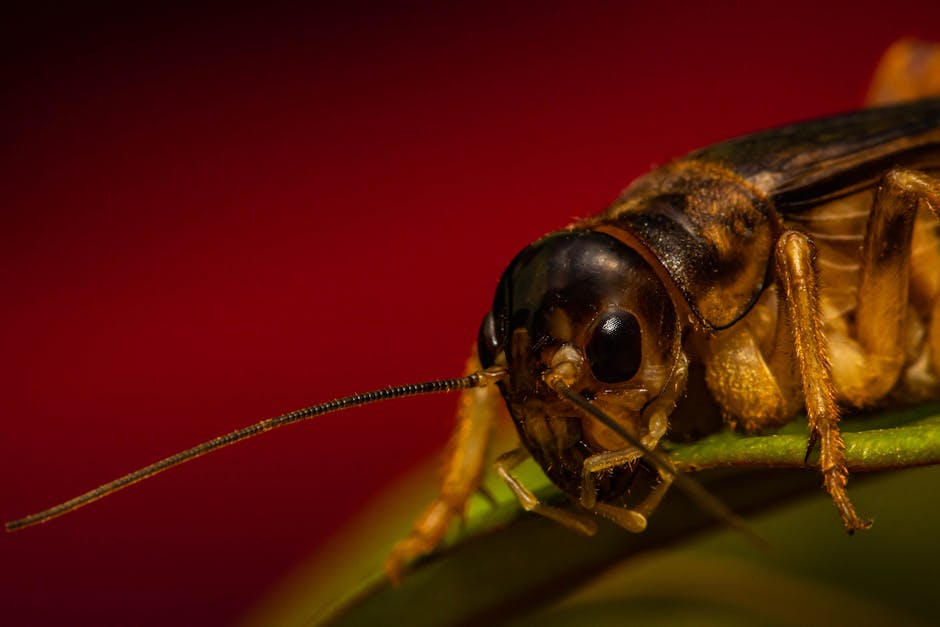
- An estimated 370 billion crickets are farmed annually for food, pet nutrition, and protein supplements.
- Crickets are praised for their low environmental footprint, high nutrient density, and rapid reproduction.
- Scientific evidence suggests that crickets may be capable of feeling pain, challenging the ethics of industrial-scale insect farming.
- Crickets exhibit behaviors indicative of pain avoidance, such as grooming injured limbs and altering feeding patterns.
- The discovery of nociceptors in crickets and other insects raises questions about their neurological complexity and potential for pain perception.
Are we causing widespread suffering in the name of sustainable protein? As the world seeks alternatives to beef and pork, insect farming—especially crickets—has emerged as a leading solution. Every year, an estimated 370 billion crickets are reared and harvested for food, pet nutrition, and protein supplements. They’re praised for their low environmental footprint, high nutrient density, and rapid reproduction. But a growing body of scientific evidence suggests that crickets may be capable of feeling pain—a revelation that could upend the ethics of industrial-scale insect farming. If these tiny creatures experience suffering, how should that reshape our food systems, regulations, and moral boundaries?
Can Crickets Actually Feel Pain?

For decades, the scientific consensus held that insects lacked the neurological complexity to experience pain as vertebrates do. However, recent studies in insect neurobiology challenge that view. Researchers have identified nociceptors—sensory neurons that respond to harmful stimuli—in crickets and other insects. More critically, crickets exhibit behaviors indicative of pain avoidance, such as grooming injured limbs, avoiding locations where they’ve experienced harm, and altering feeding patterns after injury. These responses go beyond simple reflexes; they suggest a form of centralized processing akin to pain perception. According to a 2022 review published in Nature Reviews Neuroscience, the presence of opioid receptors and modulatory pathways in insect brains supports the possibility of subjective pain experiences. While not equivalent to human pain, the evidence points to a form of aversive sensation that raises ethical red flags.
What Evidence Supports Insect Sentience?

Multiple lines of research now converge on the idea that insects, particularly social or long-lived species like crickets, possess rudimentary forms of sentience. A landmark 2021 study from the London School of Economics evaluated over 300 scientific papers and concluded that cephalopods and decapod crustaceans—once assumed insentient—clearly meet criteria for pain perception. The same methodology is now being applied to insects. Researchers observed that crickets given analgesics after injury resume normal behavior faster, suggesting discomfort was mitigated. Moreover, crickets demonstrate learning and memory: they can be conditioned to avoid certain environments after negative experiences, a trait linked to conscious processing. Dr. Lynne Sneddon, a bioveterinarian and expert in animal pain, stated in a BBC interview that “the balance of evidence is shifting—many invertebrates likely have the capacity for suffering.” These findings have prompted the UK to legally recognize decapod crustaceans as sentient beings, a precedent that could extend to insects.
Are Critics Dismissing the Pain Argument?

Despite mounting evidence, skepticism remains within parts of the scientific and agricultural communities. Some entomologists argue that insect behaviors interpreted as pain responses are merely automated survival mechanisms. Dr. Tom Collett, an insect behavior specialist, cautions that projecting vertebrate experiences onto creatures with vastly different nervous systems—crickets have fewer than a million neurons compared to 86 billion in humans—risks anthropomorphism. Others point out that even if crickets experience something akin to pain, their brief lifespans and high reproductive rates minimize individual suffering at scale. Additionally, replacing traditional livestock with insects still results in a net reduction of global animal suffering and environmental damage. The counter-argument, therefore, is utilitarian: if insect farming reduces overall harm, ethical concerns about individual crickets may be outweighed by broader benefits. Yet, this perspective hinges on the assumption that insect suffering is negligible—a claim now under scientific challenge.
What Are the Real-World Implications?

The implications of recognizing cricket pain are already unfolding. In the Netherlands, the world’s largest insect farming hub, regulators are reviewing welfare standards for edible insects. Some farms have begun experimenting with humane slaughter methods, such as rapid freezing or electrical stunning, to minimize potential suffering. Meanwhile, plant-based and lab-grown protein startups are leveraging the controversy to position their products as more ethical alternatives. Consumer awareness is also rising: a 2023 survey by the European Food Safety Authority found that 42% of respondents would reconsider eating insect-based foods if insects were proven sentient. The pet food industry, which consumes vast quantities of farmed crickets, may face scrutiny as well. If welfare regulations expand to include insects, the entire supply chain—from breeding to processing—could require costly overhauls, potentially slowing the growth of the $1.2 billion edible insect market.
What This Means For You
As consumers, we’re increasingly asked to balance sustainability with ethics. Choosing cricket protein may reduce your carbon footprint, but it may also involve complicity in widespread insect suffering—assuming the science confirms sentience. Staying informed about welfare standards and supporting transparent, humane farming practices can help align your diet with your values. For now, the question isn’t whether to eat insects, but how we define compassion in a world where even the smallest creatures may feel pain.
As research advances, we must ask: if crickets can suffer, where do we draw the line on moral consideration? Could other farmed insects—mealworms, black soldier flies, silkworms—also experience pain? And if so, does our pursuit of sustainable food require a deeper rethinking of what it means to eat ethically?
Source: Theconversation