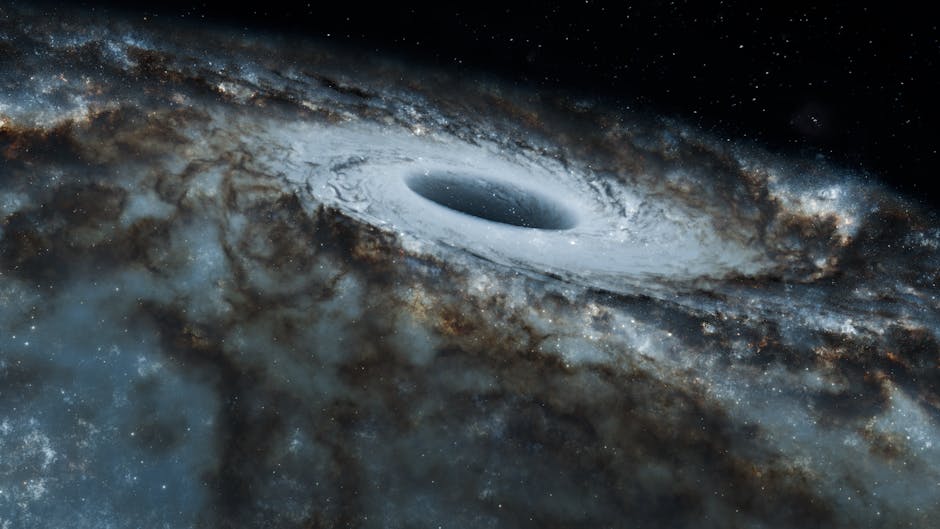
- A star identical to our Sun was ejected at 6 million km/h by a galactic black hole in the Milky Way.
- The star, LAMOST-HVS7, was hurled into intergalactic space after a close encounter with Sagittarius A*, a supermassive black hole.
- This event confirms a decades-old theoretical prediction about the gravitational mechanics of black holes.
- The discovery provides a direct observational window into the Hills mechanism, a process that explains the existence of hypervelocity stars.
- The ejection of LAMOST-HVS7 is a landmark observation in astrophysics, offering insights into the extreme gravitational forces of black holes.
In an astronomical event of rare violence, a star nearly identical to our Sun has been torn from its orbit and hurled across the Milky Way at more than 1,700 kilometers per second—over six million kilometers per hour—making it one of the fastest-moving stars ever observed. This hypervelocity star, designated LAMOST-HVS7, was ejected from the galactic center after a close encounter with Sagittarius A*, the supermassive black hole anchoring our galaxy, according to a study published in Nature on 21 May 2026. The discovery provides a direct observational window into the extreme gravitational mechanics of black holes, confirming a decades-old theoretical prediction: that binary star systems disrupted near a massive black hole can result in one star being captured while the other is flung into intergalactic space. The odds of detecting such a precise ejection are slim, making this observation a landmark in astrophysics.
The Mechanics of a Cosmic Slingshot

This event underscores a phenomenon first theorized in 1988 by astronomer Jack Hills, who proposed that when a binary star system wanders too close to a supermassive black hole, the intense tidal forces can split the pair—one star falling into the black hole’s grasp while the other is accelerated to tremendous velocity and ejected from the galaxy. Known as the Hills mechanism, this process was long considered a plausible but elusive explanation for the existence of hypervelocity stars. LAMOST-HVS7, detected using data from the Large Sky Area Multi-Object Fiber Spectroscopic Telescope (LAMOST) and confirmed with follow-up observations from the European Space Agency’s Gaia mission, offers the most compelling evidence to date. Its trajectory, chemical composition, and velocity align precisely with predictions, confirming that Sagittarius A* is not merely a gravitational anchor but an active engine of stellar expulsion.
Discovery and Stellar Fingerprinting

LAMOST-HVS7 was identified through a combination of spectroscopic and astrometric analysis, allowing astronomers to determine its radial velocity, proper motion, and elemental makeup. Unlike many previously discovered hypervelocity stars, which tend to be massive, short-lived blue stragglers, LAMOST-HVS7 is a G-type main-sequence star—nearly identical in mass, temperature, and composition to the Sun. This makes it exceptionally rare: solar analogs are not typically expected to reach such velocities, as they are less likely to form in the dense, turbulent environments near the galactic center. Yet, its presence and trajectory indicate it originated within 3 light-years of Sagittarius A*, a region dominated by massive stars and intense radiation. The star’s metallicity, measured via absorption lines in its spectrum, further confirms its origin in the chemically rich nuclear star cluster, distinguishing it from stars born in the galaxy’s outer disk.
Gravitational Dynamics at the Galactic Core

The ejection of LAMOST-HVS7 illuminates the chaotic environment surrounding Sagittarius A*, where gravitational tides dominate stellar motion. In binary systems, the differential pull across the two stars can exceed their mutual gravitational binding energy, leading to disruption. Simulations suggest that such events occur roughly once every 100,000 years in the Milky Way, yet only a few dozen hypervelocity stars have been confirmed to date, due to the difficulty of measuring precise velocities across vast distances. The detection of a solar-type star at such speed challenges assumptions about stellar populations near the galactic center and suggests that lower-mass binaries may venture closer to the black hole than previously thought. According to Dr. Elena Ramirez-Ruiz, an astrophysicist at UC Santa Cruz not involved in the study, “Finding a Sun-like star flung out at hypervelocity forces us to rethink the dynamical pathways stars take in the nuclear cluster.”
Implications for Galactic Evolution

The discovery has broad implications for understanding how galaxies evolve through stellar ejection and black hole interactions. Hypervelocity stars like LAMOST-HVS7 may carry chemical signatures from the galactic center into the outer halo and beyond, potentially seeding distant regions with enriched material. Over billions of years, such ejections could subtly influence the distribution of matter in the Milky Way and its neighbors. Moreover, these stars serve as probes of the Galaxy’s gravitational potential; their trajectories can help refine models of dark matter distribution. If more solar-type hypervelocity stars are found, it could indicate that the central region is more dynamically active than current models suggest, with implications for star formation, black hole growth, and the fate of binary systems in extreme environments.
Expert Perspectives
While the consensus supports the Hills mechanism as the most likely explanation, some researchers caution against overinterpretation. Dr. Avi Loeb of Harvard University notes that alternative ejection mechanisms—such as supernova explosions in binary systems or encounters with intermediate-mass black holes—cannot be ruled out entirely without precise pre-ejection data. However, Dr. Tuan Do, an observational astronomer at UCLA, argues that “the kinematics and origin point of LAMOST-HVS7 make the black hole slingshot scenario the simplest and most consistent explanation.” The debate underscores the need for more high-precision astrometric data, particularly from upcoming missions like the Nancy Grace Roman Space Telescope.
Looking ahead, astronomers will continue scanning the skies for similar stars, particularly using next-generation spectroscopic surveys and deep-sky monitoring. Future detections could reveal whether solar-type hypervelocity stars are rare anomalies or part of a hidden population ejected over cosmic time. Moreover, studying their paths may help pinpoint the exact mass and spin of Sagittarius A*. As the Milky Way’s black hole remains largely quiescent, these stellar “messengers” offer one of the few direct ways to probe its gravitational influence. The story of LAMOST-HVS7 is not just about a single star’s escape—it is a testament to the invisible forces shaping our galaxy from its darkest heart. Read the full study in Nature.
Source: Nature