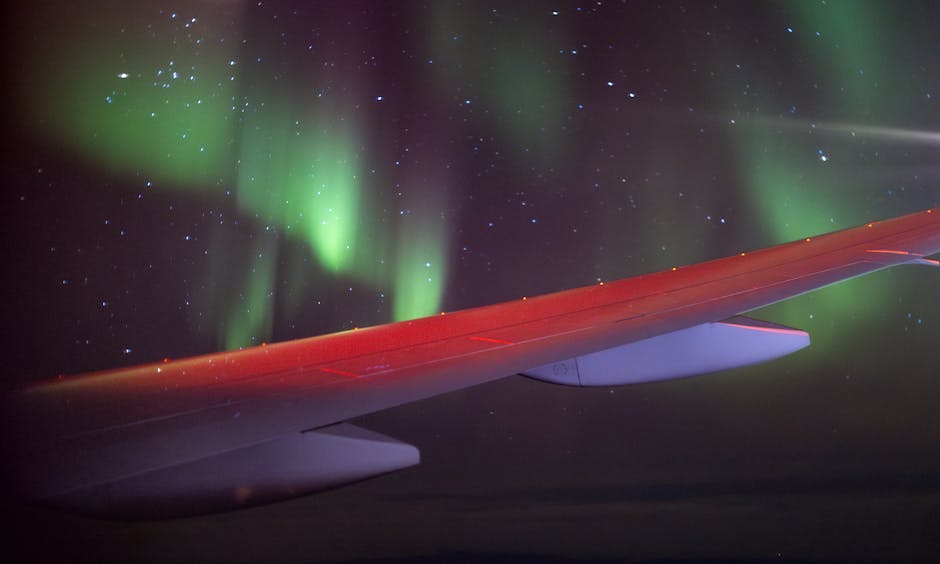
- Japanese researchers discovered a rare form of aurora reaching 500 km above the Earth’s surface, breaching previously recorded altitudes.
- The stable auroral red arc (SAR arc) is typically confined to altitudes below 300 km, but in this case, it ascended to nearly 500 km.
- The SAR arc was observed in the thermosphere, where satellite orbits intersect with the upper layers of Earth’s atmosphere.
- The aurora was a deep, blood-red color, unlike the familiar green ribbons of auroras dancing near the poles.
- The discovery suggests that scientists may have underestimated the complexity of the Sun’s atmosphere and the forces that drive auroral emissions.
On a calm winter night above the remote mountains of Hokkaido, a strange glow flickered in the sky — not the familiar green ribbons of auroras dancing near the poles, but a deep, blood-red veil stretching into the void. For local stargazers, it was a rare and eerie spectacle. But for a team of Japanese atmospheric physicists monitoring the phenomenon from a secluded observatory, it was the beginning of a revelation. Using high-resolution cameras and satellite data, they tracked the crimson tendrils as they climbed beyond 500 kilometers into the ionosphere, breaching altitudes where few auroral emissions had ever been recorded. This was not the aurora borealis of textbook descriptions. It was something rarer, higher, and far more mysterious — a luminous signal from the edge of space, whispering of forces in the Sun’s atmosphere that scientists thought they had already mapped.
Red Glow Reaches the Edge of Space

What researchers observed was a rare form of upper-atmospheric aurora known as a “stable auroral red arc” (SAR arc), but one behaving in unprecedented ways. Typically confined to altitudes below 300 kilometers, these red emissions result from oxygen atoms excited at high altitudes, often during periods of geomagnetic calm. Yet the SAR arcs above Japan in early 2023 ascended to nearly 500 kilometers — deep into the thermosphere, where satellite orbits intersect with the upper layers of Earth’s atmosphere. Data from the Japanese satellite Arase, designed to study the Van Allen radiation belts, confirmed the anomaly. Even more surprising, the event occurred during a period of only moderate solar wind activity, when space weather models predicted minimal disturbance. The fact that such intense, high-altitude emissions could form under seemingly benign conditions suggests that current models of solar-terrestrial interaction may be missing critical components of energy transfer from the Sun to Earth’s magnetosphere.
The Hidden History of High-Altitude Auroras

The discovery builds on decades of sporadic observations of red auroras, first documented in the 1950s but long dismissed as anomalies or misidentifications. In the 1970s and 1980s, rocket-borne instruments detected faint red glows above North America and Scandinavia, leading to the formal classification of SAR arcs. These events were linked to the leakage of hot plasma from the inner magnetosphere during substorms — temporary disturbances in Earth’s magnetic field. However, the mechanisms driving their intensity and altitude remained poorly understood. Advances in low-light imaging and satellite monitoring, particularly Japan’s Atmosphere and Magnetic Field Observation Satellite (ERG/Arase) mission launched in 2016, have now enabled scientists to capture these events in unprecedented detail. The Japan Aerospace Exploration Agency (JAXA) and researchers at Tohoku University have since compiled evidence suggesting that such high-altitude red auroras may be more common than previously thought, especially at mid-latitudes during periods of stealth solar activity.
The Scientists Chasing the Crimson Sky

Leading the investigation is Dr. Nozomu Tsuchiya, an atmospheric physicist at Tohoku University, whose team has spent years refining high-sensitivity camera networks across northern Japan. “We weren’t looking for this,” Tsuchiya admitted in a recent interview. “We were studying faint emissions during geomagnetic quiet periods, but what we found was a signal reaching into regions we assumed were inactive.” His team’s collaboration with JAXA and NASA’s THEMIS mission has revealed that electromagnetic waves in the plasmasphere — a donut-shaped region of cold plasma surrounding Earth — may be accelerating particles to higher energies than models predict. The motivation behind this research extends beyond curiosity; understanding these hidden energy pathways is crucial for predicting space weather that could disrupt GPS systems, telecommunications, and low-Earth-orbit satellites, including those in mega-constellations like Starlink.
Implications for Satellites and Space Infrastructure

The discovery raises concerns about the resilience of orbital assets. At altitudes above 400 kilometers, where the International Space Station and many Earth observation satellites operate, even minor increases in atmospheric density due to auroral heating can increase drag and shorten satellite lifespans. Red auroras at such heights indicate unexpected energy deposition in the thermosphere, potentially causing localized expansion of the upper atmosphere. This could lead to unanticipated orbital decay, especially for satellites lacking robust propulsion systems. Moreover, charged particles associated with these events may contribute to surface charging on spacecraft, increasing the risk of electrical failures. As satellite traffic grows, so does the need for more accurate space weather forecasts — forecasts that must now account for phenomena once considered too rare or weak to matter.
The Bigger Picture
This finding underscores a growing realization in space science: the Sun and Earth’s magnetosphere are coupled in ways that defy simple models. The classical view of solar storms as predictable bursts of energy is giving way to a more nuanced understanding of stealthy, continuous energy transfer. These red auroras may be visible manifestations of that hidden flow — nature’s way of illuminating the invisible. As climate change alters Earth’s lower atmosphere, scientists are also beginning to ask whether these changes might interact with upper-atmospheric dynamics, further complicating the picture. The sky, it seems, is not just a mirror of solar activity, but a dynamic interface shaped by forces we are only beginning to decode.
What comes next is a new phase of global observation. Scientists are calling for coordinated networks of ground-based cameras and small satellites to monitor mid-latitude auroras in real time. The European Space Agency’s Swarm mission and NASA’s upcoming Geospace Dynamics Coupling (GDC) satellite may soon provide complementary data. If these towering red auroras are indeed signs of underestimated solar influence, then redefining the boundaries of space weather is not just an academic exercise — it’s a necessity for the satellite-dependent world below.
Source: ScienceDaily