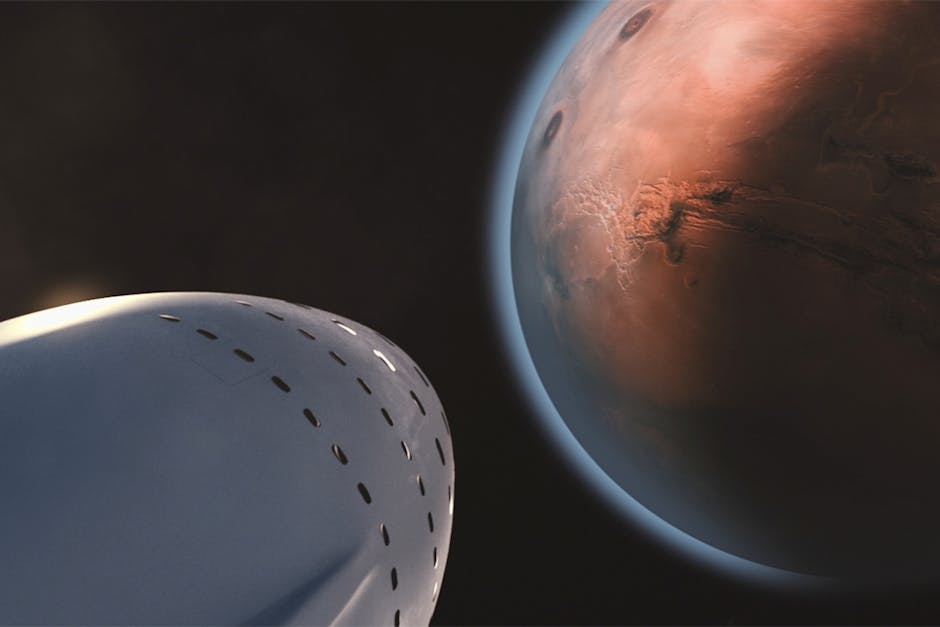
- NASA’s Psyche spacecraft used Mars’ gravity to gain momentum and save fuel for its journey to a metal asteroid.
- The spacecraft captured rare close-up images of Mars’ heavily cratered landscape during its 2023 flyby.
- The gravity assist maneuver allowed Psyche to shed excess velocity and align itself for a 2029 rendezvous with asteroid 16 Psyche.
- The mission would have required significantly more propellant without the Mars flyby, making it costlier and more complex.
- The gravity assist is a crucial technique used in space exploration to optimize fuel efficiency and trajectory.
What happens when a spacecraft built to explore a metal asteroid makes a pit stop at Mars? In the case of NASA’s Psyche mission, it delivers some of the most striking close-up views of the Red Planet in years—while using Mars’ own gravity to fling itself billions of miles deeper into space. As the spacecraft skimmed just 2,600 miles above the Martian surface in October 2023, its cameras captured detailed images of a heavily cratered landscape, including the striking Huygens crater. This high-speed flyby wasn’t just for sightseeing; it was a precisely calculated maneuver to save fuel and gain momentum toward its ultimate destination: the enigmatic asteroid Psyche, a 173-mile-wide metallic body orbiting the Sun between Mars and Jupiter.
How Did Psyche Use Mars to Boost Its Journey?

The Psyche spacecraft executed a gravity assist maneuver, leveraging Mars’ gravitational pull to alter its speed and trajectory without expending additional fuel. As it approached the planet at a velocity of over 75,000 miles per hour relative to the Sun, Mars’ gravity bent the spacecraft’s path, effectively giving it a slingshot effect that accelerated it into a new orbit. This critical maneuver allowed Psyche to shed excess velocity relative to Earth and align itself for a 2029 rendezvous with the metal-rich asteroid 16 Psyche. Without this flyby, the mission would have required significantly more propellant—making it costlier and more complex. The gravity assist is a hallmark of interplanetary navigation, a technique previously used by missions like Voyager, Cassini, and Juno. For Psyche, the Mars encounter was not just a navigational necessity but also a rare opportunity to test its instruments in a real-world environment.
What Did Psyche’s Cameras Reveal About Mars?

During the brief flyby, Psyche’s multispectral imager captured high-resolution images of Mars’ southern highlands, showcasing ancient, heavily cratered terrain shaped by billions of years of impacts. One standout feature was the Huygens crater, a 280-mile-wide impact basin with a distinctive double-ring structure, possibly formed by a massive oblique collision. The images, though not the highest resolution ever taken of Mars, are scientifically valuable due to their unique lighting and viewing angles. According to NASA, the data will help calibrate the spacecraft’s imaging systems for its primary mission. The imager, developed by Malin Space Science Systems, is optimized for asteroid observation but proved capable of capturing planetary detail. Scientists at NASA’s Jet Propulsion Laboratory noted that the images could also contribute to broader studies of Martian geology, particularly in under-observed regions near the planet’s southern latitudes.
Could These Images Challenge Existing Mars Models?

While the primary goal of the flyby was navigational, some planetary scientists argue that even brief observational windows can yield unexpected insights. Dr. Elena Rodriguez, a planetary geologist at the University of Arizona not involved in the mission, suggested that the clarity of the Huygens crater images might prompt re-evaluation of impact dynamics in Mars’ early history. “Features like double-ring basins are windows into the planet’s crustal strength and subsurface structure,” she said in an interview with Nature. However, skeptics caution that without spectral data or long-term observation, the images are more diagnostic than revolutionary. Some experts also note that the spacecraft’s rapid pass—lasting only minutes in optimal imaging range—limits the depth of analysis. Still, the fact that a mission not designed for Mars exploration returned usable planetary data underscores the value of opportunistic science in deep space missions.
What Does This Mean for Future Deep Space Missions?

The success of Psyche’s Mars flyby demonstrates how interplanetary missions can achieve multiple objectives with careful planning. Future spacecraft could similarly leverage gravity assists not just for propulsion but as chances to test instruments and gather secondary science data. For example, the European Space Agency’s upcoming JUICE mission to Jupiter’s moons will perform multiple planetary flybys, each serving dual navigational and scientific roles. Psyche’s images also highlight the growing capability of compact, high-performance cameras on deep-space probes. As missions become more ambitious—targeting distant asteroids, icy moons, and beyond—opportunities for serendipitous discovery during flybys will likely increase, transforming what were once mere trajectory corrections into full-fledged mini-missions.
What This Means For You
If you’re fascinated by space exploration, Psyche’s flyby is a reminder that breakthroughs often come from unexpected moments. The images of Mars aren’t just visually stunning—they represent smart engineering and scientific opportunism. As NASA continues its journey to one of the most unusual objects in the solar system, missions like this show how every maneuver can yield new knowledge. The same principles that propelled Psyche past Mars could one day help spacecraft reach distant exoplanets or bring samples back from Mars itself.
Yet questions remain: What will we learn when Psyche finally reaches the metal asteroid? Could its composition challenge our understanding of planetary formation? And how many more hidden discoveries await in the data collected during these fleeting planetary encounters?
Source: ScienceDaily