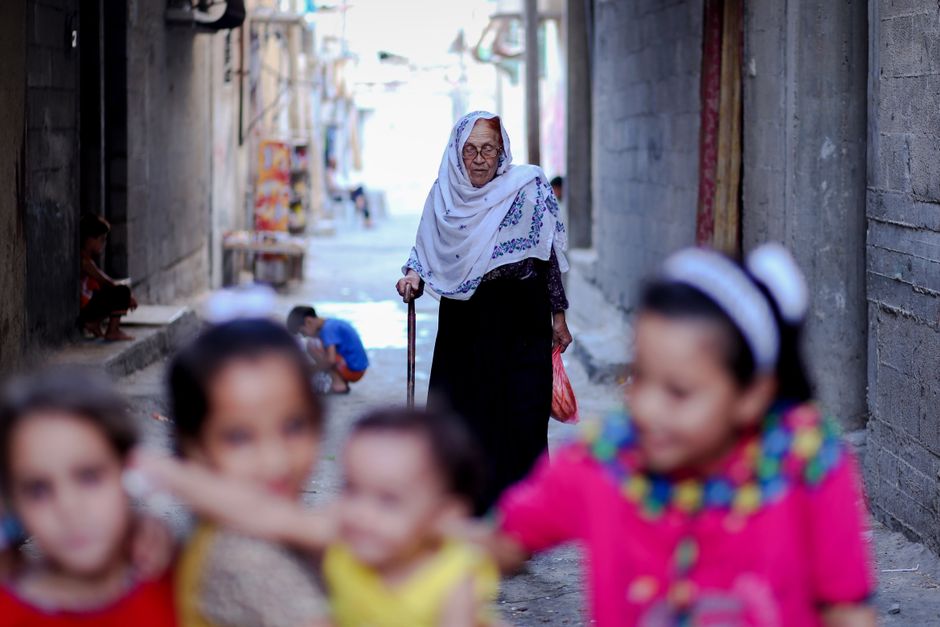
- 300 rare photos expose Gaza’s forgotten era of joy, revealing a vibrant coastal society from the 1940s to 1970s.
- The exhibition showcases Gaza as a cosmopolitan hub with a growing middle class, bustling trade, and strong cultural ties across the Arab world.
- Photos depict a world where children played freely, cinemas showed Egyptian films, and the word ‘Gaza’ meant seaside promenades, not airstrikes.
- Gaza’s urban coastal society was deeply engaged in the rhythms of modern life during this period, with thriving ports, expanding schools, and a growing university.
- The exhibition challenges audiences to reframe their understanding of Gaza, moving beyond trauma and highlighting a rich history of joy and resilience.
On a quiet street in Marseille’s historic Le Panier district, visitors pause before a black-and-white photograph: a group of young women in floral dresses and cat-eye sunglasses laugh beside a turquoise sea, their hair blown by the Mediterranean wind. The year is 1955. The place is Gaza Beach. There are no barricades, no rubble, no headlines. Just the sun, the sand, and the sound of life unfolding. This image is one of 300 on display at the Villa Méditerranée, where an exhibition titled *Gaza: Joyful Days, 1940s–1970s* is quietly reshaping how audiences see a place long reduced to trauma. The photos, drawn from private archives, family albums, and forgotten studios, depict weddings, cafés, schools, and seaside picnics—a world where children played freely, where cinemas showed Egyptian films, and where the word ‘Gaza’ meant seaside promenades, not airstrikes.
Life in Full Frame: Gaza’s Golden Era

The photographs now captivating audiences in France reveal an urban coastal society deeply engaged in the rhythms of modern life. Men in tailored suits sip coffee at open-air cafés, women in headscarves and Western fashions stroll market alleys, and boys in short pants kick soccer balls through narrow alleyways. Gaza was a cosmopolitan hub during this period, with a growing middle class, bustling trade, and strong cultural ties across the Arab world. The port thrived, schools expanded, and the first university opened in 1978. These images, curated by French-Palestinian historian Leila Al-Shami, were sourced from descendants of Gaza residents who fled during successive wars, as well as from the Al-Karmi photographic studio—one of Gaza’s oldest, whose glass plate negatives survived multiple bombardments. The exhibition deliberately avoids politics, focusing instead on the intimate: a bride adjusting her veil, a fisherman mending his nets, a family gathered under a fig tree. Reuters has documented how such personal archives are now crucial to preserving Palestinian memory amid ongoing displacement.
From Prosperity to Peril: The Road to Occupation

The world these photos depict began to unravel in 1967. After the Six-Day War, Israel occupied Gaza, marking the start of a military administration that would last for nearly four decades. Though daily life continued, movement became restricted, land was seized, and political repression grew. The first Intifada in 1987 marked a turning point, as mass protests met with violent crackdowns. Gaza’s economy, once buoyed by trade and agriculture, began to stagnate under curfews and border closures. The 1993 Oslo Accords brought temporary hope, but failed to deliver lasting autonomy. By 2005, Israel withdrew its settlements, but retained control over airspace, territorial waters, and most border crossings. The election of Hamas in 2006 and Israel’s subsequent blockade transformed Gaza into what human rights groups call an ‘open-air prison.’ Over 70% of the population are refugees from villages depopulated in 1948, a history embedded in family memory but erased from mainstream narratives. These photos, taken before the fractures deepened, serve as a visual counterpoint to the narrative of eternal conflict.
The Keepers of Memory: Archivists and Exiles

Many of the images in the exhibition were rescued by diaspora Palestinians who safeguarded albums through generations of exile. Among them is Sami Al-Hajj, a photojournalist and former Guantanamo detainee, who contributed scans from his family’s collection. ‘We are not just preserving pictures,’ he said in a BBC interview, ‘we are resisting erasure.’ The curation team worked closely with the Palestinian Museum in Birzeit and the Institute for Palestinian Studies in Beirut, both of which have launched digital initiatives to archive pre-1948 and postwar life. French archivists used infrared scanning to restore faded prints, revealing details long thought lost. For younger visitors—Palestinian and non-Palestinian alike—the exhibition is a revelation. ‘I didn’t know Gaza ever looked like this,’ said 22-year-old Marseille student Camille Roux. ‘It makes you realize how much war steals—not just lives, but futures.’
The Weight of What Was Lost

The emotional power of the exhibition lies in its quiet defiance of simplification. In a media landscape dominated by images of destruction, these photographs assert that Gaza was, and is, more than a casualty of war. They challenge viewers to reconcile the vibrant society on display with the current reality: a population of 2.3 million enduring chronic electricity shortages, a collapsed health system, and repeated military assaults. The photos do not minimize suffering, but they expand the narrative. Psychologists working with Palestinian refugees note that such visual histories can be therapeutic, helping displaced families reclaim identity. For policymakers, the images offer a reminder that peace cannot be built solely on security frameworks—it must also honor memory, dignity, and the right to a past.
The Bigger Picture
This exhibition is part of a broader movement to reclaim Palestinian narrative sovereignty. From oral history projects to digital archives, a new generation is insisting that Gaza’s story not be told only through the lens of victimhood or violence. Similar photo retrospectives have appeared in London, Berlin, and Ramallah, drawing crowds hungry for complexity. In an age of algorithmic simplification, where conflict zones are reduced to memes and slogans, these images demand attention, patience, and empathy. They remind us that every war is preceded by peace—that behind every statistic is a life lived, a moment cherished, a photograph taken on an ordinary day that would one day become history.
As the Marseille exhibition prepares to tour Amman and Cairo, its creators hope it will spark dialogue, not nostalgia. These are not just relics; they are evidence. Evidence of resilience, of beauty, of a people who have outlived every attempt to erase them. The next chapter of Gaza’s story remains unwritten. But with archives like these, it may yet be told in full.
Source: Al Jazeera