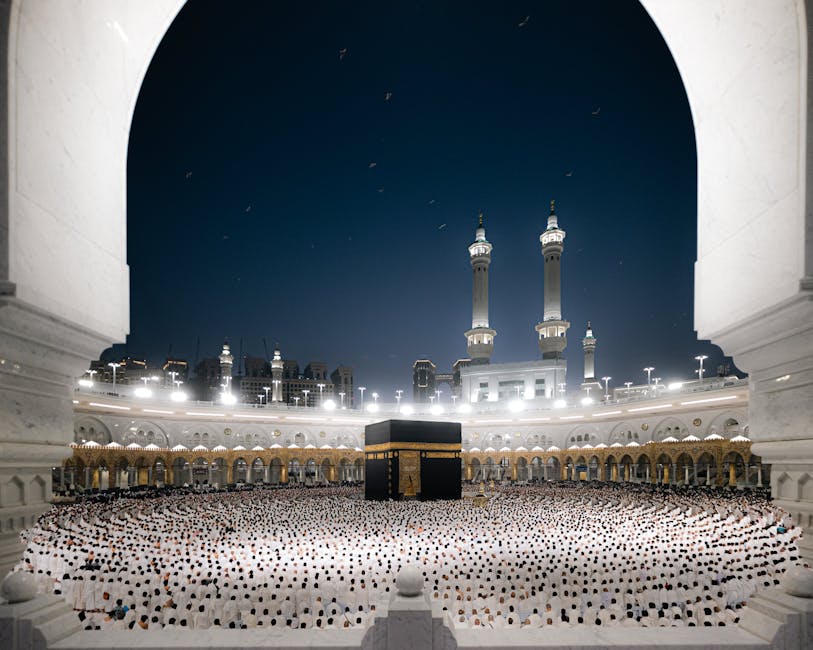
- The Ibrahimi Mosque was illuminated in Israel’s national colors, sparking controversy among Palestinians and Muslim leaders worldwide.
- The act was seen as a symbolic assertion of dominance over Palestinian religious identity and territorial sovereignty.
- The mosque is revered by both Muslims and Jews as the burial site of Abraham, Isaac, and Jacob, and is located in the occupied West Bank.
- The illumination was carried out by Israeli authorities on June 9, during Israel’s Memorial Day and Independence Day observances.
- The Ibrahimi Mosque has long been a site of contention in the Israeli-Palestinian conflict, with strict access controls and periodic closures.
In a move that has ignited fierce controversy, the Ibrahimi Mosque in Hebron was illuminated in the blue and white colors of the Israeli flag during a national holiday celebration. The act, carried out by Israeli authorities on June 9, marked Israel’s Memorial Day and Independence Day observances, but it was perceived by Palestinians and Muslim leaders worldwide as a desecration of one of Islam’s most sacred spaces. Located in the heart of the occupied West Bank, the mosque—also known as the Cave of the Patriarchs—is revered by both Muslims and Jews as the burial site of Abraham, Isaac, and Jacob. Lighting it in the colors of a national flag, particularly one associated with ongoing military occupation, has been condemned as a symbolic assertion of dominance over Palestinian religious identity and territorial sovereignty.
A Flashpoint in Sacred Geography

The Ibrahimi Mosque sits at the epicenter of one of the most sensitive religious and political fault lines in the Israeli-Palestinian conflict. Its dual significance—as Al-Khalil to Muslims and as the Tomb of the Patriarchs to Jews—has long made it a site of contention, especially since Israel’s occupation of the West Bank began in 1967. The mosque has been subject to strict access controls and periodic closures, often during times of heightened tension. The recent illumination, reportedly organized by the Israeli Ministry of Tourism and carried out with government approval, is seen not merely as an aesthetic choice but as a deliberate political statement. Palestinian officials, including the Ministry of Foreign Affairs, called the act a ‘blatant provocation’ and a violation of international agreements safeguarding religious sites. UNESCO has repeatedly affirmed the mosque’s status as a protected World Heritage site, warning against any unilateral actions that could alter its character.
What Triggered the Illumination?

The lighting of the mosque coincided with Israel’s annual Yom HaZikaron and Yom Ha’atzmaut commemorations, periods marked by national flags, public ceremonies, and patriotic displays across the country. However, extending such symbolism to the Ibrahimi Mosque—located in a predominantly Palestinian city under Israeli military control—crossed a red line for many. Photos and videos of the illuminated structure circulated widely on social media, showing the mosque’s stone façade bathed in bright blue and white, with projected slogans such as ‘Am Yisrael Chai’ (The People of Israel Live) visible from nearby streets. The Israeli government has not issued a formal apology, with some right-wing ministers defending the act as an expression of Jewish heritage and historical connection to the land. The event was organized by the Hebron Jewish Community and supported by state-affiliated tourism bodies, signaling high-level approval despite its inflammatory impact.
Religious Desecration or National Expression?

Analysts warn that the illumination reflects a broader trend in which religious sites are increasingly weaponized as symbols of national identity. According to Dr. Khalil al-Hayek, a political scientist at Birzeit University, ‘Using sacred spaces for nationalist displays erodes the possibility of coexistence and deepens communal mistrust.’ Data from the United Nations Office for the Coordination of Humanitarian Affairs (OCHA) shows a 30% increase in incidents involving religious sites in the West Bank over the past three years. The Ibrahimi Mosque, already divided between Muslim and Jewish prayer areas since the 1994 massacre by Israeli extremist Baruch Goldstein, is particularly vulnerable to symbolic provocations. International law, including the 1954 Hague Convention for the Protection of Cultural Property, prohibits the use of religious sites for military or political purposes. Critics argue that the lighting campaign, while non-physical, constitutes a form of cultural aggression.
Escalating Tensions in Hebron

The immediate aftermath of the illumination saw protest rallies in Hebron, Nablus, and Ramallah, with demonstrators denouncing what they described as state-sanctioned disrespect for Islamic sanctity. The Palestinian Authority summoned the Israeli ambassador to deliver a formal protest, while Jordan’s King Abdullah II—custodian of Muslim holy sites in Jerusalem and the West Bank—issued a rare public rebuke. Meanwhile, settlers in Hebron celebrated the display, further inflaming local tensions. The city, already one of the most militarized urban areas in the world, saw increased IDF patrols and temporary road closures. Civil society groups warn that such incidents could trigger a wider cycle of violence, particularly during religious holidays when emotions run high. The act also undermines ongoing, albeit fragile, interfaith dialogue efforts supported by international organizations.
Expert Perspectives
Reactions from experts are sharply divided. Dr. Yossi Klein, a historian at Tel Aviv University, defended the illumination as ‘a legitimate expression of Jewish historical memory,’ arguing that the site holds equal significance for Jews. In contrast, Dr. Lamis Andoni, a Middle East analyst for Al Jazeera, called it ‘a colonial act disguised as patriotism,’ noting that no equivalent display would be tolerated at Islamic holy sites under Muslim-majority control. International legal scholars, including those from BBC analysis, have questioned whether the act violates the Oslo Accords, which stipulate shared respect for religious sites. The silence of major Western governments has also drawn criticism from human rights groups concerned about double standards in condemning religious violations.
Looking ahead, the Ibrahimi Mosque incident may set a dangerous precedent for the use of religious symbolism in national celebrations. With municipal elections in Hebron approaching and rising settler influence in the region, similar provocations could become more frequent. The international community faces a critical test: whether to treat such acts as internal cultural expressions or as violations of religious freedom and international norms. Monitoring groups urge UNESCO and the UN Human Rights Council to intervene before further damage is done to intercommunal relations. As the status quo in Hebron grows increasingly unstable, the question is no longer just about lighting a building—but about who controls memory, identity, and sacred space in one of the world’s most contested cities.
Source: Al Jazeera