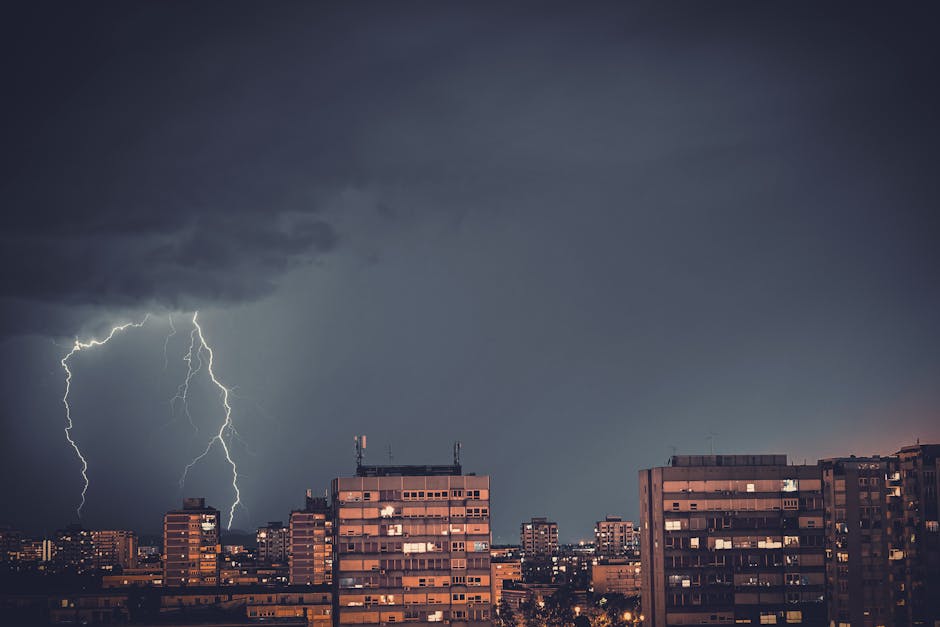
- Urban areas in Texas are actively altering storm behavior, increasing frequency by up to 28%.
- Urbanization intensifies rainfall by 15–20% and changes the vertical distribution of storm clouds.
- The effects of urbanization on storms vary depending on whether they are convective, frontal, or tropical in origin.
- The study reveals a nuanced interplay between city landscapes and atmospheric dynamics.
- This research challenges long-standing assumptions about uniform urban impacts on weather.
Urban areas are no longer just bystanders to extreme weather—they are actively reshaping it. A groundbreaking study published in Nature in May 2026 demonstrates that cities across Texas are altering the behavior of warm-season storms in complex and often divergent ways. By analyzing three-dimensional radar reflectivity data from over a decade of storm events, researchers found that urbanization can increase storm frequency by up to 28%, intensify rainfall by 15–20%, and shift the vertical distribution of storm clouds—effects that vary dramatically depending on whether the system is convective, frontal, or tropical in origin. These findings challenge long-standing assumptions that urban impacts on weather are uniform, revealing instead a nuanced interplay between city landscapes and atmospheric dynamics that could redefine how we prepare for urban flooding and climate adaptation.
Why Storm Type Matters in Urban Weather

The significance of this research lies in its granular approach to storm classification—moving beyond treating all storms as interchangeable weather events. The study examined five distinct warm-season storm types: isolated convection, multicell clusters, mesoscale convective systems (MCSs), cold frontal passages, and tropical cyclone remnants. For decades, scientists have debated whether and how cities influence local weather, often focusing on the urban heat island effect and increased surface roughness as primary drivers. However, results have been inconsistent, with some cities showing enhanced rainfall and others no change—or even suppression. This new analysis reconciles those contradictions by showing that urban impacts are not universal but are instead mediated by the storm’s underlying dynamics. In Texas, where rapid urban expansion coincides with high storm frequency, the implications for infrastructure planning, emergency response, and climate resilience are profound.
How Cities Reshape Different Storm Systems

The research team, led by atmospheric scientists at the University of Texas at Austin, used high-resolution WSR-88D radar data from 2009 to 2023 to map the three-dimensional structure of over 1,200 storms across five metropolitan areas: Houston, Dallas-Fort Worth, Austin, San Antonio, and Corpus Christi. They categorized each event by storm type and compared urban-core developments with adjacent rural regions. The results revealed stark contrasts: isolated convective storms—often afternoon thunderstorms triggered by surface heating—were 28% more frequent downwind of cities, with stronger updrafts and higher cloud tops due to enhanced thermal forcing from paved surfaces. In contrast, cold frontal systems showed little change in frequency but exhibited a 15% increase in rainfall intensity as fronts interacted with urban terrain. Tropical cyclone remnants, however, behaved differently still: while total rainfall did not significantly increase, the vertical distribution of precipitation shifted upward by as much as 1.2 kilometers over cities, potentially altering flood timing and drainage efficiency.
The Science Behind Urban-Storm Interactions

The divergent responses stem from how each storm type interacts with the altered urban environment. For isolated convection, the urban heat island provides additional buoyancy, destabilizing the lower atmosphere and promoting earlier and more intense storm initiation. The study found that surface temperatures in city centers were on average 2.1°C higher than surrounding areas, enough to trigger convection under marginally unstable conditions. Meanwhile, for MCSs and frontal systems, the dominant influence is mechanical—urban structures increase surface roughness, slowing storm motion and enhancing low-level convergence, which prolongs rainfall over cities. This ‘storm anchoring’ effect was particularly pronounced in Dallas and Houston, where sprawling development patterns create large, continuous zones of friction. In the case of tropical remnants, the presence of tall buildings appears to disrupt low-level inflow, lifting the core of precipitation higher into the atmosphere. This vertical displacement, while subtle, could delay surface runoff and challenge existing flood models calibrated for rural hydrology.
Impacts on Urban Planning and Public Safety

These findings have direct consequences for millions of residents across Texas and other rapidly urbanizing regions. Storms that are more frequent, more intense, or structurally altered over cities increase the risk of flash flooding, infrastructure strain, and emergency response delays. The 28% increase in isolated convection near urban cores, for example, suggests that suburban expansion into formerly rural zones may inadvertently create new hotspots for thunderstorm development. Moreover, the vertical shift in tropical rainfall could undermine current flood prediction systems, which assume a consistent relationship between radar echoes at altitude and surface precipitation. Municipal planners may need to revise stormwater design standards, while meteorologists could improve short-term forecasts by incorporating storm-type-specific urban adjustment factors. As climate change amplifies extreme weather, the synergy between warming and urbanization could create compounding risks in the decades ahead.
Expert Perspectives
Dr. Elena Rodriguez, an atmospheric physicist at Texas A&M not involved in the study, called the work “a paradigm shift in urban meteorology,” noting that “treating all storms the same way in city environments has led to flawed models and underestimated risks.” She emphasized the need for adaptive forecasting systems that account for storm type. Conversely, Dr. Mark Chen of the National Center for Atmospheric Research cautioned against overgeneralization, pointing out that “Texas’s flat terrain and coastal influences may not translate to mountainous or inland cities.” He urged replication of the study in other U.S. regions to test the robustness of the findings.
Looking ahead, researchers plan to expand this analysis to other urban corridors, including Atlanta, Miami, and Phoenix, to determine how geography and city layout modulate storm responses. A key unanswered question is whether green infrastructure—such as urban forests and permeable pavements—can mitigate these effects. As cities continue to grow, understanding the two-way relationship between urban form and atmospheric behavior will be essential for building resilient, climate-adaptive communities.
Source: Nature