- Pep Guardiola has departed Manchester City after 10 trophy-laden years, leaving behind a transformed club and a sport forever altered.
- Guardiola’s final season at Manchester City was marked by triumph and tension, with the club securing a fifth Premier League title in six years.
- The team’s success was built on a combination of tiki-taka evolution, data-driven dominance, and Qatari-backed supremacy.
- Guardiola’s departure raises questions about his legacy as the greatest or most complicated manager in the game’s history.
- The sudden departure has left fans and pundits alike wondering what led to the end of his tenure at Manchester City.
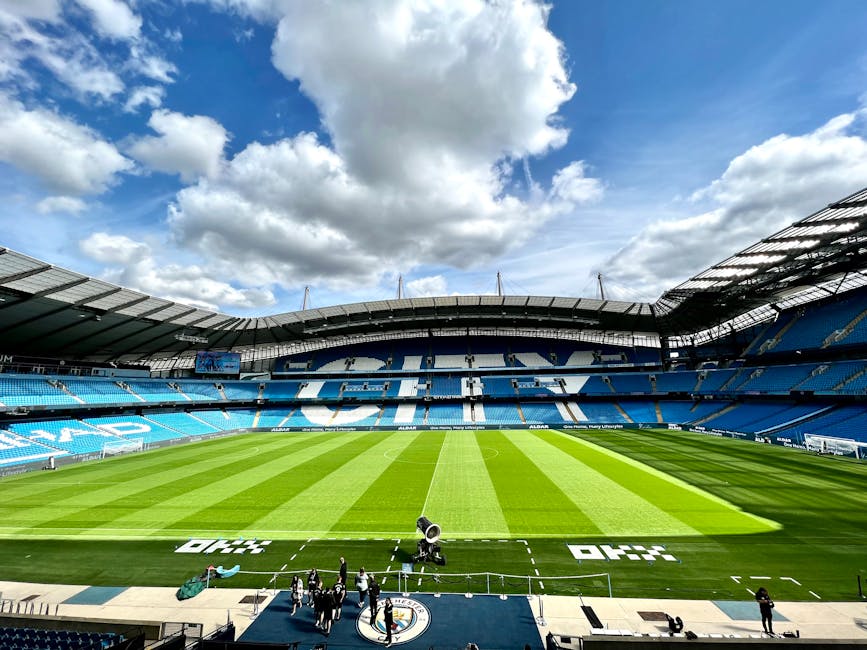
On a cool May evening in Manchester, beneath a sky streaked with the fading pink of twilight, the Etihad Stadium stood silent—no roar of the crowd, no pulsing bassline of victory anthems, just the faint echo of history settling. The pitch, immaculately striped and still damp from an early shower, seemed to hold its breath. Inside the boardroom, handshakes were exchanged with a solemnity usually reserved for state funerals. Pep Guardiola, clad in his signature navy coat and scarf, walked out not with a flourish but with a quiet finality, leaving behind not just a club transformed, but a sport forever altered. For over a decade, his presence had been as constant as the tides—meticulous, relentless, brilliant. Now, it was over. The era of tiki-taka evolution, data-driven dominance, and Qatari-backed supremacy had reached its crescendo. And as the gates closed behind him, one question lingered: Was he the game’s greatest manager—or its most complicated?
Guardiola’s Final Season and Sudden Departure

Pep Guardiola’s final campaign at Manchester City was both triumphant and tense. The club secured a fifth Premier League title in six years, edged past Bayern Munich in a pulsating Champions League semi-final, and lifted the Club World Cup in Saudi Arabia—adding to an already staggering trophy haul. Yet, behind the scenes, fractures were forming. Reports from The Guardian confirmed that Guardiola had informed senior players of his decision weeks before the season’s end, citing emotional exhaustion and a desire to reconnect with his family in Catalonia. His successor, Enzo Maresca, was swiftly appointed from Chelsea’s coaching staff, with City agreeing to pay compensation. The official statement was characteristically restrained: “Pep Guardiola has decided to step down as head coach… his legacy is etched in football history.” But the silence on future plans—and the absence of a farewell match—only deepened the intrigue.
The Rise of a Tactical Revolutionary

Guardiola’s ascent began not on English soil but in the sun-drenched training pitches of La Masia, Barcelona’s famed academy. As manager of FC Barcelona from 2008 to 2012, he weaponized possession, turning the pitch into a chessboard and players into precision instruments. His teams won 14 trophies in four years, including two Champions League titles, and redefined what was possible in modern football. When he arrived at Bayern Munich, he adapted his system to German efficiency, winning three Bundesliga titles. But it was in Manchester, from 2016 onward, that his philosophy met scale. Backed by the financial might of City’s Abu Dhabi ownership, Guardiola fused analytics, sports science, and relentless pressing into a near-invincible machine. By 2023, City had broken the Premier League points record—twice. His influence rippled across leagues, forcing rivals to hire data analysts, rethink formations, and emulate his high line. But with innovation came scrutiny—over tactics, ethics, and the sport’s growing entanglement with authoritarian wealth.
The People Behind the Project

Guardiola was never alone in his vision. Behind every tactical tweak stood a network of minds: Txiki Begiristain, the sporting director who shaped the squad; Rodolfo Borrell, the academy architect; and Domenec Torrent, his longtime assistant. But equally pivotal was Khaldoon Al Mubarak, chairman of City’s parent company, City Football Group, whose access to Gulf capital made the project sustainable. Guardiola, for all his genius, operated within a system where football was both art and instrument—a soft-power tool for a nation seeking global legitimacy. Players like Kevin De Bruyne, Ilkay Gündogan, and Erling Haaland became symbols of this fusion: technically sublime, psychologically resilient, and contractually bound to a machine larger than any one club. Yet, even among allies, tensions surfaced. Reports from 2024 revealed Guardiola’s frustration with transfer decisions, particularly the failed pursuit of Pedri, which he saw as a betrayal of his philosophy.
Consequences for Football’s Power Structure

Guardiola’s departure marks a turning point not just for Manchester City, but for the sport’s geopolitical balance. His tenure exemplified the rise of state-backed clubs—entities less dependent on organic growth than on sovereign wealth. As other leagues struggle with financial sustainability, City’s model, replicated in clubs like PSG and Newcastle, looms large. UEFA has already signaled stricter Financial Fair Play enforcement, while fans increasingly question the soul of a game where titles are won as much in boardrooms as on pitches. For players, the post-Guardiola era may mean less tactical rigidity and more individual expression. For managers, it sets a new benchmark: can anyone replicate sustained excellence without a billionaire patron? The answer may redefine competitiveness in the decades to come.
The Bigger Picture
Guardiola’s legacy transcends trophies. He forced football to confront its contradictions: the beauty of the game versus the machinery behind it, the purity of play versus the politics of ownership. In an age where sport is increasingly a theater of influence, his career embodies both the pinnacle of coaching artistry and the moral ambiguities of modern football. He didn’t just win—he reshaped how the game is played, watched, and monetized. And in stepping away, he leaves a vacuum not just in Manchester, but in the conscience of the sport.
What comes next remains uncertain. Guardiola has hinted at a sabbatical, perhaps a return to education, or even politics in Catalonia. Manchester City will move forward, as institutions do. But the silence at the Etihad this spring is more than the absence of a man. It is the sound of an era ending—one defined by brilliance, ambition, and the quiet hum of power behind the beautiful game.
Source: The Guardian