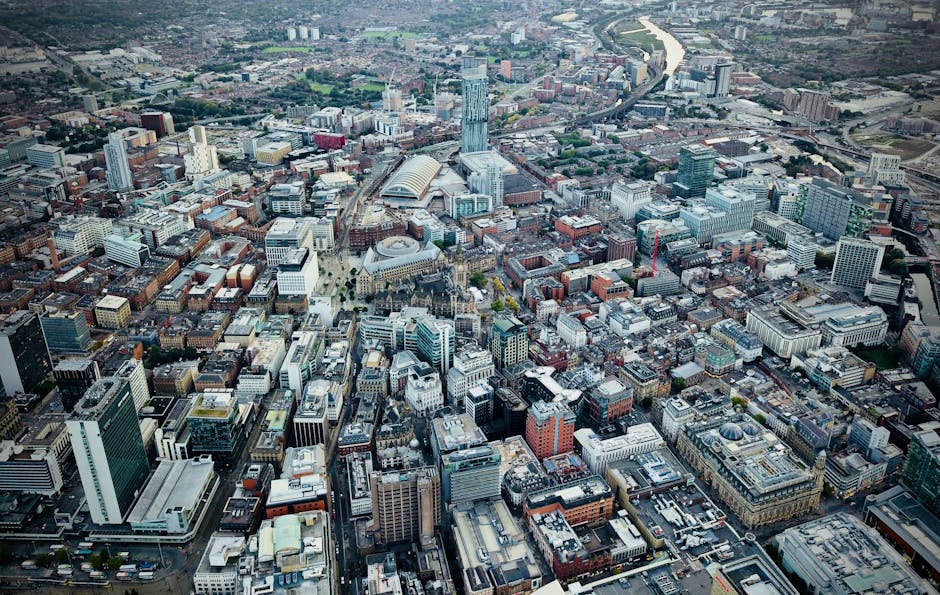
- Manchester has seen a 45% drop in deprivation since 2010, making it a model for urban resilience.
- The city’s deprivation rates plummeted faster than London, Birmingham, and Liverpool between 2010 and 2025.
- Child poverty rates in Manchester decreased from 38% to 26%, and youth unemployment halved.
- The Index of Multiple Deprivation (IMD) scores for Manchester’s core wards showed a significant improvement in key indicators.
- Manchester’s transformation is attributed to coordinated policy, civic engagement, and a reimagined role for local government.
On a crisp autumn morning in Moss Side, the hum of construction blends with the chatter of residents outside a newly opened community health hub. Where boarded-up shopfronts once lined the street, a renovated market now buzzes with local vendors selling fresh produce, artisan bread, and handmade crafts. Children cycle along widened sidewalks, past murals celebrating the area’s Caribbean heritage. This is not the Manchester of the 2000s — a city synonymous with post-industrial decay and social fragmentation. Over the past 15 years, a quiet transformation has taken root, driven by coordinated policy, civic engagement, and a reimagined role for local government. What was once one of England’s most deprived inner-city zones is now a symbol of urban resilience, part of a broader turnaround that has positioned Manchester at the forefront of Britain’s fight against inequality.
Deprivation Rates Plummet Citywide

Between 2010 and 2025, Manchester recorded the largest decline in inner-city deprivation of any major UK city, according to a comprehensive analysis by the Centre for Cities, a nonpartisan urban research thinktank. The Index of Multiple Deprivation (IMD) scores for Manchester’s core wards fell by an average of 45%, outpacing London, Birmingham, and Liverpool. Key indicators — including employment, education, health outcomes, and housing quality — all showed marked improvement. Child poverty rates dropped from 38% to 26%, while youth unemployment halved. Investment in digital infrastructure brought high-speed internet to 95% of households, and life expectancy in the most disadvantaged areas rose by nearly four years. These gains were not accidental but the result of sustained, place-based policymaking that prioritized equity and local agency.
The Roots of the Revival

The turnaround traces back to the early 2010s, when austerity measures disproportionately affected northern English cities. Manchester, however, avoided the worst of the cuts by pioneering a devolution model that transferred control over housing, transport, and skills funding from Westminster to the local authority. The creation of the Greater Manchester Combined Authority (GMCA) in 2011 gave elected leaders leeway to redirect resources strategically. By 2015, the city-region had secured control of its health budget, enabling integrated care systems that addressed social determinants of health. Early investments in the Manchester Innovation District and retrofitting of social housing laid the groundwork for inclusive growth. Unlike other cities that relied on top-down regeneration, Manchester emphasized community land trusts and co-design, ensuring residents had a stake in redevelopment. This approach limited displacement and nurtured long-term social cohesion.
Architects of Change

Andy Burnham, elected as Mayor of Greater Manchester in 2017 and re-elected in 2021 and 2024, has become the public face of this transformation. A former MP and cabinet minister, Burnham championed what he calls “Manchesterism” — a political philosophy blending municipal socialism with pragmatic economic intervention. His administration expanded the region’s bus franchising system, introduced a youth jobs guarantee, and launched the £1 billion Green Futures Fund to train workers for clean energy jobs. Behind the scenes, civil servants like Dame Jackie O’Sullivan, chief executive of Manchester City Council, and Dr. Zahid Chauhan, a GP and health inequalities advocate, have been instrumental in aligning policy with community needs. Burnham’s team forged partnerships with universities, credit unions, and grassroots organizations, ensuring that policy was not only data-driven but also grounded in lived experience.
Implications for the Nation

Manchester’s success has national implications, especially as Labour contemplates its post-Starmer future. Burnham’s model challenges the long-standing assumption that economic revival must precede social investment. Instead, Manchester proved that equitable growth can be both a cause and effect of policy innovation. Other cities, from Newcastle to Bristol, are now studying its approach to devolved health budgets and skills accreditation. Yet challenges remain: housing affordability has worsened in revitalized neighborhoods, and some peripheral boroughs still lag behind. Critics caution against over-attributing progress to individual leadership, stressing the need for systemic reform. Still, the data suggest that empowered local governments, backed by stable funding, can outperform centralized models in addressing entrenched deprivation.
The Bigger Picture
Manchester’s trajectory illuminates a broader truth: the future of urban policy lies not in grand national schemes but in adaptive, community-centered governance. In an era of climate crisis and widening inequality, cities that integrate health, housing, and economic development are better equipped to build resilience. As the UK grapples with regional disparities, Manchester offers a template — not a blueprint — for how place-based leadership can yield outsized social returns. Its experience resonates beyond Britain, echoing reforms in Barcelona and Medellín, where citizen participation redefined urban renewal.
What comes next may hinge on whether Manchester’s gains can be sustained amid national economic headwinds. With Burnham positioning himself as a potential Labour leader, the idea of “Manchesterism” could soon face its greatest test: scaling a local miracle to a national level. The world will be watching to see if a city once written off as broken can become the architect of Britain’s next political era.
Source: The Guardian