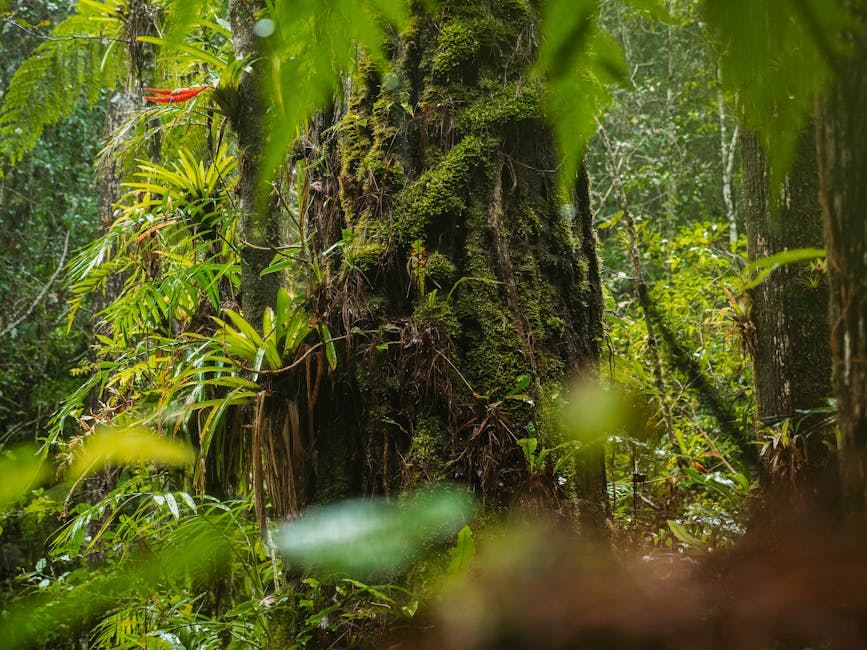
- The Isle of Man has 90% potential for temperate rainforest development due to its climatic and soil conditions.
- Temperate rainforests store more carbon per hectare than tropical rainforests, making large-scale restoration a priority.
- The Isle of Man’s high rainfall and humidity levels create a natural incubator for moss-rich, ancient woodland ecosystems.
- Temperate rainforests have dwindled to fragments in western Europe, with the UK retaining less than 0.5% of its original cover.
- Conservationists see the Isle of Man as a rare, viable site for rewilding efforts in a region where temperate rainforests have largely disappeared.
Temperate rainforests cover less than 1% of the planet’s surface, yet they store more carbon per hectare than tropical rainforests. Now, conservationists are turning their attention to an unexpected candidate for large-scale restoration: the Isle of Man. Recent ecological assessments reveal that over 90% of the island’s landmass possesses the climatic and soil conditions ideal for temperate rainforest development. With annual rainfall exceeding 1,200 millimeters and consistent humidity levels, the island offers a natural incubator for moss-rich, ancient woodland ecosystems once widespread across western Europe. These findings, published in a Nature journal review on Atlantic biomes, position the Isle of Man as a rare, viable site for rewilding efforts in a region where such forests have dwindled to fragments.
Reviving a Vanishing Ecosystem

Temperate rainforests—distinct from their tropical counterparts—are defined by high rainfall, persistent cloud cover, and a rich understory of bryophytes, lichens, and epiphytic plants. Once spanning the coastal fringes of the British Isles, Norway, and parts of Chile, these ecosystems have declined by over 85% due to centuries of deforestation, agriculture, and urbanization. The UK, in particular, retains less than 0.5% of its original temperate rainforest cover, mostly in isolated pockets of Scotland and Wales. The discovery that the Isle of Man, a self-governing British Crown Dependency in the Irish Sea, remains ecologically primed for restoration offers a rare opportunity. Unlike mainland areas burdened by intensive land use, the island’s low population density, minimal industrial agriculture, and existing woodland corridors create a uniquely favorable environment for large-scale reforestation.
Ecological Advantages of the Isle of Man

The Isle of Man’s geographic isolation and maritime climate produce stable environmental conditions crucial for rainforest development. Its average temperatures range from 6°C in winter to 15°C in summer—well within the sweet spot for temperate forest biodiversity. The island’s bedrock, primarily slate and volcanic basalt, supports acidic, well-drained soils that favor native oak, ash, and birch species, all key components of Atlantic rainforests. Additionally, the absence of non-native predators like grey squirrels and minimal deer overpopulation—common problems on the UK mainland—reduces threats to sapling survival. According to Dr. Elara Moss, a restoration ecologist at the University of Edinburgh, “The Isle of Man is a biological time capsule. It hasn’t suffered the same levels of soil degradation or invasive species pressure, making it one of the few places in Northwest Europe where passive rewilding could succeed.”
Scientific Basis and Conservation Strategy

A 2023 biogeographic survey conducted by the Manx Wildlife Trust and the Woodland Trust mapped over 40,000 hectares of land with high rainforest suitability. Using climate modeling, soil analysis, and historical vegetation records, researchers identified key zones in the northern and central uplands where native woodland expansion could occur with minimal human intervention. The proposed strategy combines assisted natural regeneration—removing livestock and non-native conifers—with targeted planting of keystone species like sessile oak and holly. Crucially, the island government has committed to rewilding 25% of its land by 2040, aligning with the UK’s broader 30×30 biodiversity target. Financial support from the European Outdoor Conservation Association and monitoring via satellite imaging from NASA’s Earth Observing System will track canopy density and carbon sequestration rates over time.
Socioeconomic and Ecological Impacts

Restoring temperate rainforests on the Isle of Man would yield benefits far beyond carbon capture. These forests act as natural water filters, reducing runoff and improving watershed health—a critical advantage given increasing rainfall intensity linked to climate change. Biodiversity would likely surge, with potential habitat expansion for threatened species like the Manx shearwater, red-billed chough, and several rare lichens. Economically, eco-tourism could flourish, drawing visitors interested in immersive forest experiences akin to those in Scotland’s Caledonian Forest. However, challenges remain: some local farmers express concern over land-use restrictions, though conservation groups emphasize that only marginal, less-productive areas are targeted. Public consultations have shown growing support, particularly among younger residents eager to position the island as a climate leader.
Expert Perspectives
While many scientists applaud the initiative, some urge caution. Dr. Niall O’Dea of Oxford’s Environmental Change Institute warns that “ideal conditions don’t guarantee success—long-term monitoring and adaptive management are essential.” Others, like conservation biologist Dr. Lina Chen, argue that the Isle of Man could serve as a blueprint: “If we can reestablish a functional temperate rainforest here, we can replicate the model in Ireland, western France, and even coastal British Columbia.” The debate centers on scalability—whether lessons from this small island can inform continental rewilding, or if its unique conditions render it an ecological outlier.
Looking ahead, the success of the Isle of Man’s rainforest project may hinge on policy continuity and community engagement. Researchers plan to establish a permanent monitoring station to track microclimate shifts, species migration, and soil regeneration. If the initiative meets its goals, the island could become the first jurisdiction in Europe to officially classify and protect a restored temperate rainforest biome. As global attention turns to nature-based climate solutions, the Isle of Man’s quiet hills may soon echo with the rustle of a reborn rainforest—one that could inspire a continent.
Source: BBC