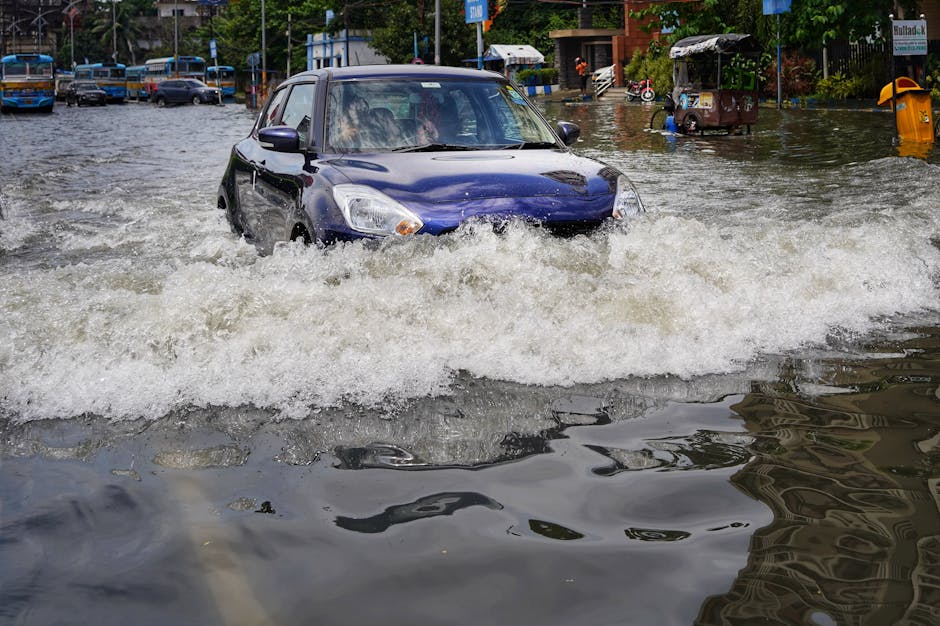
- Cities amplify large, intense storms by up to 48% while suppressing smaller, lighter ones by up to 30% in rainfall intensity.
- Urban heat islands enhance convection in strong storms, fueling their intensity and rainfall.
- Impervious surfaces and reduced vegetation in cities limit evaporation, decreasing low-level moisture availability for weaker storms.
- Storm intensity dictates the urban impact, with strong storms experiencing increased rainfall and weaker storms experiencing decreased rainfall.
- This nuanced understanding has critical implications for urban planning, flood risk modeling, and climate adaptation strategies worldwide.
Urban environments do not uniformly intensify storms, as previously assumed, but instead exert a dual influence: amplifying large, intense storms while suppressing smaller, lighter ones. A 23-year analysis of storm patterns across Texas, published in Nature, reveals that city-induced changes in heat, airflow, and surface texture create divergent outcomes depending on storm intensity. This nuanced understanding has critical implications for urban planning, flood risk modeling, and climate adaptation strategies in rapidly expanding metropolitan regions worldwide.
\n\n
Storm Intensity Dictates Urban Impact

\n
The study analyzed 40,000 storm events across 23 years (2000–2023) using high-resolution radar data from the NOAA National Severe Storms Laboratory and land-use maps from the U.S. Geological Survey. Researchers found that storms with initial rainfall rates above 25 millimeters per hour experienced, on average, a 48% increase in rainfall intensity when passing over major urban centers like Houston, Dallas, and Austin. In contrast, lighter storms — those below 10 millimeters per hour — saw rainfall reduced by up to 30% over the same areas. The urban heat island effect, which elevates surface temperatures by 2–5°C in cities, enhances convection in strong storms, effectively fueling their intensity. At the same time, impervious surfaces and reduced vegetation limit evaporation, decreasing low-level moisture availability that sustains weaker systems. These findings, derived from a spatially and temporally robust dataset, suggest that the impact of cities on weather is not monolithic but contingent on pre-existing atmospheric conditions.
\n\n
Key Players: Cities, Weather Systems, and Infrastructure

\n
The primary actors in this urban-climate interaction are the cities themselves, whose sprawling infrastructure alters local meteorology, and the storm systems whose trajectories intersect with them. Researchers at the University of Texas at Austin led the study, collaborating with atmospheric scientists from NASA’s Goddard Institute for Space Studies to model urban airflow dynamics. They found that tall buildings disrupt wind patterns, forcing air to converge and rise — a process known as mechanical lifting — which can trigger or enhance precipitation in already unstable atmospheres. Simultaneously, municipal water management systems, including storm drains and paved surfaces, reduce soil moisture, diminishing the latent heat flux that supports weaker convective systems. The study underscores how urban design, often developed without climatic feedbacks in mind, inadvertently shapes regional weather outcomes.
\n\n
Trade-Offs: Flood Risk vs. Drought Resilience

\n
The dual effect of cities on storms presents a complex trade-off: while urbanization may reduce the frequency of light rainfall beneficial for groundwater recharge and vegetation, it simultaneously heightens the risk of extreme flooding during major events. The 48% rainfall amplification in intense storms correlates with a 35% higher probability of flash flooding in urban watersheds, according to flood gauge data from the U.S. Geological Survey. On the other hand, the suppression of light rain — which accounts for nearly 60% of non-storm precipitation in rural Central Texas — could exacerbate drought stress in urban green spaces and reduce natural irrigation. This dichotomy forces city planners to balance flood mitigation infrastructure, such as retention basins and permeable pavements, against strategies to conserve moisture and enhance evapotranspiration in drier periods.
\n\n
Why the Timing Matters Now

\n
This study arrives at a critical juncture when both urbanization and climate change are accelerating globally. Over 56% of the world’s population lives in cities, a figure projected to rise to 60% by 2030, according to the United Nations. Concurrently, climate models predict more frequent and intense rainfall events in many mid-latitude regions, including the southern United States. The interaction between these two trends — larger cities and more extreme weather — means that the storm-modifying effects documented in Texas are likely to intensify. Earlier models treated urban areas as uniform heat sources, but this research shows that their meteorological influence is nonlinear and context-dependent, necessitating a revision of current weather prediction systems and urban climate resilience frameworks.
\n\n
Where We Go From Here
\n
In the next 6 to 12 months, three scenarios could unfold. First, meteorological agencies may begin integrating storm-intensity-dependent urban parameters into regional forecasting models, improving accuracy for both flood warnings and drought assessments. Second, city governments in flood-prone areas could accelerate investments in green infrastructure — such as rooftop gardens and urban forests — to modulate both runoff and local humidity. Third, international climate assessments, including those by the IPCC, might incorporate these findings into urban adaptation guidelines, recognizing cities not just as emitters of greenhouse gases but as active modifiers of weather. The path forward hinges on interdisciplinary collaboration between climatologists, urban planners, and policymakers.
\n\n
Bottom line — cities are not merely passive victims of climate change but active participants in reshaping local weather, with profound consequences for how we design and manage urban environments in an era of increasing climate volatility.
Source: Nature