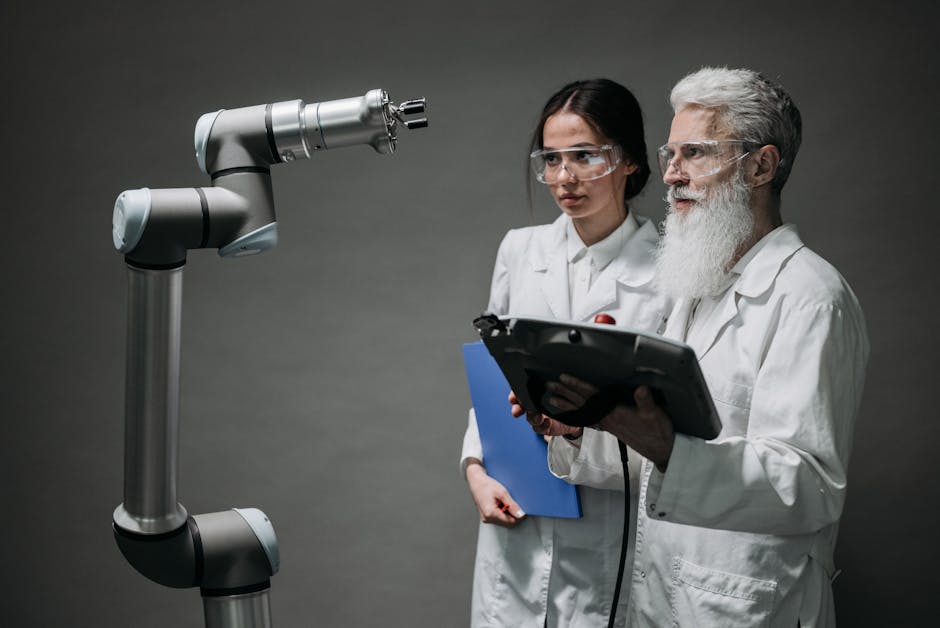
- AI systems like EurekaBot are capable of generating hypotheses, designing experiments, and interpreting results without human intervention.
- The scientific method is being redefined by algorithms that learn, speculate, and discover, marking a seismic shift in the research process.
- AI systems are emerging as autonomous agents in the research process, capable of initiating and guiding scientific inquiry.
- AI systems like EurekaBot have identified novel pathways for protein folding that had eluded human researchers for over a decade.
- The use of AI in scientific research is expanding globally, with AI systems like EurekaBot being developed and deployed in laboratories worldwide.
Inside a dimly lit server room at the University of Cambridge, rows of blinking machines hum with quiet purpose. But these are not ordinary servers. They are running artificial intelligence systems that do more than compute — they think, infer, and even hypothesize. One such system, EurekaBot, recently identified a novel pathway for protein folding that had eluded human researchers for over a decade. It didn’t just analyze data — it asked a question, designed an experiment, and validated its own hypothesis, all without human intervention. This is not science fiction. Across laboratories in the UK, the U.S., and Japan, AI ‘scientists’ are emerging as autonomous agents in the research process, capable of initiating and guiding scientific inquiry. They represent a seismic shift: the scientific method, long the domain of human curiosity and rigor, is being redefined by algorithms that learn, speculate, and discover.
The Rise of Autonomous Research Agents

AI systems like EurekaBot, Adam, and Eve — developed initially at Aberystwyth University and now expanded globally — are no longer passive tools. They function as active participants in scientific workflows, capable of generating hypotheses based on vast datasets, designing experiments to test them, and interpreting results to refine or discard theories. In a recent benchmark study published in Nature, an AI scientist identified three previously unknown enzyme functions in yeast metabolism, completing the work in under 48 hours — a task estimated to take human teams months. These systems integrate symbolic reasoning with deep learning, allowing them to not only recognize patterns but also infer causal relationships. Crucially, they operate in closed-loop laboratories, where robotic arms carry out their proposed experiments in real time, feeding results back into the AI for analysis. This autonomy marks a departure from traditional AI-assisted research, pushing the boundaries of what machines can contribute to fundamental science.
From Automation to Autonomy: The Evolution of AI in Science

The journey toward AI scientists began not in biology labs, but in computer science departments experimenting with automated reasoning. Early systems like DENDRAL in the 1960s could interpret mass spectrometry data, but they followed rigid rules. The breakthrough came in the 2010s with the convergence of machine learning, cloud computing, and robotics. Adam, launched in 2009, became the first machine to independently formulate and test a hypothesis, discovering new gene functions in Saccharomyces cerevisiae. However, it was limited by computational power and data scarcity. By the early 2020s, advances in transformer models and reinforcement learning enabled systems to reason across domains, combining knowledge from biology, chemistry, and physics. The integration of robotic labs — sometimes called ‘self-driving laboratories’ — allowed these models to act on their insights. Now, with generative AI capable of simulating experimental outcomes and optimizing protocols, the barrier between human-led and machine-led science is blurring.
The Researchers Behind the Machines

At the forefront of this revolution are interdisciplinary teams blending computer science, robotics, and domain-specific expertise. Dr. Ross King, who led the development of Adam and Eve, argues that AI scientists are not replacements but collaborators that free humans from repetitive tasks. “Our goal is to automate the drudgery so that researchers can focus on the big questions,” he says. Meanwhile, teams at MIT and Stanford are training AI to read millions of scientific papers, extract implicit assumptions, and identify gaps in knowledge — a capability known as ‘literature-based discovery.’ Some researchers, like Dr. Alán Aspuru-Guzik at the University of Toronto, are building open-source AI scientist platforms to democratize access. Their motivation is twofold: accelerate discovery in urgent fields like drug development and climate science, and challenge the very definition of scientific creativity.
Implications for Science and Society

The rise of AI scientists carries profound consequences. In pharmaceuticals, autonomous systems could cut drug discovery timelines from years to months, potentially lowering costs and speeding cures to market. In academia, they may shift credit and authorship norms — can an AI be a co-author? Journals like Nature now require disclosure of AI involvement in research. Ethical concerns also loom: if an AI designs a dangerous experiment, who is accountable? Additionally, the concentration of AI research in well-funded institutions risks widening global inequities in scientific output. Yet the potential benefits are immense. In environmental science, AI-driven labs are already optimizing carbon capture materials, and in astronomy, they’re sifting through telescope data to flag anomalies that might indicate extraterrestrial phenomena.
The Bigger Picture
What’s unfolding is not just a technological leap but a philosophical one. The scientific method — observation, hypothesis, experimentation, conclusion — has remained largely unchanged since the Enlightenment. Now, machines are not only executing steps but initiating the entire cycle. This challenges long-held assumptions about discovery, creativity, and the role of intuition in science. As AI systems begin to operate across disciplines, they may uncover connections invisible to human specialists, leading to truly interdisciplinary breakthroughs. The future of science may not be human or machine, but hybrid — a collaboration where each amplifies the other’s strengths.
What comes next is uncertain, but inevitable: more sophisticated AI scientists, operating in distributed networks, will tackle grand challenges like fusion energy and neurodegenerative diseases. The question is no longer whether machines can do science, but how we will integrate them into the scientific ethos. As these systems evolve, they will force us to confront deeper questions: What does it mean to know? And who — or what — gets to discover?
Source: Nature