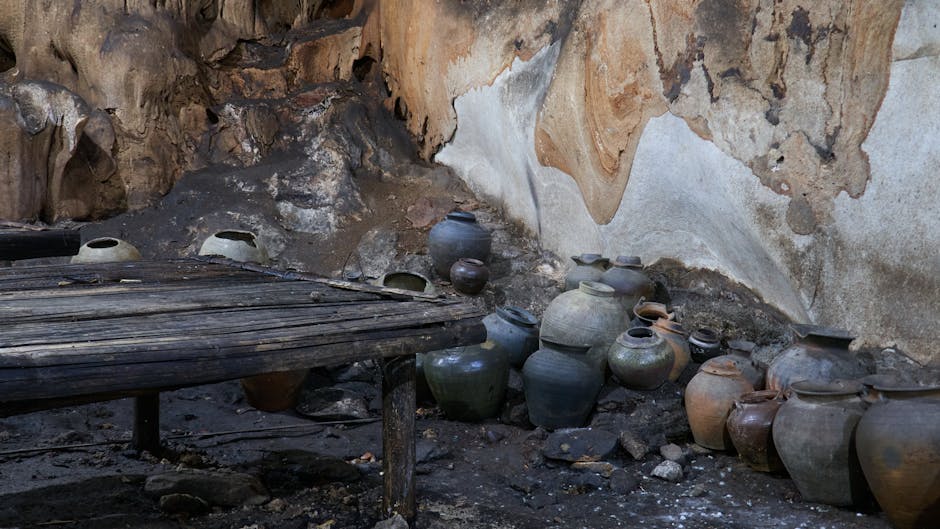
- Researchers have confirmed that at least one of the massive stone jars in Laos served as a repository for human bones for generations.
- The jars were used over a span of several centuries, transforming them into recurring sacred spaces for ancestral remembrance and ritual practice.
- The Plain of Jars in Laos has captivated researchers since the 1930s, but definitive proof of the jars’ use in mortuary rituals remained elusive until now.
- Advanced dating techniques and collaborative efforts have helped uncover the purpose of the enigmatic jars, which weigh up to 10 tons and were carved from rock over 2,000 years ago.
- The discovery sheds light on Bronze Age Southeast Asia’s mortuary rituals and ancestral practices, providing valuable insights into the region’s cultural heritage.
In a remote upland plateau of central Laos, more than 2,000 colossal stone jars stand like silent sentinels from a forgotten era. For decades, archaeologists have puzzled over the purpose of these megalithic containers, some weighing up to 10 tons and carved from rock over 2,000 years ago. Now, groundbreaking research published in Nature confirms that at least one of these enigmatic jars served as a repository for human bones for generations. The discovery, based on radiocarbon dating and detailed osteological analysis, reveals that individuals were placed in the jar over a span of several centuries, transforming it into a recurring sacred space for ancestral remembrance and ritual practice in Bronze Age Southeast Asia.
Unraveling the Mystery of the Plain of Jars

The Plain of Jars, located in Xiangkhouang Province, has captivated researchers since French archaeologist Madeleine Colani first documented the site in the 1930s. Scattered across the landscape, the jars—some over three meters tall—are carved from sandstone, granite, or limestone, with no known quarry source nearby. While Colani hypothesized their use in mortuary rituals, definitive proof remained elusive due to wartime destruction, unexploded ordnance, and limited excavation access. Now, with advanced dating techniques and collaborative efforts between Laotian authorities and international researchers, the mystery is yielding concrete answers. The new study focuses on Site 1, the most extensively studied cluster, where researchers examined human remains, burial contexts, and soil stratigraphy to reconstruct how the jars were used over time.
A Jar Transformed into a Sacred Ancestral Space

At the heart of the discovery is a single, well-preserved jar into which human remains were repeatedly deposited over centuries. The study analyzed fragmented bones from at least 40 individuals, including men, women, and children, whose remains were placed in the jar between 1240 BCE and 660 BCE. Radiocarbon dating of tooth enamel and bone collagen revealed that the earliest remains predate the jar’s construction, suggesting ancestral bones were intentionally curated and interred as part of a lineage-based burial tradition. Unlike typical single-event burials, this jar functioned as a dynamic mortuary site where successive generations returned to honor their dead. Associated artifacts—such as ceramic pots, glass beads, and iron tools—further indicate ritual offerings, pointing to a complex belief system centered on ancestor veneration and community identity.
Why These Jars Were Chosen for Burial

The choice of massive stone jars as burial containers raises questions about the societal and spiritual values of the people who built them. Researchers suggest the jars’ immensity symbolized permanence and continuity, anchoring ancestral memory within the physical landscape. Their open tops may have allowed for repeated access, distinguishing them from sealed tombs. The labor required to quarry, transport, and carve these vessels—likely using stone tools and wooden rollers—implies a highly organized society with shared religious goals. Dr. Louise Shewan, lead archaeologist on the project, noted in a ScienceDaily interview that the jars represent “a communal investment in memory,” where each deposition reinforced social cohesion and historical consciousness. The absence of written records makes interpreting their beliefs challenging, but the spatial arrangement of the jars—often aligned with cardinal directions or topographic features—hints at cosmological significance.
Implications for Southeast Asian Prehistory

The findings reshape our understanding of early Southeast Asian civilizations, long overshadowed by more studied regions like China or India. The Plain of Jars reveals a sophisticated culture capable of large-scale engineering and sustained ritual practice long before the rise of known kingdoms in the region. The multi-generational use of a single jar suggests a lineage-based social structure, possibly matrilineal or clan-centered, where ancestral ties dictated land rights and communal authority. Moreover, the presence of non-local materials—such as Indian Ocean beads and Chinese-style bronzes—indicates early trade networks spanning hundreds of kilometers. These connections challenge the notion of prehistoric Southeast Asia as isolated, instead painting a picture of interconnected, spiritually rich societies navigating complex social landscapes.
Expert Perspectives
While the study has been widely praised, some scholars urge caution. Dr. Marc Oxenham, a bioarchaeologist at the Australian National University, notes that the sample size remains limited and calls for broader excavation across other jar sites to confirm patterns. Others, like Dr. Catherine Murphy of the University of Hawaii, emphasize the importance of engaging local communities in interpreting the jars’ meaning, as oral traditions among the Phuan people still reference the stones as ancestral dwellings. The convergence of scientific data and indigenous knowledge, she argues, offers a richer, more ethical path forward in archaeology.
Looking ahead, researchers plan to expand their work to lesser-known jar sites across Laos, Thailand, and Vietnam, where similar megaliths have been reported. Questions remain about the builders’ origins, their linguistic identity, and how their traditions evolved or disappeared. As technology advances and access improves, the Plain of Jars promises to yield more answers—offering a rare window into a civilization that shaped its world through stone, memory, and the enduring reverence for those who came before.
Source: Nature