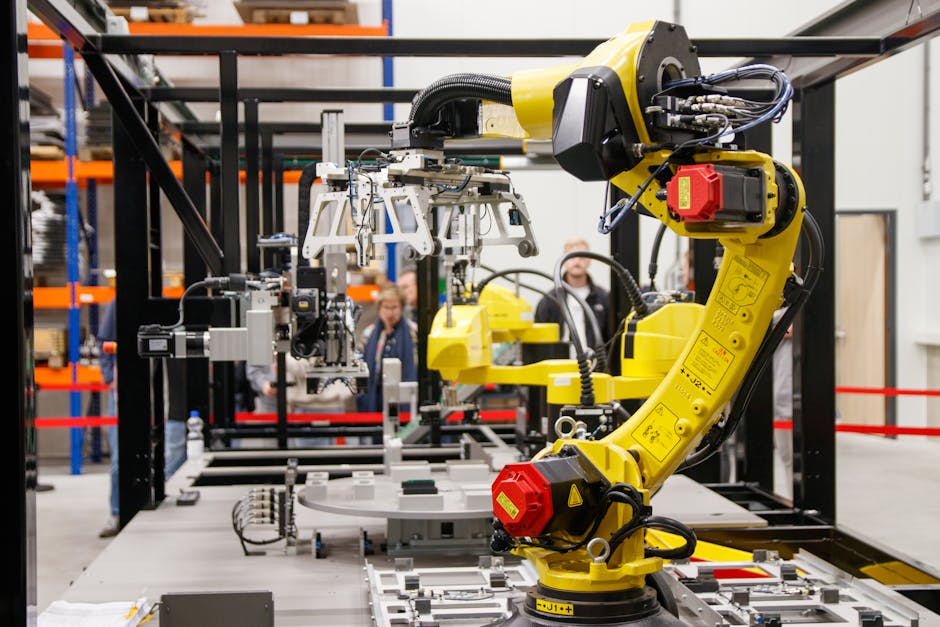
- AI has successfully mastered 90% of robot coding tasks in a recent experiment, marking a significant shift in AI’s role in robotics.
- The OpenClaw agent can autonomously generate control code for robots, enabling them to manipulate objects and navigate obstacles.
- The convergence of AI and robotics has accelerated with recent advances in large language models (LLM)-driven code generation.
- Modern AI agents like OpenClaw can interpret high-level goals and generate software stacks to achieve them, reducing development time.
- This fusion of AI and robotics has the potential to slash development time from months to hours and enable scalable, adaptive robotics.
Researchers have successfully equipped an AI coding agent—trained to write and debug complex software—with a robotic body, enabling it to perform real-world physical tasks with minimal human intervention. In a recent experiment, the system, referred to as an OpenClaw agent, autonomously generated the control code necessary to manipulate objects, navigate obstacles, and respond to sensor feedback in real time. This fusion of advanced artificial intelligence and robotics marks a pivotal shift: AI is no longer just an analytical tool but a full participant in the design and execution of physical systems. With over 90% of the robot’s operational code written and optimized by the AI itself, the implications for scalable, adaptive robotics are profound—potentially slashing development time from months to hours.
The Rise of Autonomous Machine Builders

The convergence of AI and robotics has long been anticipated, but recent advances in large language models (LLM)-driven code generation have accelerated the timeline dramatically. Unlike earlier robotic systems that relied on hand-coded instructions for every movement and decision, modern AI agents like OpenClaw can interpret high-level goals—such as ‘pick up the red block’—and generate the necessary software stack to achieve them. This capability stems from training on vast datasets of open-source robotics code, software documentation, and physics simulations. What once required teams of engineers across disciplines can now be initiated by a single prompt. The significance lies not just in speed, but in adaptability: these AI-driven systems can debug their own code, simulate outcomes, and refine behaviors before physical deployment, drastically reducing trial-and-error cycles.
Inside the OpenClaw Experiment

The OpenClaw agent was developed by a research team combining expertise in machine learning and robotics engineering, aiming to test the limits of AI-generated autonomy. The robot was equipped with standard sensors—depth cameras, force feedback grippers, and inertial measurement units—and tasked with completing a series of manipulation challenges, including sorting objects, opening containers, and assembling simple structures. Remarkably, the AI wrote over 8,000 lines of operational code, including low-level motor control, perception pipelines, and error-handling routines. When the robot encountered an unexpected obstacle—such as a slippery surface or a misaligned component—the agent revised its code in real time, recompiling and redeploying updated instructions within seconds. This self-correcting loop, powered by a combination of reinforcement learning and symbolic reasoning, demonstrates a new paradigm: machines that not only act but also think and rewrite their own behavior.
Why This Changes Everything for Robotics

Historically, robotics development has been bottlenecked by software complexity. Even minor changes in task requirements often demanded weeks of reprogramming. Now, AI agents can generate, test, and optimize robotic behaviors at unprecedented speed. According to a 2023 study published in Nature, integrating AI into robotic control systems reduced development time by up to 70% in controlled trials. The OpenClaw experiment builds on this, showing that AI can handle not just isolated functions but entire software stacks. This shift lowers the barrier to entry for robotics startups and could democratize access to automation in sectors like agriculture, elder care, and small-scale manufacturing. Moreover, it enables rapid prototyping in high-risk environments—such as disaster zones or space exploration—where sending human engineers is impractical.
Economic and Ethical Implications

As AI becomes both the architect and operator of robotic systems, the workforce impact will be significant. Routine programming and testing roles in robotics may decline, while demand grows for AI oversight, safety auditing, and ethical governance. Industries reliant on manual labor could see accelerated automation, raising concerns about job displacement. At the same time, the ability to deploy customized robots quickly could improve safety in hazardous jobs, from mining to firefighting. There are also risks: if AI-generated code contains hidden flaws or biases, the consequences in physical systems could be severe. Regulatory frameworks lag behind these developments, leaving critical gaps in accountability, especially when autonomous agents modify their own behavior in real time without human review.
Expert Perspectives
“This is the beginning of a new software era—where machines write their own operating logic,” says Dr. Lena Cho, a roboticist at MIT. “The efficiency gains are undeniable, but we must ensure transparency in AI-generated code.” Others urge caution. “Autonomy without oversight is a recipe for failure,” warns Kenji Sato, an AI ethics researcher at the University of Tokyo. “We’re giving machines the power to reshape their own behavior, and we don’t yet have the tools to audit every decision.” The debate centers on how much autonomy should be granted and under what conditions—especially as these systems move from labs into public spaces.
Looking ahead, the next milestone will be AI agents that can design not just software but hardware—selecting actuators, sensors, and materials to build entirely new robots from scratch. Projects at Boston Dynamics and ETH Zurich are already exploring this frontier. As AI becomes a co-creator in both code and physical form, the boundary between programmer and machine continues to blur. The key challenge will not be technical feasibility, but ensuring that these powerful systems remain aligned with human values, safety, and societal needs.
Source: WIRED