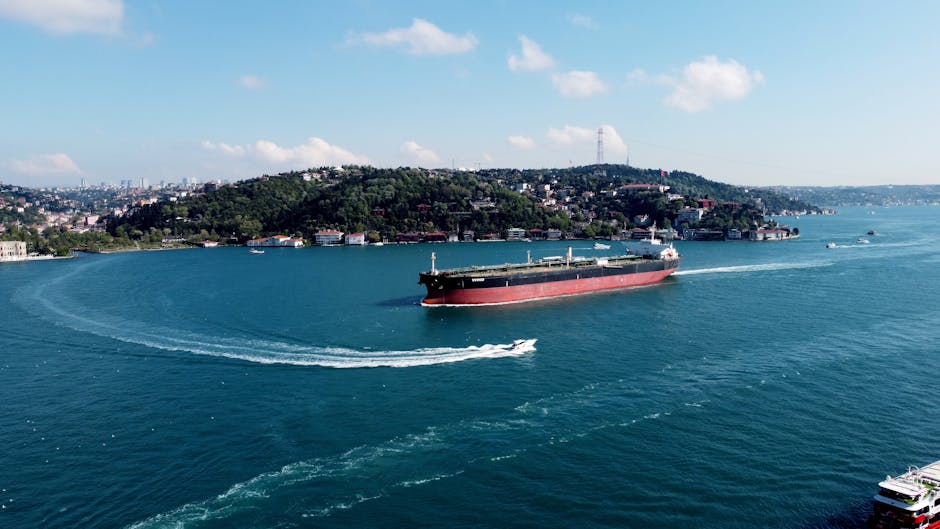
- Three supertankers, the Coral Voyager, Ocean Sovereign, and Polaris Horizon, carry 6M barrels of crude oil through the critical Strait of Hormuz.
- The vessels transport light crude from the UAE to refineries in China and South Korea, navigating a geopolitical powder keg.
- The Strait of Hormuz, just 21 miles wide, is one of the most perilous maritime passages on Earth.
- The supertankers are escorted by U.S. Fifth Fleet assets and Emirati patrol boats under coordinated naval monitoring.
- Global markets are on edge due to diplomatic tensions between Iran and the West, making this oil shipment a high-stakes endeavor.
Under a blistering Persian Gulf sun, the horizon trembles with heat as three colossal shadows cut through the turquoise waters: the *Coral Voyager*, the *Ocean Sovereign*, and the *Polaris Horizon*. Each stretches longer than four football fields, their rust-streaked hulls riding low under the weight of 2 million barrels of crude oil apiece. They glide forward under armed escort, their captains scanning radar screens for sudden blips, their crews trained to respond to anything from radio silence to missile threats. This is the Strait of Hormuz—just 21 miles wide at its narrowest—and one of the most perilous maritime passages on Earth. With global markets on edge and diplomatic tensions simmering between Iran and the West, these three supertankers are not just delivering fuel; they are navigating a geopolitical powder keg.
Oil Giants Risk the Strait Amid Heightened Surveillance

The three Very Large Crude Carriers (VLCCs) are en route from the United Arab Emirates to refineries in China and South Korea, collectively transporting approximately 6 million barrels of light crude. Maritime tracking data from Reuters confirms the vessels entered the strait under coordinated naval monitoring, with U.S. Fifth Fleet assets observing from a distance and Emirati patrol boats providing close escort. The shipment represents a significant portion of Asia’s weekly oil intake, underscoring the continued reliance on Persian Gulf supplies despite years of diversification efforts. While no official threats have been issued, Iranian naval activity has spiked in recent weeks, with drone patrols and fast-attack craft conducting exercises near shipping lanes. Insurers have raised premiums for vessels transiting the area by as much as 300%, and some shipping firms have rerouted around Africa to avoid risk—costing millions in fuel and time.
The Long History of Chokepoint Conflict

The Strait of Hormuz has been a flashpoint for decades, a maritime bottleneck through which nearly 20% of the world’s traded oil flows. Its strategic importance surged during the 1980s Iran-Iraq War, when both nations attacked oil tankers in what became known as the ‘Tanker War.’ Since then, the waterway has seen repeated crises: in 2019, Iran seized a British tanker in retaliation for the detention of an Iranian vessel near Gibraltar; in 2021, an Israeli-owned ship was attacked, allegedly by an Iranian drone. Each incident sent shockwaves through global markets, spiking oil prices and triggering emergency coordination among NATO, Gulf states, and major importers. The U.S. maintains a permanent naval presence in the region, while China and India have begun increasing their own patrols to protect energy interests. Despite technological advances in surveillance and defense, the strait remains vulnerable—its narrowness and proximity to hostile shores make it nearly impossible to fully secure.
Who’s Behind the Oil Gamble

The stakes are being weighed by a constellation of actors: national oil companies like ADNOC and Saudi Aramco, private shipping giants such as Frontline and Euronav, and state-backed insurers in London and Tokyo. Behind the scenes, energy ministers in Beijing and Seoul are monitoring the crossings closely, aware that a single disruption could destabilize their industrial economies. Traders in Singapore and Geneva are adjusting futures positions based on real-time AIS data. Meanwhile, Iranian naval commanders, operating under the Islamic Revolutionary Guard Corps, view every foreign tanker as a symbol of Western dominance—and a potential bargaining chip. The supertankers’ captains, mostly Greek and Filipino nationals employed by third-party management firms, operate under strict protocols: minimal radio use, constant position reporting, and emergency drills conducted weekly. Their personal safety is often an afterthought in the calculus of global energy flow.
Global Markets Hang on a Narrow Passage

A successful transit reassures markets, but the risk remains high. Disruption in the strait could instantly remove millions of barrels from circulation, triggering price spikes and inflationary pressure worldwide. Asian economies, heavily dependent on Gulf oil, are particularly exposed. Japan, for instance, imports over 80% of its crude from the Middle East, while South Korea relies on the region for nearly 70%. Even fleeting uncertainty can alter trade flows: in past crises, refiners have drawn from strategic reserves or switched to more expensive West African or U.S. shale supplies. Shipping alliances are quietly discussing contingency plans, including armed private security teams and satellite-guided evasion routes. For oil-dependent nations, the message is clear: energy security is no longer just about reserves or pipelines—it’s about the few nautical miles that separate stability from chaos.
The Bigger Picture
This latest crossing is not an isolated event but a symptom of a deeper reality: the world’s energy infrastructure remains tethered to unstable regions, even as climate policies push for renewables. The persistence of these massive oil flows exposes the limits of decarbonization in the short term and the enduring power of petrostates. Moreover, the militarization of shipping lanes reflects a new era of hybrid warfare, where commerce itself becomes a battlefield. As great power competition intensifies, the Strait of Hormuz may serve less as a trade corridor than as a stage for geopolitical theater—where every tanker is both a lifeline and a liability.
What comes next may not be a single catastrophic event but a series of calculated risks—shadow blockades, drone harassment, or cyberattacks on navigation systems. The three supertankers moving through the strait today are not just carrying oil; they are carrying the weight of a fragile global order. Whether they reach their destination safely may depend less on steel hulls and more on the quiet calculations of diplomats, admirals, and traders watching from afar.
Source: Financial Times