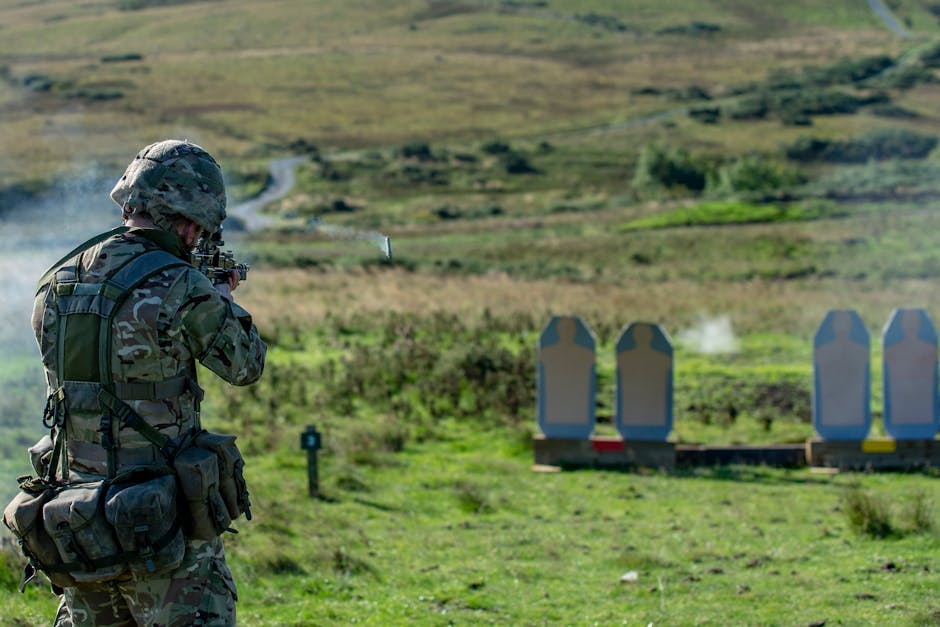
- Russia has secretly trained over 10,000 soldiers in China for Ukraine war efforts since early 2023.
- The training focuses on asymmetric warfare, counter-drone operations, and deep-strike reconnaissance, crucial in the Ukraine conflict.
- The clandestine alliance between Russia and China has been confirmed by Western intelligence agencies and NATO officials.
- Advanced combat training on Chinese soil includes urban warfare simulations mirroring Ukrainian city layouts.
- This new axis of military escalation poses a significant threat to global stability and regional security.
In the shadowed corridors of a remote training compound in Xinjiang, far from the prying eyes of foreign satellites and journalists, rows of Russian soldiers moved through simulated Ukrainian villages under the watchful gaze of Chinese instructors. Dust swirled around their boots as drones buzzed overhead, guiding artillery strikes on mock separatist strongholds. The terrain was artificial, but the tactics were real—urban clearance, electronic warfare, and drone swarm coordination—skills now being deployed in the smoldering ruins of Bakhmut and Avdiivka. What unfolded there was not an exercise in bilateral friendship, but the quiet forging of a new axis of military escalation. These scenes, pieced together from intelligence intercepts and defector testimonies, suggest a clandestine alliance deepening at a moment of geopolitical fragility.
Russia’s Reinforced War Machine

Western intelligence agencies have confirmed that since early 2023, more than 10,000 Russian military personnel have undergone advanced combat training on Chinese soil. The program, coordinated through the People’s Liberation Army (PLA) and Russia’s General Staff, focuses on asymmetric warfare, counter-drone operations, and deep-strike reconnaissance—all critical components in the grinding attrition war in eastern Ukraine. According to classified assessments reviewed by Reuters and corroborated by NATO officials, the training includes urban warfare simulations mirroring Ukrainian city layouts and electronic warfare drills designed to disrupt Western-supplied communication systems. While China officially maintains a stance of neutrality, these operations represent a significant breach of that posture, fueling concerns that Beijing is now an active, albeit indirect, participant in the conflict. Satellite imagery from Xinjiang and Ningxia provinces shows expanded facilities with mock European-style buildings and trench networks consistent with frontline conditions in Donbas.
The Road to Covert Collaboration

The roots of this military partnership stretch back to the 2010s, when Russia and China began expanding joint war games under the banner of “anti-terrorism” cooperation. Exercises like “Peace Mission” within the Shanghai Cooperation Organization laid the groundwork for interoperability, but the invasion of Ukraine in 2022 accelerated the shift from theater to reality. As Western sanctions crippled Russia’s defense industry and limited access to advanced electronics, China emerged as a critical supplier of dual-use technologies—semiconductors, navigation systems, and drone components. By mid-2023, intelligence reports indicated that training had moved beyond observation to direct instruction. The U.S. Department of Defense confirmed in a closed briefing that PLA instructors began embedding with Russian units, while Russian officers received classified instruction in AI-driven battlefield analytics at Chinese military academies. This quiet escalation has bypassed formal alliances but deepened de facto coordination between two powers increasingly at odds with the Western-led order.
The Architects of the Shadow War

At the helm of this covert engagement are figures like PLA General Li Shangfu, former Defense Minister until his 2023 dismissal amid U.S. sanctions, and Valery Gerasimov, Russia’s Chief of the General Staff. Though public appearances have dwindled, their influence persists through intermediaries in military attaché networks and intelligence liaison channels. Chinese strategists, driven by a long-term vision of weakening NATO’s cohesion and testing U.S. resolve, see Ukraine as a proving ground for hybrid warfare doctrines. For Russian commanders, the training fills critical gaps left by battlefield losses and technology shortages. Defectors from Russia’s 58th Guards Combined Arms Army report that soldiers returning from Chinese programs are assigned to elite assault units, often deployed in high-casualty urban operations. Their enhanced capabilities—particularly in drone-guided artillery strikes—have contributed to recent Russian advances near Chasiv Yar and Pokrovsk.
Escalation and Its Fallout

The implications of China’s involvement are far-reaching. For Ukraine, it means facing an adversary increasingly adept at countering Western-supplied weapons and tactics. For NATO, it signals a dangerous evolution in great-power collusion, where plausible deniability masks direct military enablement. The training programs blur the line between advisory support and active belligerence, challenging international norms on non-intervention. Economically, the transfer of dual-use technologies risks triggering broader sanctions on Chinese firms, potentially destabilizing global supply chains. Diplomatically, it strains EU-China relations at a time when Brussels seeks to decouple from Russian energy while managing trade dependencies with Beijing. Most critically, it emboldens Moscow to prolong the war, calculating that behind-the-scenes support will offset battlefield attrition and Western fatigue.
The Bigger Picture
This covert alignment is not merely a tactical adjustment—it reflects a strategic realignment in global military affairs. As the U.S. and its allies promote democratic coalitions, China and Russia are building a parallel infrastructure of mutual support, combining Chinese technological prowess with Russian combat experience. The war in Ukraine has become a laboratory for this partnership, testing doctrines that could be deployed in Taiwan, the Arctic, or the South China Sea. Unlike Cold War blocs, this axis operates through ambiguity, leveraging deniability to avoid direct confrontation while steadily eroding the rules-based order. The result is a more fragmented, unpredictable world—one where wars are fought not just on battlefields, but in the shadows of training camps and semiconductor factories.
What comes next may hinge on whether the West can expose and disrupt these covert flows without triggering wider conflict. Diplomatic protests have so far yielded little. Enhanced satellite surveillance, cyber counterintelligence, and targeted sanctions on facilitator entities offer possible tools—but they require consensus among fractious allies. Meanwhile, in the steppes of eastern Ukraine, soldiers trained in Chinese academies continue to advance, their tactics refined not in Moscow, but in the remote deserts of Xinjiang. The war is no longer just Ukraine’s to fight.
Source: Reuters