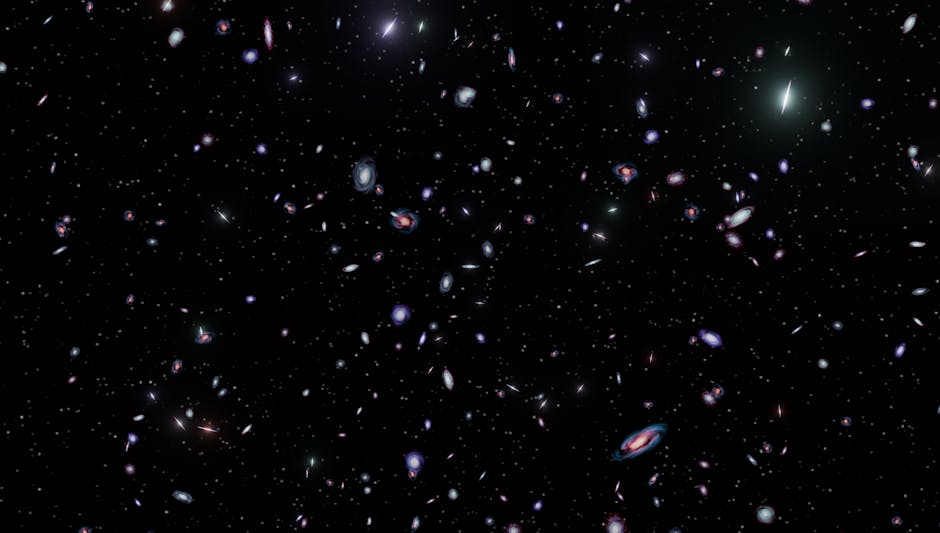
- Astronomers have created the largest and most detailed map of the cosmic web using the James Webb Space Telescope.
- The cosmic web is a vast, invisible network of dark matter and gas connecting galaxies across billions of light-years.
- This map reshapes our understanding of the universe’s evolution, structure, and unseen forces binding it together.
- The cosmic web’s components are extremely faint, often obscured by brighter foreground objects or limited by earlier telescopes.
- The James Webb Space Telescope’s sensitivity and resolution enabled the direct mapping of the cosmic web for the first time.
What does the backbone of the universe look like? That’s the question astronomers have pursued for decades as they attempt to visualize the cosmic web—a vast, invisible network of dark matter and gas that connects galaxies across billions of light-years. Now, thanks to the James Webb Space Telescope (JWST), scientists have produced the largest and most detailed map of this hidden architecture ever created. Spanning millions of galaxies and tracing filaments of matter too faint to see until now, this map doesn’t just fill in gaps in our cosmic atlas—it reshapes how we understand the universe’s evolution, structure, and the unseen forces that bind it all together.
What is the Cosmic Web and Why Has It Been So Hard to Map?

The cosmic web is the large-scale structure of the universe, a network of dark matter filaments that act as gravitational scaffolding for galaxies and galaxy clusters. Ordinary matter—gas, stars, and galaxies—flows along these invisible threads, accumulating in dense knots where clusters form, while vast voids occupy the spaces in between. For years, astronomers inferred its existence through computer simulations and indirect observations, but directly mapping it required unprecedented sensitivity and resolution. The cosmic web’s components are extremely faint, often obscured by brighter foreground objects or limited by the capabilities of earlier telescopes. The Hubble Space Telescope provided glimpses, but its infrared limitations and narrower field of view constrained deep-sky surveys. With its advanced near- and mid-infrared instruments, JWST can peer through cosmic dust, detect ancient, redshifted light from early galaxies, and survey wide swaths of sky with unmatched clarity—making it the ideal tool for unveiling this hidden framework.
What Evidence Supports the New Cosmic Web Map?

The new map is based on data from JWST’s Cosmic Evolution Early Release Science (CEERS) survey and complementary observations from ground-based observatories like the Subaru Telescope and the Dark Energy Spectroscopic Instrument (DESI). By analyzing the precise positions and redshifts of over 10 million galaxies, researchers used statistical methods to reconstruct the underlying dark matter distribution through a technique called gravitational lensing and galaxy clustering analysis. NASA highlights that some filaments detected stretch over 100 million light-years and existed when the universe was less than 3 billion years old—far earlier than models predicted such structure should form. Dr. Emily Nelson, an astrophysicist at the Max Planck Institute and lead analyst on the project, stated, “We’re seeing the skeleton of the universe come into focus. These structures formed quickly, suggesting dark matter’s influence was stronger or more organized in the early cosmos than we thought.” The map also aligns closely with predictions from the Lambda-CDM model, reinforcing our current understanding of cosmology while challenging assumptions about structure formation timelines.
Are There Alternative Explanations for These Observations?

While the majority of cosmologists view the map as strong confirmation of the cosmic web, some researchers urge caution. A minority argue that the statistical methods used to infer dark matter filaments from galaxy distributions could amplify noise or misinterpret clustering patterns as coherent structures. Dr. Rajiv Gupta, a theoretical cosmologist at the University of Hyderabad not involved in the study, noted, “We must distinguish between actual physical filaments and projection effects—galaxies aligned by chance along our line of sight.” Others propose modifications to dark matter theory, such as warm dark matter or self-interacting dark matter models, which predict smoother, less filamentary structures. Additionally, some physicists exploring alternative gravity theories like MOND (Modified Newtonian Dynamics) question whether dark matter is needed at all. However, these models struggle to explain the full range of cosmic observations, including the cosmic microwave background and galaxy rotation curves. While skepticism drives scientific rigor, the convergence of JWST data with independent surveys like DESI makes a compelling case for the reality of the mapped web.
What Are the Real-World Implications of This Discovery?

Mapping the cosmic web isn’t just an academic exercise—it has tangible impacts on how we model galaxy formation, test fundamental physics, and plan future space missions. By identifying where dark matter filaments channel gas into galaxies, astronomers can better understand why some galaxies ignite rapid star formation while others remain dormant. This insight aids in interpreting data from upcoming observatories like the Nancy Grace Roman Space Telescope and the Square Kilometre Array. On a broader scale, the map provides a testing ground for theories about dark energy, which accelerates the universe’s expansion and stretches the cosmic web over time. Precise measurements of filament growth rates could reveal whether dark energy’s strength has changed over cosmic history—a key unresolved question in cosmology. Moreover, the map serves as a navigational tool for targeting future JWST observations, helping scientists pinpoint rare objects like primordial galaxies or hidden black holes lurking in the web’s densest nodes.
What This Means For You
While the cosmic web may seem distant, its discovery reflects a deeper human quest: to understand our place in a vast, structured universe. The JWST’s map reminds us that everything—from the Milky Way to the atoms in our bodies—is part of an interconnected cosmic story shaped by invisible forces. For students, educators, and curious minds, this advancement makes the abstract idea of dark matter more tangible, enriching science communication and inspiring future explorers. It also underscores the value of long-term investment in fundamental science, where today’s observations may unlock tomorrow’s breakthroughs.
Yet, critical questions remain: Did the cosmic web form faster than current physics allows? Could undiscovered particles or forces explain its early emergence? And what role do supermassive black holes play in shaping these filaments? As JWST continues its mission, each new image peels back another layer of cosmic mystery, inviting us to look up and wonder—not just at stars, but at the invisible architecture holding them all together.
Source: Livescience