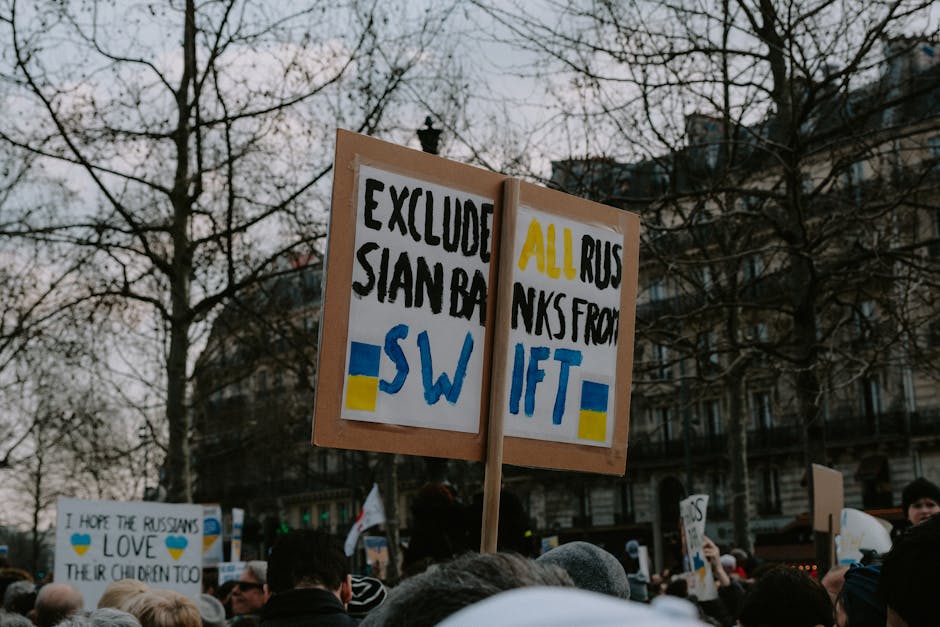
- Western sanctions have reduced Russia’s GDP by an estimated 5% since the invasion of Ukraine in 2022.
- President Putin faces difficult choices between escalating militarily or risking domestic instability.
- Russia’s economic isolation has led to critical imports being rerouted through third countries.
- The Kremlin’s ability to sustain its war effort is increasingly questioned by Western and former Soviet analysts.
- Sanctions have systematically targeted Russia’s access to advanced semiconductors and dual-use technologies.
Western sanctions have slashed an estimated 5% from Russia’s GDP since the full-scale invasion of Ukraine in 2022, according to intelligence assessments from Estonia’s Foreign Intelligence Service. As economic isolation deepens, President Vladimir Putin faces what Tallinn describes as “very difficult choices”—either escalate militarily to break the stalemate or risk domestic instability from a war-weary, economically strained population. With critical imports rerouted through third countries and military-industrial output stretched thin, Russian leadership is navigating a perilous convergence of battlefield attrition and financial suffocation. The Kremlin’s ability to sustain its war effort is increasingly questioned, not only by Western analysts but by former Soviet-aligned intelligence officials who see cracks in Moscow’s strategic resolve.
Strategic Squeeze on the Russian Economy

The coordinated sanctions regime led by the United States, European Union, and G7 nations has systematically targeted Russia’s access to advanced semiconductors, financial markets, and dual-use technologies. According to a 2023 report by the OECD, Russia’s economic growth has stagnated at less than 0.5% amid inflationary pressures and declining productivity. Estonia’s Foreign Intelligence Service director, Mikk Marran, emphasized that while Russia has adapted through alternative trade routes via China, Iran, and Turkey, these channels cannot fully compensate for the loss of high-tech Western components essential for modern warfare. The long-term degradation of Russia’s defense manufacturing base threatens not only current operations in Ukraine but also its broader military readiness in a potential wider conflict.
Ukraine’s Resistance and Russian Mobilization

Despite significant territorial gains in the Donbas region in 2023 and early 2024, Russian forces have failed to achieve a decisive breakthrough, facing resilient Ukrainian defenses backed by Western-supplied artillery, drones, and air defense systems. Ukrainian forces, though constrained by slower-than-expected aid deliveries, have maintained control over key cities including Kharkiv and Kyiv. In response, Moscow has intensified mobilization efforts, including the recruitment of convicts and expanded conscription drives. Satellite imagery analyzed by the BBC shows increased troop movements near the Kharkiv and Zaporizhzhia fronts, suggesting preparations for new offensives. However, low morale and high casualty rates continue to plague Russian units, undermining the effectiveness of these reinforcements.
Roots of the Stalemate and Strategic Miscalculation

At the heart of Russia’s predicament lies a fundamental miscalculation: the assumption that Ukraine could be swiftly subdued and that Western support would wane over time. Instead, Kyiv’s determination, bolstered by over $100 billion in military aid from NATO members, has prolonged the conflict far beyond Moscow’s expectations. Analysts at the Royal United Services Institute (RUSI) note that Russia is now producing artillery shells at nearly twice the rate of Ukraine, but with lower precision and reliability. This shift toward a war of attrition favors Ukraine in the long run, provided Western aid remains consistent. The sanctions’ delayed but compounding effects—on everything from tank production to pilot training—are now becoming evident, limiting Russia’s ability to adapt to battlefield realities.
Human and Geopolitical Costs Mount

The war’s toll extends far beyond the battlefield. Over 30,000 civilians have been killed or injured, and more than 8 million Ukrainians remain displaced. Inside Russia, dissent is suppressed, but economic hardship is fueling quiet discontent, particularly in rural regions and among families of conscripted soldiers. Meanwhile, NATO’s eastern flank—from Estonia to Romania—has entered a state of heightened readiness, with new defense spending and troop deployments redefining European security. Should Russia attempt to expand the war beyond Ukraine, it risks triggering Article 5, drawing the alliance into direct conflict. The danger of miscalculation, especially in contested airspace or cyber domains, grows with each passing month.
Expert Perspectives
“Putin is trapped between military overreach and political vulnerability,” says Dr. Maria Lipman, a senior fellow at the Carnegie Endowment for International Peace. “Escalation risks war with NATO; de-escalation risks his grip on power.” Others, like former NATO strategist General Ben Hodges, argue that Russia still possesses enough conventional and nuclear leverage to deter direct Western intervention. “They don’t need to win,” Hodges stated in a recent AP News interview, “they just need to make the cost of supporting Ukraine unbearable over time.” This dual pressure—on both Kyiv and its allies—defines the current phase of the war.
Looking ahead, the trajectory of the conflict hinges on two variables: the continuity of Western military aid and Russia’s capacity to retool its economy under sanctions. Ukraine’s 2024 counteroffensive, though limited, demonstrated improved coordination and drone warfare capabilities. If Western governments sustain support, particularly in air defense and long-range strike systems, Ukraine may yet regain strategic momentum. However, political divisions in the U.S. Congress and delays in EU funding packages leave room for doubt. The world watches as Putin weighs his next move—one that could either extend a grinding war or, in worst-case scenarios, shatter the fragile threshold of conventional conflict.
Source: Reuters