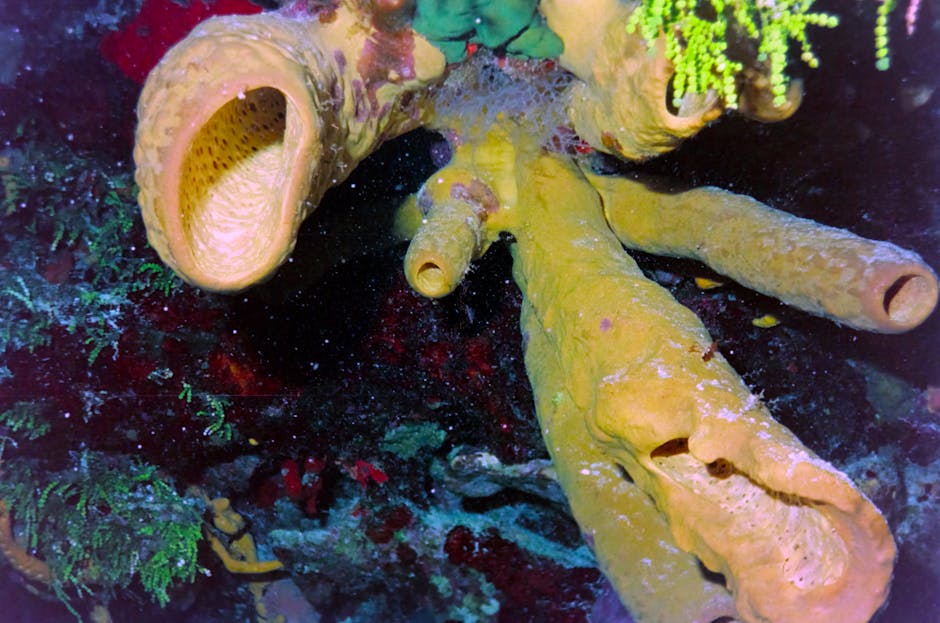
- A new 3D-printed material mimics the structure of a deep-sea sponge to achieve exceptional fracture resistance.
- The material withstands fractures 187 times better than conventional concrete, making it suitable for high-demand applications.
- Researchers at Harvard University and the University of California, Berkeley, engineered the composite material by layering polymer and mortar sheets.
- The sponge’s lattice structure distributes mechanical forces efficiently, unlike traditional concrete’s uniform composition.
- This breakthrough in materials science may transform the construction industry, enabling stronger, longer-lasting structures.
What if the key to building stronger, longer-lasting structures wasn’t found in a high-tech lab, but in the dark, crushing depths of the ocean? A recent breakthrough in materials science suggests exactly that. Researchers have developed a new 3D-printed composite material so resilient it withstands fractures 187 times better than conventional concrete. The secret? A humble deep-sea sponge known as Euplectella aspergillum, or the Venus’ flower basket. This translucent, lattice-like creature survives extreme underwater pressures thanks to its intricate skeletal structure. Now, by mimicking that natural design, scientists are ushering in a new era of bio-inspired construction materials capable of withstanding earthquakes, erosion, and decades of wear—potentially transforming how we build everything from bridges to skyscrapers.
How Does a Deep-Sea Sponge Inspire Stronger Concrete?

The Venus’ flower basket, found in the western Pacific Ocean at depths exceeding 1,000 feet, builds its skeleton from silica, forming a delicate yet remarkably tough lattice. Unlike traditional concrete, which cracks under stress due to its brittle nature and uniform composition, the sponge’s skeletal architecture features a staggered, crisscrossing pattern that distributes mechanical forces efficiently. Inspired by this, researchers at Harvard University and the University of California, Berkeley engineered a composite by layering thin sheets of polymer with mortar, arranging them in a controlled, offset pattern reminiscent of the sponge’s structure. This 3D-printed design, detailed in the journal Advanced Materials, creates weak interfaces intentionally—allowing microcracks to form and dissipate energy without propagating into catastrophic failures. The resulting material isn’t just stronger; it’s fundamentally smarter in how it manages stress.
What Evidence Supports This Material’s Superior Strength?

Testing revealed the composite could absorb significantly more energy before fracturing—187 times more than conventional 3D-printed concrete with a uniform layering pattern. Scanning electron microscopy showed that when cracks began to form, they were deflected along the polymer interfaces, forcing them to travel longer, more tortuous paths. This “crack deflection” mechanism is a hallmark of many biological materials, from nacre in seashells to human bone. “We’re not just copying nature’s design,” said Dr. Matija Radović, a materials scientist at UC Berkeley not involved in the study, in an interview with Nature. “We’re reverse-engineering the principles that make biological systems so durable under stress.” The team also used finite element modeling to simulate stress distribution, confirming that the staggered arrangement minimized localized strain. These findings align with biomimicry research previously seen in aerospace and protective gear, now making significant inroads into civil engineering.
Are There Limitations or Skeptical Views?

Despite the promise, experts caution that laboratory success doesn’t guarantee real-world scalability. “The jump from a small sample in a controlled environment to a full-scale bridge or building is enormous,” said Dr. Lorna Gibson, a materials engineer at MIT, in a commentary for ScienceDaily. Challenges include the cost of polymer materials, the time required for precise 3D printing, and the need for new regulatory standards. Some argue that traditional reinforced concrete, when properly maintained, already performs well in most environments. Others question whether the material can withstand chemical degradation from saltwater or pollutants over decades. Additionally, the current prototype is not load-bearing at the scale required for high-rise construction. While the fracture resistance is impressive, long-term durability, thermal performance, and fire resistance remain untested—critical factors in construction safety and compliance.
What Real-World Applications Could This Enable?

Even with current limitations, the material holds immediate promise for high-risk or remote infrastructure. Engineers could use it in earthquake-prone regions like Japan or California, where crack-resistant materials are vital for overpasses and retaining walls. It may also be ideal for 3D-printed housing in disaster zones, offering rapid deployment with enhanced longevity. NASA has expressed interest in similar bio-inspired composites for lunar or Martian habitats, where traditional construction methods are impractical. In underwater environments, such as offshore wind turbine foundations or subsea pipelines, the material’s resistance to pressure and fatigue could extend service life dramatically. Already, startups like ICON and COBOD are exploring hybrid printing techniques that could incorporate such bio-mimetic designs, suggesting a future where buildings are not just assembled, but grown from nature’s blueprints.
What This Means For You
If this technology matures, future homes, roads, and public infrastructure could last decades longer with less maintenance, reducing both costs and environmental impact. Cement production accounts for nearly 8% of global CO₂ emissions, so materials that last longer or require less of it offer a path to greener cities. For communities in disaster-prone areas, this could mean safer shelters and more resilient recovery. While widespread adoption is years away, the principles behind this innovation—learning from nature’s time-tested designs—could influence everything from consumer products to urban planning.
As scientists continue to decode the structural secrets of organisms like the Venus’ flower basket, a deeper question emerges: how many other solutions to human engineering challenges already exist in the natural world, silently thriving in the planet’s most extreme environments? From spider silk to shark skin, nature has spent millions of years optimizing for survival. The next great leap in materials science may not come from a supercomputer or particle accelerator—but from a quiet, glassy sponge swaying in the deep sea.
Source: Engineering