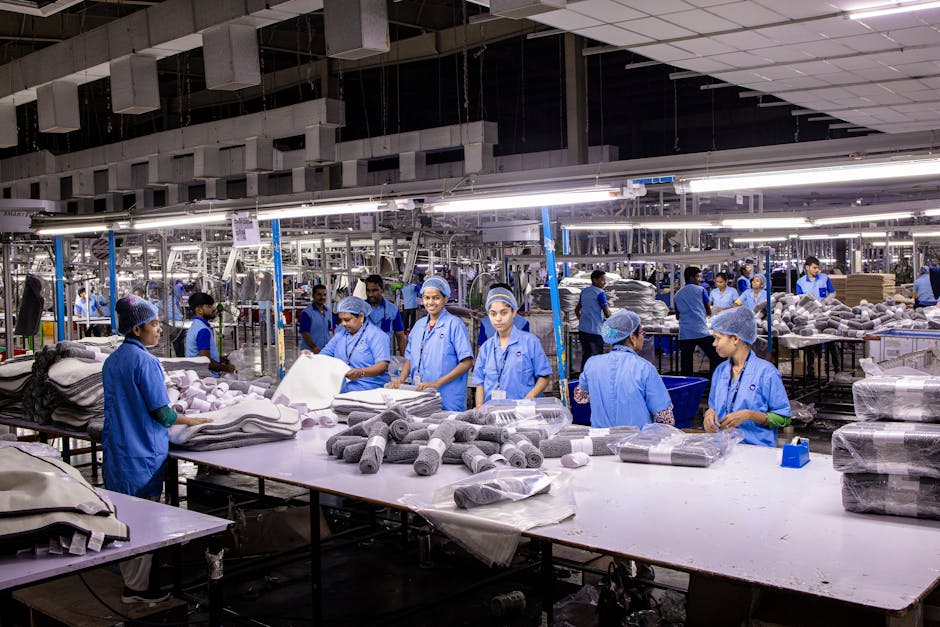
- Asia is on the cusp of an industrial supercycle driven by coordinated infrastructure expansion and rising green technology investments.
- Manufacturing activity in the region is expanding at its fastest pace in over a decade, reshaping supply chains and boosting capital expenditure.
- Emerging and advanced economies in Asia are implementing policy frameworks to support long-term productivity gains and structural transformation.
- The region’s manufacturing sector is becoming the epicenter of global industrial rebalancing, with sustained production growth and rising capital expenditure.
- Foreign direct investment (FDI) into Asian manufacturing hit $680 billion in 2023, a 22% increase from 2022.
Asia is poised to enter a sustained industrial supercycle, driven by coordinated infrastructure expansion, rising green technology investments, and deepening regional trade integration. This upswing is not merely cyclical but structural, supported by policy frameworks across emerging and advanced economies alike. With manufacturing activity expanding at its fastest pace in over a decade, the region is becoming the epicenter of global industrial rebalancing—reshaping supply chains, boosting capital expenditure, and setting the stage for long-term productivity gains that could outlast current economic volatility.
Manufacturing and Investment Data Signal Structural Shift

Recent economic indicators across Asia point to a structural transformation in industrial capacity. Purchasing Managers’ Index (PMI) readings for manufacturing in China, South Korea, Vietnam, and India have remained above the 50-point expansion threshold for eight consecutive quarters, signaling sustained production growth. Industrial output in ASEAN countries rose 6.9% year-on-year in 2023, the highest in over a decade, according to data from the Asian Development Bank. Capital expenditure is surging: firms across Southeast Asia plan to increase factory investments by an average of 14% in 2024, driven by semiconductor, electric vehicle (EV), and renewable energy projects. Foreign direct investment (FDI) into Asian manufacturing hit $680 billion in 2023—up 22% from 2022 and surpassing North America and Europe combined. Notably, Japan’s machinery orders, a leading indicator of capital spending, rose 8.1% in Q1 2024, the sharpest increase since 2010. This data reflects more than just recovery—it suggests a reindustrialization wave underpinned by strategic state planning and private-sector alignment.
Key Players Reshaping the Industrial Landscape

National governments and multinational corporations are the primary architects of this industrial shift. China continues to dominate through its Made in China 2025 initiative, allocating over $1.5 trillion to advanced manufacturing, robotics, and semiconductor self-sufficiency. Meanwhile, India’s Production-Linked Incentive (PLI) scheme has attracted over $27 billion in investments across electronics, pharmaceuticals, and solar modules. Vietnam and Malaysia are emerging as critical nodes in global tech supply chains, with Samsung, Intel, and Foxconn expanding production facilities to meet demand for AI chips and EVs. Japan and South Korea are investing heavily in next-generation battery technologies and hydrogen energy systems. Regional cooperation is also accelerating: the Regional Comprehensive Economic Partnership (RCEP), the world’s largest trade bloc, has reduced tariffs on over 90% of goods, facilitating seamless cross-border manufacturing. These coordinated efforts signal a strategic pivot away from consumption-led growth toward industrial resilience and technological sovereignty.
Trade-Offs: Growth Versus Inflation and Geopolitical Risk

The industrial boom brings significant trade-offs. On one hand, increased manufacturing capacity enhances energy security, reduces import dependency, and creates millions of skilled jobs—particularly vital for younger populations in India and Indonesia. On the other hand, the surge in demand for raw materials is driving up commodity prices: lithium, copper, and rare earth metals have risen 30–50% since 2022, threatening inflationary pressures. Environmental concerns are mounting, as rapid industrialization strains power grids still reliant on coal; coal-fired generation in Southeast Asia increased by 12% in 2023. Additionally, the concentration of critical supply chains in Asia raises geopolitical risks, particularly as U.S.-China tensions persist. While nearshoring and friend-shoring strategies benefit regional stability, they also risk fragmenting global trade into competing blocs. Policymakers must balance rapid industrialization with sustainable practices and inclusive growth to avoid long-term vulnerabilities.
Why the Supercycle Is Happening Now

This industrial upswing is the result of converging forces that have matured over the past five years. The pandemic exposed fragilities in global supply chains, prompting nations to prioritize domestic production. The U.S.-China trade war accelerated de-risking strategies, leading multinationals to diversify manufacturing bases across Asia. Simultaneously, the global push for decarbonization has created massive demand for green technologies—solar panels, batteries, and EVs—most of which are produced in Asia. Digital infrastructure, including 5G and AI-driven automation, has matured to support smart factories at scale. Finally, regional financial integration, through mechanisms like the ASEAN+3 Macroeconomic Research Office (AMRO), has improved capital allocation and macroeconomic coordination. These factors, once fragmented, are now aligning to create a self-reinforcing cycle of investment, innovation, and export growth.
Where We Go From Here
Looking ahead, three scenarios could unfold over the next 12 months. In an optimistic scenario, coordinated green industrial policies and stable global demand could extend the supercycle into 2026, lifting regional GDP growth to 6% and reducing carbon intensity by 15%. A moderate scenario sees growth plateauing at 4.5% as inflation and supply bottlenecks constrain expansion, prompting central banks to maintain tight monetary policies. In a pessimistic scenario, a resurgence of geopolitical tensions or a global recession could disrupt FDI flows and trigger a partial reversal of supply chain diversification. Each path hinges on policy coherence, technological diffusion, and external demand—particularly from Europe and North America. The window for locking in long-term gains remains narrow but decisive.
Asia’s industrial resurgence represents the most consequential shift in global manufacturing since China’s WTO accession, combining scale, speed, and strategic intent in a way unmatched by any other region.
Source: Reddit