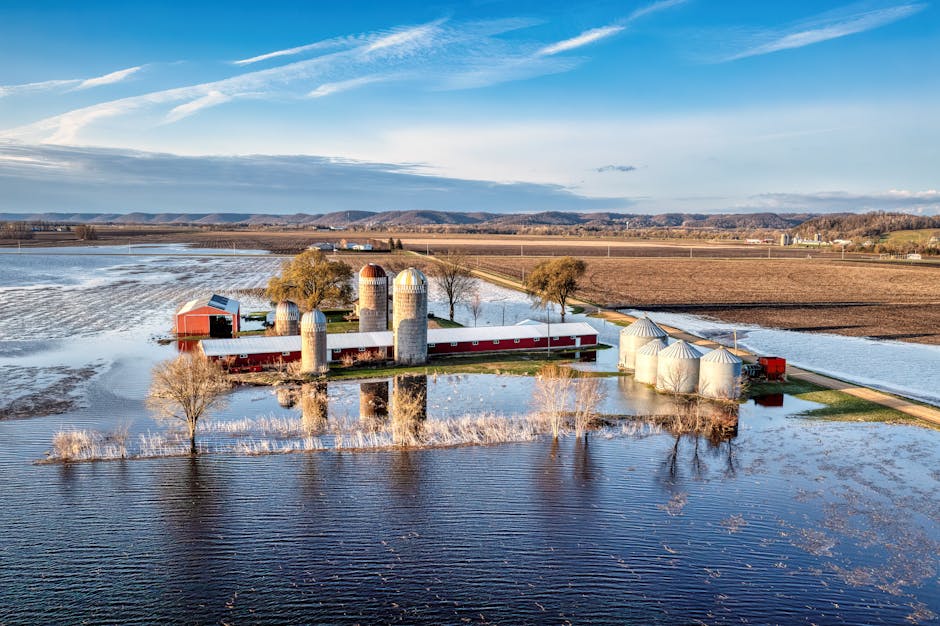
- Over 25,000 acres of farmland have been lost to saltwater intrusion in the Mid-Atlantic coast since the 1980s, threatening local livelihoods and ecosystems.
- Saltwater intrusion is consuming coastal cropland at twice the rate of adjacent forests, with devastating consequences for agriculture and wildlife.
- Farmers are struggling to adapt to the changing environment, with traditional methods proving ineffective against the rising tide of saltwater.
- The loss of farmland not only impacts local economies but also erodes the cultural heritage of farming communities along the eastern shore.
- Scientists warn that the environmental changes unfolding in the Mid-Atlantic coast are a harbinger of a broader, global crisis of soil degradation and salinization.
On Maryland’s eastern shore, where the horizon blurs between field and sky, farmer Alvin Daley walks what used to be his soybean rows. Now, the soil glistens white with salt, cracked and barren under the sun. Patches of cordgrass—Spartina alterniflora—creep in from the ditches, a telltale sign of invasion from the Chesapeake Bay. Just a decade ago, this land produced reliable yields. Today, it’s part of a growing wasteland, one that scientists say is expanding silently but swiftly across the Mid-Atlantic coast. This is not a sudden disaster but a slow suffocation: saltwater seeping through ditches, rising groundwater, and storm surges that linger too long. Farmers build levees, dig deeper ditches, and rotate crops, but the tide, quite literally, cannot be turned. What’s unfolding here is not just environmental change—it’s the erosion of livelihoods, culture, and a way of life rooted in soil that can no longer sustain growth.
Farmland Vanishes at Double the Forest Rate

A 2023 study published in Nature Communications reveals that saltwater intrusion is consuming coastal cropland at twice the rate of adjacent forests. Analyzing 35 years of satellite data across Delaware, Maryland, and Virginia, researchers found that over 25,000 acres of agricultural land have been lost to salinization since the 1980s. Unlike forests, which can tolerate moderate salt exposure due to deep root systems and woody resilience, annual crops like corn, soy, and wheat have little defense. Even low concentrations of salt disrupt nutrient uptake, stunt growth, and ultimately render soil infertile. The study also found that while forests migrate inland as sea levels rise, farmland often does not—held in place by property lines, infrastructure, and economic dependence on specific plots. This creates a paradox: the most intensively managed landscapes are the least adaptable to climate pressures.
The Slow Creep of Saltwater Intrusion

The crisis stems from a confluence of factors: rising sea levels, land subsidence, and increased frequency of coastal flooding. The Mid-Atlantic region is sinking at a rate of about 1.5 to 4 millimeters per year due to glacial isostatic adjustment—a geological rebound from the last ice age—while sea levels have risen nearly a foot since 1900. This double whammy intensifies saltwater’s reach. During high tides and storms, saline water flows through aging drainage ditches originally built to dry farmland, now serving as conduits for invasion. Groundwater tables, pushed upward by rising seas, bring salt into root zones even without surface flooding. What was once a seasonal issue has become persistent. Researchers used remote sensing to detect the spectral signature of salt-affected soils and combined it with land-use records, revealing that cropland conversion to ‘ghost forests’—dead or dying stands of trees—and salt marshes is accelerating, especially on low-lying peat soils that dominate the Delmarva Peninsula.
Farmers on the Front Lines

For farmers like Daley, adaptation is a daily improvisation. Some have tried planting salt-tolerant crops such as quinoa or barley, but markets are limited and yields uncertain. Others install water control structures to block tidal inflow, but maintenance is costly and often outpaced by environmental change. There’s also a psychological toll. ‘You spend your life building soil health,’ Daley said in an interview with Science Magazine, ‘and then one bad year, and it’s gone.’ Agricultural extension agents and researchers at the University of Maryland and Virginia Tech are working with farmers to test new strategies, including strategic retreat, managed wetland conversion, and crop diversification. But many smallholders lack the resources to pivot. The federal government offers some cost-share programs through the USDA’s Environmental Quality Incentives Program, but enrollment is low, and assistance often arrives too late.
Consequences for Food and Communities

The loss of farmland has ripple effects beyond individual farms. The Delmarva Peninsula produces a significant portion of the region’s poultry feed and contributes to national grain supplies. As productive acreage shrinks, farmers may intensify use of remaining land, risking further degradation. Rural economies dependent on agriculture face declining property values and tax bases. Meanwhile, the conversion of cropland to wetlands, while ecologically beneficial in some respects, is unplanned and often results in fragmented, low-functioning ecosystems. Insurance models and land-use planning have not caught up with this new reality. Without coordinated policy, experts warn of a wave of abandoned farms, increased food vulnerability, and inequitable burdens on low-income and minority farming communities who have fewer options to relocate or adapt.
The Bigger Picture
This phenomenon is not confined to the Mid-Atlantic. Coastal agriculture from Louisiana to Bangladesh faces similar threats, but the U.S. case offers a stark lesson in the limits of technological fixes in the face of systemic change. It underscores a broader truth: climate adaptation cannot rely solely on engineering solutions when the underlying conditions—rising seas, sinking lands, salt-laden aquifers—are beyond local control. The crisis also highlights the vulnerability of annual cropping systems in an era of accelerating environmental change, suggesting a need to rethink agricultural resilience through perennial crops, agroforestry, and landscape-scale planning that respects ecological thresholds.
What comes next may be a redefinition of what farmland is—and what it can be. In some areas, the future may lie not in fighting the water but in working with it, transitioning to aquaculture, managed wetlands, or hybrid systems that blend food production with ecosystem services. But such shifts require vision, investment, and recognition that some lands have reached their limit. As salt continues to rise, the question is no longer if we must adapt, but how equitably and wisely we do so.
Source: Nature