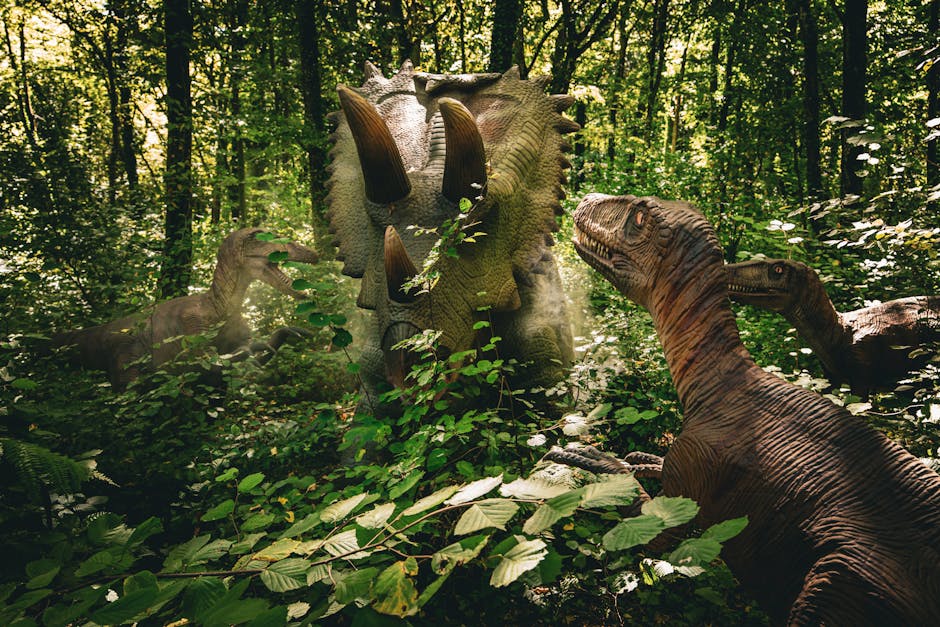
- New fossil discoveries show that many dinosaur species lived in tightly knit herds, challenging the common misconception of dinosaurs as solitary animals.
- Evidence suggests that some dinosaurs cared for their offspring for extended periods and engaged in ritualized combat, similar to modern deer or antelope.
- Dinosaur societies were likely far more nuanced than previously believed, with species building complex nests, monitoring their eggs, and possibly communicating with one another.
- A cascade of discoveries across continents, including a mass burial site in Montana and trackways in China and Colorado, has rewritten our understanding of dinosaur behavior.
- Dinosaurs’ social complexity is thought to have evolved over 150 million years, with species developing unique social structures and behaviors.
For decades, dinosaurs were portrayed as slow, dim-witted reptiles locked in a constant battle for survival—lumbering beasts driven by instinct rather than intelligence. But a wave of fossil discoveries over the past ten years has shattered that image. Evidence now shows that many dinosaur species lived in tightly knit herds, cared for their offspring for extended periods, and even engaged in ritualized combat akin to modern deer or antelope. Some species built complex nests, monitored their eggs, and may have communicated with one another using visual or vocal signals. These findings, unearthed across continents from Mongolia to Argentina, suggest that dinosaur societies were far more nuanced than previously believed—rewriting the narrative of how these ancient animals lived, interacted, and evolved over 150 million years.
The Social Lives of Dinosaurs

What changed our understanding wasn’t just one fossil, but a cascade of discoveries pointing to social complexity. In 2017, researchers in Montana uncovered a mass burial site of Einiosaurus—a horned dinosaur—containing individuals of all ages, from juveniles to adults, tightly grouped together. This pattern mirrors modern herd animals like elephants or buffalo, suggesting long-term social bonds. Further evidence comes from trackways in China and Colorado, where hundreds of hadrosaur footprints align in parallel, indicating coordinated group movement. Such behavior implies communication, hierarchy, and possibly even collective decision-making. According to Dr. Dave Hone, a paleontologist at Queen Mary University of London, “These weren’t random aggregations. The consistency in spacing and direction tells us these animals were moving with purpose—as a unit.” Such findings challenge the long-held notion that complex social behavior evolved only in mammals and birds.
Parenting and Nesting Strategies

Perhaps even more surprising is the evidence of parental care. Fossilized nests of Maiasaura, discovered in the Two Medicine Formation, show hatchlings with underdeveloped leg bones—meaning they couldn’t have wandered far from the nest. Yet, their stomach contents reveal they were fed regurgitated food, a behavior seen in modern birds. This indicates that at least some dinosaurs provided extended care, possibly for months. In Mongolia, a Protoceratops nest was found with an adult positioned protectively over the young—frozen in time by a collapsing sand dune. Even more striking, Oviraptor fossils have been unearthed in brooding positions atop clutches of eggs, their arms spread like modern birds. These behaviors, once considered uniquely avian, now appear deeply rooted in dinosaur evolution. As detailed in a 2020 study published in Nature, such parental investment suggests higher cognitive function and emotional complexity than reptiles typically exhibit.
Combat and Courtship Rituals

Dinosaurs didn’t just nurture—they also fought, and not always to the death. Many theropods and ceratopsians show signs of cranial injuries, but crucially, these wounds are often healed, indicating survival after combat. This points to ritualized, non-lethal battles—likely for dominance or mating rights—rather than predatory attacks. Triceratops skulls, for example, frequently bear puncture marks from rival horns, but with no signs of fatal trauma. Similarly, Tyrannosaurus rex specimens display facial bite marks, possibly from intra-species sparring. Dr. Hone notes that such behavior “isn’t about killing—it’s about display, endurance, and reputation.” These contests resemble those of modern elk or rams, where strength and stamina are on display. The presence of elaborate crests, frills, and feathers across many species further supports the idea that visual signaling played a central role in social interaction, possibly during courtship or territorial disputes.
Implications for Evolution and Intelligence

The growing body of evidence suggests that the evolutionary path to intelligence and social complexity began long before mammals dominated the Earth. Dinosaurs, particularly theropods closely related to birds, may have possessed neural structures capable of learning, memory, and emotional responses. CT scans of fossilized braincases reveal enlarged optic lobes and cerebellums, associated with coordination and sensory processing. While we can’t measure IQ in extinct species, the behavioral patterns imply a level of awareness previously unattributed to non-avian dinosaurs. These insights also reshape how we view the Cretaceous world—not as a brutish landscape of solitary predators and prey, but as an ecosystem teeming with social networks, family units, and behavioral traditions passed across generations.
Expert Perspectives
While most paleontologists agree that dinosaur behavior was more complex than once thought, some urge caution in drawing parallels to modern animals. Dr. Sarah Werning of Des Moines University warns against “over-anthropomorphizing” fossil evidence, noting that “we can infer behavior from bones, but we can’t observe it directly.” Others, like Dr. Hone, argue that the consistency across multiple lines of evidence—nests, trackways, healed injuries—makes the case robust. “We’re not guessing,” he says. “We’re seeing patterns that only social, intelligent animals produce.” The debate continues, but the consensus is shifting: dinosaurs were not evolutionary dead-ends, but sophisticated animals in their own right.
As new technologies like high-resolution CT scanning and isotopic analysis become more accessible, researchers are poised to unlock even deeper secrets of dinosaur life. Upcoming excavations in Patagonia and the Gobi Desert may reveal more nesting colonies or migration patterns. The real question now isn’t whether dinosaurs were complex—it’s just how complex they truly were. And as our understanding evolves, so too does our appreciation for the rich tapestry of life that existed long before humans walked the Earth.
Source: New Scientist