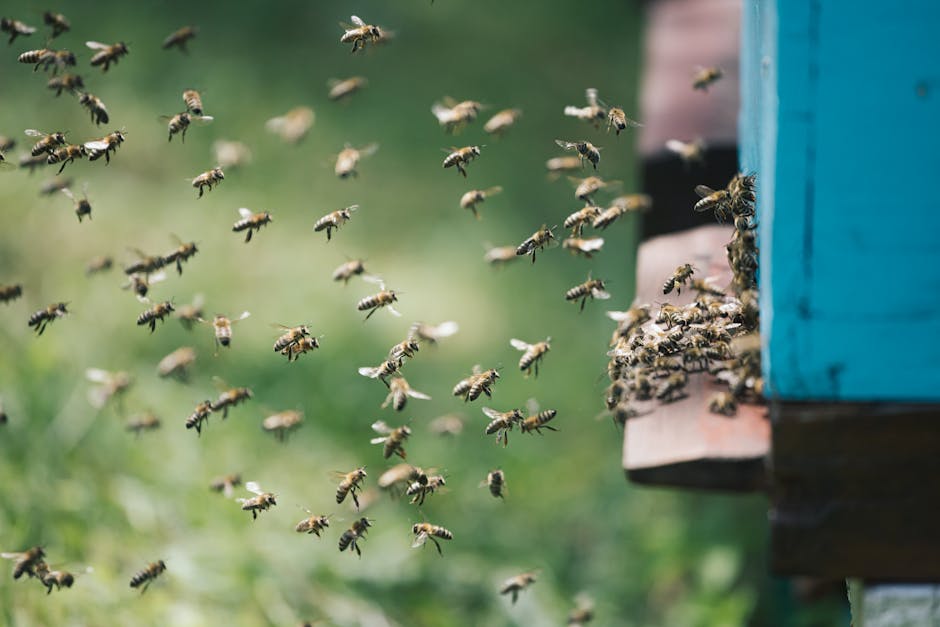
- A bee-inspired robot uses a simplified machine-learning algorithm to find its way home without GPS or maps.
- The robot’s navigation system is modeled on the central complex of the honeybee brain.
- The system allows the robot to memorize visual features of its home location and calculate a homing vector.
- The lightweight robot uses only a camera and compact processor for navigation.
- Nature’s smallest navigators, like honeybees, may hold the key to smarter, lighter, and more energy-efficient autonomous systems.
How can a robot find its way home using only what it sees—without GPS, maps, or satellite signals? This is the challenge researchers have long faced in robotics and autonomous navigation. Now, a breakthrough inspired by one of nature’s most efficient navigators—the honeybee—has yielded a surprising answer. A team of neuroscientists and roboticists has developed a small flying robot that uses a simplified machine-learning algorithm modeled on the insect’s brain to visually recognize and return to its home location, just like a bee returning to its hive after foraging. Could nature’s smallest navigators hold the key to smarter, lighter, and more energy-efficient autonomous systems?
What Makes This Robot Act Like a Bee?

The robot’s navigation system is powered by a neural network modeled on the central complex of the honeybee brain—a region responsible for processing visual cues and directional information. Unlike traditional drones that rely on GPS and heavy sensor arrays, this robot uses only a lightweight camera and a compact processor running a bio-inspired algorithm. The system, described in a recent Nature study, allows the robot to memorize visual features of its home location, such as patterns of light and shadow, contrast edges, and spatial layout. When displaced, it compares its current view with its stored memory and calculates a homing vector—essentially asking, “Does this look like home?” and adjusting its flight path accordingly. This approach mirrors how bees use “snapshot memory,” a well-documented behavior in which insects store visual images of their surroundings to retrace their steps.
What Evidence Shows It Actually Works?

In controlled experiments, the robot successfully returned to its starting point from distances up to 50 meters away across varying terrain, including grassy fields and urban-like environments with obstacles. The team trained the neural network using simulated bee vision data, then fine-tuned it with real-world footage captured by the robot’s onboard camera. According to the Nature paper, the algorithm achieved over 90% success rate in homing accuracy, even when lighting conditions changed or objects partially obscured the nest site. Dr. Lena Moreau, lead author from the Institute of Biomimetic Robotics, explained: “We’re not copying the bee brain neuron-for-neuron, but distilling its principles into something a machine can use.” The system operates with minimal computational power—just 1.2 watts—making it ideal for small drones where battery life and weight are critical constraints.
Are There Limits to This Bee-Like Navigation?

Despite its promise, the system has limitations. Critics point out that bee-inspired navigation works best in static environments; if the landscape changes dramatically—such as a tree falling or a new building erected—the robot may fail to recognize home. “It’s robust within familiar settings, but lacks the flexibility of higher-order path planning seen in mammals or advanced AI drones,” says Dr. Rajiv Patel, a robotics expert at MIT not involved in the study. Additionally, the current version cannot build maps or handle complex multi-step routes, only point-to-point homing. Some researchers also question how well the model scales to larger or more dynamic environments, like dense cities or forests with shifting canopies. Still, the authors argue that this isn’t meant to replace GPS or SLAM (simultaneous localization and mapping) systems, but to complement them in situations where signals are weak or energy is scarce.
What Real-World Applications Could This Enable?

This technology could transform search-and-rescue drones, agricultural robots, and even space exploration probes. For instance, miniature drones equipped with bee-like navigation could enter collapsed buildings after earthquakes and return to base without relying on GPS, which often fails indoors. In agriculture, swarms of small pollinator-sized robots could monitor crops and return to charging stations autonomously. NASA has shown interest in bio-inspired navigation for future Mars missions, where dust storms and terrain shifts challenge conventional systems. The lightweight design and low power needs make it especially suitable for micro-drones that must operate for extended periods. As one engineer noted, “We’re moving from drones that think like computers to ones that perceive like animals.”
What This Means For You
While this robot won’t be in your backyard anytime soon, the principles behind it are paving the way for smarter, more resilient machines that can operate in environments where technology currently fails. As robotics moves toward smaller, more efficient systems, nature continues to offer elegant solutions. This bio-inspired approach could lead to drones that assist in emergencies, monitor ecosystems, or even support sustainable farming—all while using a fraction of the energy of today’s models. The fusion of neuroscience and engineering is not just advancing robots; it’s redefining what autonomy means.
As researchers refine these systems, a deeper question emerges: if machines can navigate like insects, what other natural behaviors—swarming, learning, adapting—can we harness to build better technology? And as we draw inspiration from the smallest minds in nature, how much intelligence do we risk underestimating in the creatures we emulate?
Source: Nature