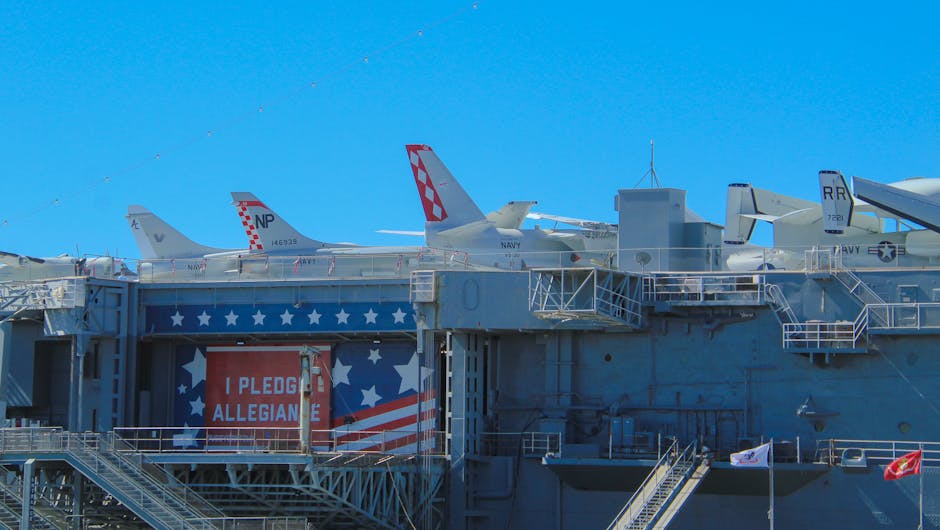
- The USS Gerald R. Ford’s 11-month deployment marked the longest carrier deployment since the Vietnam War, highlighting the US Navy’s reach and resilience.
- The Ford’s operational range and versatility were showcased through its involvement in multiple conflicts, including the Iran conflict and a covert operation in Venezuela.
- The Ford’s air wing conducted over 10,000 sorties during the deployment, demonstrating the carrier’s ability to provide sustained air support.
- The deployment has sparked debate over the strategic value of US naval power and the potential strains on an overstretched fleet.
- The Ford’s success has raised questions about the future of modern carrier operations and their potential impact on global military strategy.
How does a single aircraft carrier reshape global military strategy across two hemispheres? The return of the USS Gerald R. Ford to Norfolk Naval Station after an 11-month continuous deployment has reignited debate over the reach, resilience, and strategic value of U.S. naval power. This marathon mission—the longest carrier deployment since the Vietnam War—spanned violent confrontations in the Persian Gulf, precision strikes during the Iran conflict, and an audacious but covert operation targeting Nicolás Maduro’s inner circle in Venezuela. As the Ford and its strike group are honored with the Presidential Unit Citation, the military and policymakers are asking: has this deployment redefined what’s possible for modern carrier operations, or exposed dangerous strains in an overstretched fleet?
\n\n
The Scope and Significance of the Ford’s Deployment

\n
The USS Gerald R. Ford (CVN-78), the U.S. Navy’s most advanced nuclear-powered aircraft carrier, completed an 11-month overseas mission without returning to home port—a feat not seen since the USS Enterprise’s 1972–1973 deployment during the Vietnam War. Operating primarily in the U.S. 5th Fleet area, which includes the Persian Gulf, Red Sea, and parts of the Indian Ocean, the Ford led Carrier Strike Group 12 in over 10,000 sorties, including air support during the 2024 Iran conflict following attacks on U.S. facilities in Iraq and Jordan. According to the Department of Defense, the Ford’s air wing conducted more than 2,300 combat missions, providing close air support, reconnaissance, and strategic deterrence. The deployment was extended twice due to escalating tensions, marking a shift from the Navy’s typical six- to eight-month rotation cycles.
\n\n
Evidence of Strategic Impact and Operational Excellence

\n
The Presidential Unit Citation, awarded collectively to the Ford and its accompanying vessels, recognizes “extraordinary heroism in action against an armed enemy.” In a statement, Secretary of the Navy Carlos Del Toro called the mission “a testament to the endurance, training, and technological superiority of the American naval force.” The carrier’s Electromagnetic Aircraft Launch System (EMALS) and Advanced Arresting Gear (AAG) achieved 98% operational availability, a critical benchmark given early technical issues during the ship’s commissioning. According to Reuters reporting from April 2024, F-35C Lightning II squadrons from the Ford destroyed key Iranian missile defense sites in Khuzestan Province, disrupting retaliatory capabilities. Additionally, the carrier served as command hub during Operation Southern Shield, a joint effort with U.S. Southern Command that supported a clandestine raid on a narcotics-financed paramilitary compound linked to Maduro’s regime in Venezuela.
\n\n
Counter-Perspectives: Fatigue, Risk, and Strategic Overreach

\n
Despite the accolades, some defense analysts warn that such extended deployments risk long-term fleet sustainability. Admiral (ret.) James Stavridis, former Supreme Allied Commander of NATO, told BBC News that “pushing a carrier beyond 10 months at sea sets a dangerous precedent. Crew fatigue, maintenance deferrals, and supply chain strain can undermine combat readiness.” A 2023 Government Accountability Office report noted that prolonged deployments increase wear on propulsion, radar, and launch systems, particularly on new platforms like the Ford. Moreover, critics argue that concentrating so much power in one vessel creates a high-value target; Iran’s development of long-range anti-ship missiles and drone swarms raises concerns about vulnerability. There are also ethical questions about the Maduro-linked raid, which lacked UN authorization and drew condemnation from several Latin American governments as a violation of sovereignty.
\n\n
Real-World Impact: Deterrence, Alliances, and Naval Doctrine

\n
The Ford’s deployment has already influenced U.S. military planning. NATO allies, particularly in Eastern Europe and the Gulf, have requested more persistent carrier presence as a deterrent against Russian and Iranian aggression. The success of the F-35C in contested environments has accelerated plans to equip all carrier air wings with stealth fighters by 2030. Domestically, the mission has bolstered support for the Navy’s 313-ship goal, with Congress approving additional funding for carrier maintenance and crew mental health programs. For sailors, the deployment’s length sparked renewed debate over work-life balance; the Navy has since announced pilot programs to rotate air wings mid-deployment using forward bases in Greece and Guam. Meanwhile, Iran has responded with increased naval exercises in the Strait of Hormuz, signaling ongoing regional volatility.
\n\n
What This Means For You
\n
For the American public, the Ford’s mission underscores how naval power directly affects global stability and national security. Long deployments mean more pressure on service members and higher operational costs, but also stronger deterrence against adversaries. As geopolitical tensions rise, the ability to sustain forward-deployed forces may define U.S. influence in critical regions. Taxpayers and voters should consider the balance between military readiness and sustainable force management in defense policy debates.
\n
Yet, unanswered questions remain: Will future conflicts demand even longer deployments, and can the Navy maintain this pace without compromising safety or morale? As new threats emerge—from drone warfare to hybrid naval tactics—how will the U.S. adapt its carrier strategy to remain dominant at sea?
Source: Fortune