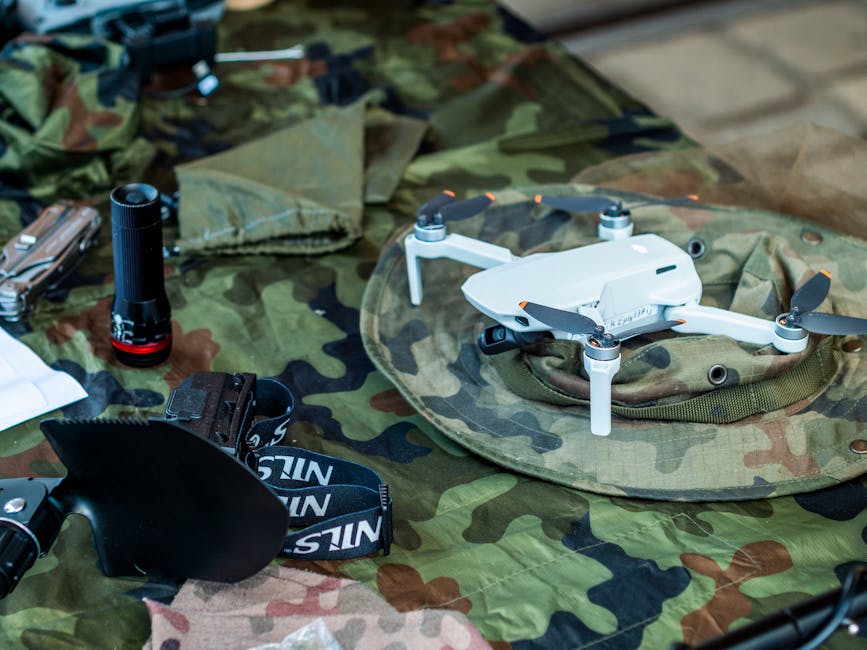
- Hezbollah has launched over 40 drone attacks in 3 weeks, shifting tactics from traditional rocket barrages to precision-guided drones.
- Fiber-optic guided drones allow real-time visual control and resist electronic jamming, posing a significant threat to Israel’s air defense networks.
- Hezbollah’s drones often fly at low altitudes, avoiding radar detection, and are launched from densely forested or urban areas in southern Lebanon.
- The precision payloads delivered by these drones signal a new phase in asymmetric warfare, raising questions about deterrence and defense capabilities.
- The surge in drone attacks raises the risk of wider conflict in the Middle East, particularly in the context of ongoing conflict in Gaza.
What does the surge in Hezbollah’s drone attacks mean for the stability of the Middle East? As Israel faces ongoing conflict in Gaza, a parallel escalation is unfolding along its northern border with Lebanon. Over the past three weeks, the Lebanese armed group Hezbollah has launched dozens of drone strikes into northern Israel, many guided by advanced fiber-optic technology. Verified footage analyzed by BBC Verify reveals a calculated shift in tactics—smaller, harder-to-detect drones delivering precision payloads. These attacks, while not yet causing mass casualties, signal a new phase in asymmetric warfare and raise urgent questions about deterrence, defense capabilities, and the risk of wider conflict.
How Is Hezbollah Using Drones Differently Now?

Hezbollah is no longer relying solely on traditional rocket barrages; it is deploying fiber-optic guided drones that allow real-time visual control over long distances. Unlike GPS-dependent systems, these drones transmit video through a thin fiber-optic wire unspooled during flight, making them immune to electronic jamming—a significant advantage against Israel’s sophisticated air defense networks. BBC Verify has authenticated over 40 such attacks since mid-September, most targeting military outposts and surveillance infrastructure in northern Israel. These drones, often launched from densely forested or urban areas in southern Lebanon, fly at low altitudes to avoid radar detection. Their warheads, though smaller than conventional missiles, are capable of penetrating armored vehicles and fortified positions, suggesting a focus on precision over volume.
What Evidence Supports This Tactical Shift?

Video evidence, geolocation analysis, and technical assessments confirm the growing sophistication of Hezbollah’s drone arsenal. In one verified attack on an Israeli Merkava tank near Metula, a fiber-optic drone struck the vehicle’s top armor—consistent with a guided munition exploiting a known vulnerability. BBC Verify’s forensic review matched timestamps, terrain features, and weapon characteristics to confirm the incident. Further analysis by conflict monitors indicates that many drones originate from Hezbollah’s elite Radwan Force, trained specifically for cross-border operations. U.S. defense officials, speaking anonymously to Reuters, acknowledge these tactics represent a “measurable escalation” in capability, likely supported by Iranian technical assistance. Satellite imagery also shows increased activity at known Hezbollah storage and launch sites near the Litani River.
Are These Attacks as Threatening as They Seem?

While the drone attacks are technically impressive, some military analysts caution against overstating their strategic impact. Dr. Amal Saad, a Lebanese security expert at Lebanese American University, argues that “these are tactical probes, not war-winning weapons—at least not yet.” She notes that most strikes have caused limited damage and no mass casualties, serving more as psychological pressure than battlefield disruption. Others point out that Israel’s Iron Dome and David’s Sling systems remain largely effective against larger, faster threats. Additionally, Hezbollah may be constrained by supply chains and operational security; sustained drone campaigns require significant logistical support, which could expose launch teams to retaliation. Skeptics also question whether these drones can scale effectively or if they represent a limited, high-risk tactic vulnerable to countermeasures like signal interception or physical disruption of launch zones.
What Are the Real-World Consequences of These Attacks?

The immediate impact is being felt by civilians and soldiers in northern Israel, where towns like Kiryat Shmona and communities near the border have faced repeated evacuations. Israeli defense forces have shifted to a posture of constant alert, deploying additional radar units and drone-jamming systems along the frontier. In late September, a drone strike near a military intelligence base in Manara injured three soldiers, prompting retaliatory airstrikes on Hezbollah positions in southern Lebanon. The cycle of attack and response has displaced over 60,000 people on both sides of the border, according to UN estimates. Beyond the human toll, these incidents risk triggering a broader war: Israel has warned that any attack on its critical infrastructure could prompt a large-scale invasion of southern Lebanon, a scenario that would dwarf the 2006 Lebanon War in scale and destruction.
What This Means For You
If you’re tracking global security trends, the Hezbollah-Israel drone conflict is a real-time case study in how non-state actors are closing the technological gap with conventional militaries. These fiber-optic drones represent a shift toward stealthier, more resilient weapons that can bypass traditional defenses. For civilians in conflict zones, this means threats are becoming harder to predict and defend against. On a geopolitical level, the escalation underscores how regional powers like Iran can project influence through proxy forces using increasingly accessible technology. As drone warfare evolves, so too must defense strategies and diplomatic efforts to prevent miscalculation.
Yet one question remains unresolved: Can deterrence hold when both sides are testing new capabilities in real time? With Hezbollah demonstrating advanced precision strikes and Israel responding with overwhelming force, the margin for error is shrinking. Are we witnessing the normalization of low-intensity drone warfare, or is this the prelude to a much larger confrontation? The answer may depend not on technology, but on the decisions of leaders under pressure.
Source: BBC