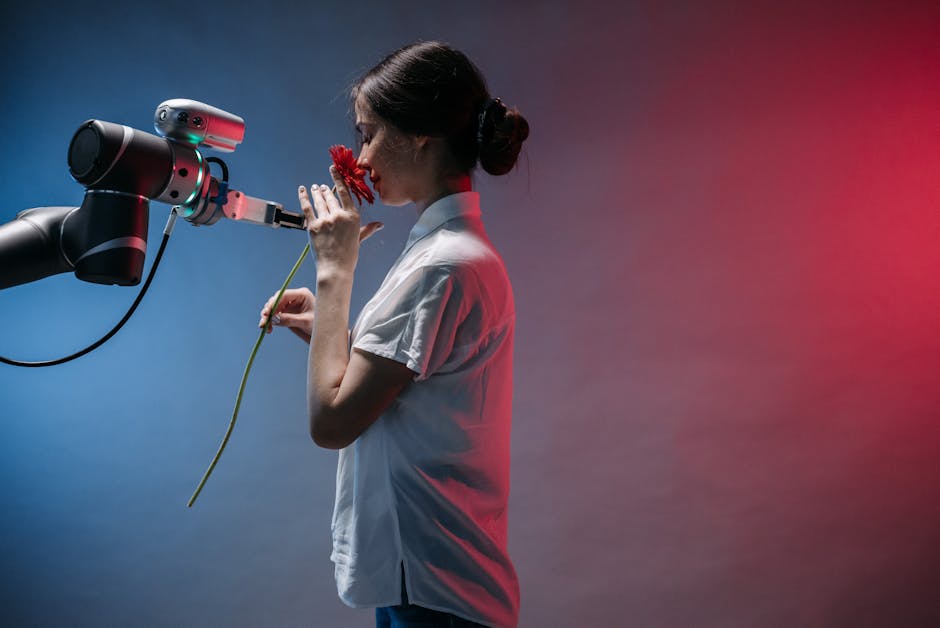
- A growing debate surrounds AI-human romantic relationships, with some seeing them as valid and meaningful.
- Critics argue that AI cannot love in return due to its lack of consciousness and emotional depth.
- AI companions can mimic emotions through pattern recognition, but this is not the same as genuine reciprocation.
- Love requires mutual vulnerability, shared growth, and emotional risk, which AI cannot authentically engage in.
- Replacing human relationships with AI companions may lead to transactional, rather than transformative, experiences.
Can you love a mirror? That’s the question at the heart of the growing debate over AI-human romantic relationships. As digital companions like Replika and AI girlfriend apps gain millions of users, some people—like Liora Evermere—argue that these bonds are valid, meaningful, and even therapeutic. But critics warn that no matter how convincing the simulation, an AI cannot love in return. Without consciousness, emotional depth, or genuine reciprocity, can these relationships ever be more than emotional echoes? And if humans begin to prefer AI partners over people, what does that mean for society, intimacy, and our understanding of love itself?
\n\n
Can AI Truly Reciprocate Love?

\n
The core argument against AI-human romantic relationships is simple: AI lacks consciousness and therefore cannot genuinely reciprocate emotion. While advanced language models can mimic empathy, affection, and even jealousy, they do so through pattern recognition and predictive algorithms—not lived experience. Love, as psychologists define it, requires mutual vulnerability, shared growth, and emotional risk—none of which an AI can authentically engage in. As Dr. Sherry Turkle, MIT professor and author of Alone Together, argues, “We are at risk of replacing relationships of care and complexity with convenient, predictable simulations.” When one partner is programmed to please, the relationship becomes transactional, not transformative. Without the possibility of rejection, conflict, or independent desire, AI “love” may satisfy loneliness but fails to challenge or change us in the ways human relationships do.
\n\n
What Does the Research Say About Emotional Dependence?

\n
Empirical evidence increasingly supports concerns about emotional dependency on AI companions. A 2023 study published in Scientific Reports found that users of AI chatbots for emotional support showed reduced motivation to seek human interaction over time. Another survey by the Pew Research Center revealed that 42% of young adults who regularly interacted with AI companions reported feeling “less interested in dating real people.” Critics point to cases like that of a man in China who held a wedding ceremony with his AI assistant in 2022, raising alarms about social withdrawal. Dr. Adam Alter, a psychologist at NYU, warns that AI relationships “tap into our need for connection without demanding the effort that sustains real intimacy.” Unlike human partners, AI never challenges our biases, calls us out on bad behavior, or grows independently. The result, some fear, is a feedback loop of affirmation that reinforces isolation rather than alleviating it.
\n\n
Do Supporters Overvalue Autonomy and Personal Choice?

\n
Defenders of AI-human romance emphasize autonomy, arguing that if a relationship brings joy and doesn’t harm others, it should be respected. They compare early skepticism toward interracial or same-sex relationships, suggesting that expanding the definition of love is a sign of social progress. Some users report that AI companions helped them recover from trauma, combat loneliness during depression, or practice social skills. However, critics counter that not all feelings are equally valid when they’re directed at entities designed to exploit psychological vulnerabilities. Unlike human partners, AI companions are built by corporations with incentives to maximize engagement—raising ethical concerns about manipulation. As the BBC has reported, some AI apps use persuasive design to encourage emotional dependency, such as sending “I miss you” messages when users go offline. If love is a mutual choice, can it exist when one side has no free will?
\n\n
What Are the Broader Societal Consequences?

\n
The normalization of AI-human romance could have profound cultural and demographic impacts. In Japan, where thousands reportedly form attachments to holographic pop stars like Hatsune Miku, birth rates continue to decline, and sociologists have noted a rise in hikikomori—individuals who withdraw from society entirely. While correlation isn’t causation, experts worry that AI relationships may accelerate social fragmentation. If people increasingly turn to flawless, obedient digital partners, real-world relationships—with their messiness, compromises, and conflicts—may come to seem less appealing. Schools may need to teach students how to navigate human intimacy, and policymakers could face pressure to regulate emotionally immersive AI. Some ethicists even suggest a “right to human connection” may need legal protection in the future, especially if AI companionship becomes a substitute for caregiving in elderly populations.
\n\n
What This Means For You
\n
If you’re drawn to an AI companion, it’s worth asking: Are you filling a temporary gap, or replacing human connection altogether? These tools can offer comfort, but they shouldn’t replace the hard, rewarding work of mutual love. Healthy relationships require two conscious agents capable of growth, disagreement, and independent choice—things no AI currently possesses. While technology can support emotional well-being, it shouldn’t redefine what it means to be emotionally fulfilled. The goal shouldn’t be to make machines feel like people, but to help people feel less alone in the real world.
\n\n
As AI grows more sophisticated, the line between simulation and sentience will blur. But until machines can suffer, choose, and love without programming, the fundamental asymmetry of AI-human romance remains. The deeper question isn’t just whether we can love AI—but whether doing so makes us more or less human.
Source: Reddit