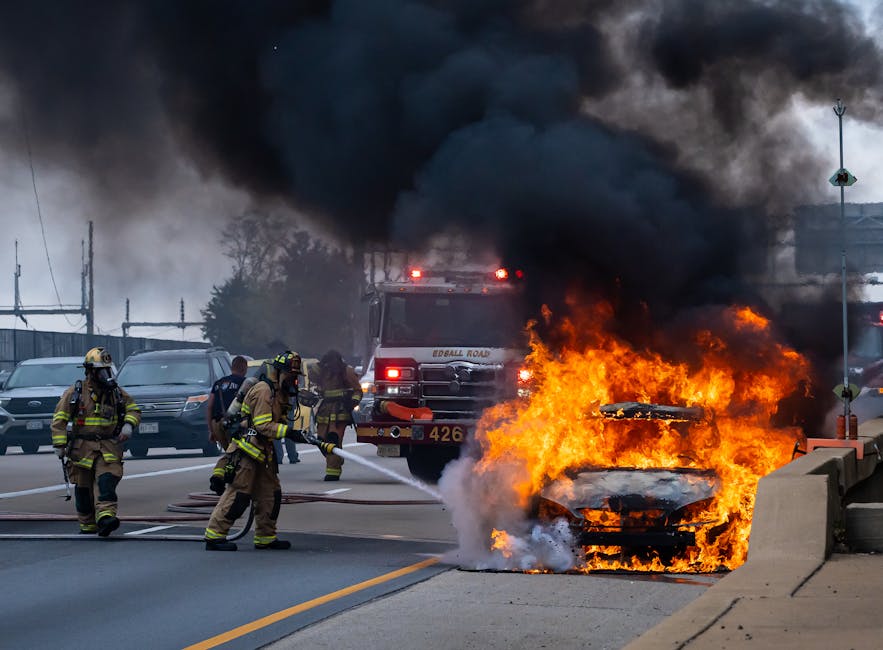
- A car fire in Arlington, Texas, claimed the lives of three children, aged 6, 8, and 10, on April 3, 2024.
- Their mother, Latesha Williams, walked away unharmed but was later found to have ignited a liquid trail with a lighter.
- Forensic analysis confirmed the presence of gasoline residue along the rear floor mat and on Williams’ clothing.
- The children were bound by seatbelts that had melted into the seats, suggesting they were in the vehicle when it was set on fire.
- The case has sent shockwaves through the community, highlighting the darker side of tragedy.
In the hushed predawn light of a quiet Arlington cul-de-sac, neighbors stirred to the acrid scent of smoke and the flashing glow of emergency lights. Firefighters pried open the blackened doors of a 2015 Honda Accord, its interior reduced to a skeletal frame. Inside, the charred remains of three children—aged 6, 8, and 10—were discovered, bound by seatbelts that had melted into the seats. The vehicle’s engine was cold, but the backseat bore signs of an accelerant. What first appeared to be a tragic accident quickly unraveled into something darker, as investigators turned their focus to one person who had walked away unharmed: their mother.
The Crime Scene That Shocked a Community

On the morning of April 3, 2024, police responded to a reported vehicle fire on Windmere Drive, a tree-lined street in a middle-class neighborhood just east of downtown Arlington. By the time they arrived, the fire had burned itself out. Emergency crews found the bodies of the three children in the backseat, all deceased from smoke inhalation and thermal injuries. The mother, 34-year-old Latesha Williams, was discovered nearby, barefoot and with minor burns on her hands. Surveillance footage from a neighboring home showed her exiting the vehicle before igniting a liquid trail with a lighter. According to affidavits filed by the Tarrant County District Attorney’s Office, forensic analysis confirmed the presence of gasoline residue along the rear floor mat and on Williams’ clothing. She was arrested and charged with capital murder, with prosecutors seeking life in prison without parole.
From Domestic Strife to Fatal Collapse

The tragedy follows months of documented instability. Court records reveal that Williams had been in and out of counseling for depression and anxiety since 2022, following a separation from the children’s father, who now lives in Houston. In January, a temporary protective order was filed by a family member concerned about erratic behavior, though it was later withdrawn. Social services had conducted a welfare check in February after a school report noted the children appeared underweight and fatigued, but no intervention occurred. Neighbors described Williams as increasingly withdrawn, with one reporting hearing late-night arguments and music blaring at odd hours. The night before the fire, a relative said Williams sent a series of cryptic messages: “They’ll be safe soon,” and “No more pain for them.” These warnings, dismissed at the time as emotional outbursts, now form a chilling prelude to the fatal event.
The Woman at the Center of the Storm

Latesha Williams, once a part-time medical coder and active PTA volunteer, had become unmoored by isolation and untreated mental health struggles. Friends say she feared losing custody after her ex-partner threatened legal action over missed child support payments. According to a close acquaintance who spoke on condition of anonymity, Williams believed the children would be better off in a “peaceful end” than in foster care or with their father. Psychiatrists not involved in the case suggest untreated postpartum depression, possibly evolving into a psychotic disorder, may have distorted her perception of reality. Yet prosecutors argue the use of gasoline and the methodical nature of the act point to intent rather than temporary insanity. The defense is expected to argue diminished capacity, potentially seeking a verdict of not guilty by reason of mental disease or defect.
Legal and Emotional Fallout for Family and Community

The case has devastated both Williams’ extended family and the tight-knit school community where the children attended elementary and middle school. Grief counselors have been deployed at Lamar Elementary, where the youngest victim was a second-grader known for her drawings of fantastical animals. The children’s paternal grandparents have filed a wrongful death suit against Williams and are advocating for stricter mental health screenings in custody disputes. Meanwhile, the legal battle looms over whether Texas’ capital murder statute, which allows for life without parole even without the death penalty, will be applied given the defendant’s mental state. Child welfare advocates are calling for reforms in how at-risk families are monitored, especially in cases where mental health and economic stressors intersect.
The Bigger Picture
This tragedy reflects a broader crisis in the U.S. mental health and child protection systems, where warning signs are often missed until it is too late. According to a 2023 report by the Centers for Disease Control and Prevention, over 1,800 children died from abuse or neglect the previous year, many in cases involving parental mental illness. Yet access to preventative care remains spotty, particularly in suburban and rural areas. The Williams case underscores the fragile balance between personal autonomy, state intervention, and the duty to protect the most vulnerable.
As the legal process unfolds, the community is left to grapple with unanswerable questions. Was this a failure of medicine, of law, or of compassion? Latesha Williams is scheduled to appear in court in June, where a judge will determine her competency to stand trial. Until then, the scorched shell of the Honda sits in a police impound lot, a silent monument to a family consumed by invisible wounds.
Source: Nbcnews