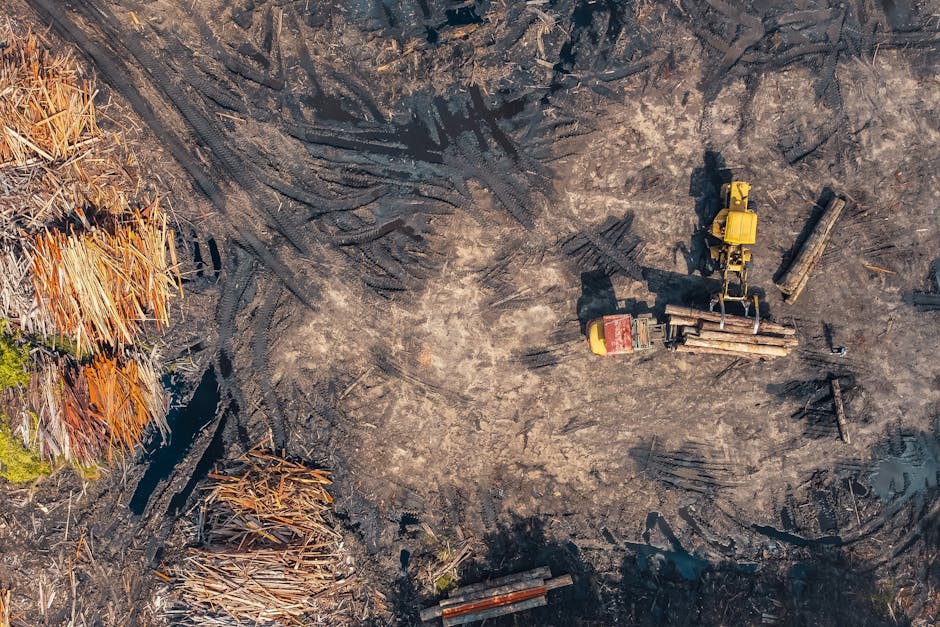
- The Amazon rainforest may reach a catastrophic tipping point by 2030 due to 15% deforestation and rising global temperatures.
- At least 15% of the Amazon has been cleared, primarily for agriculture and logging, with 20-25% loss initiating irreversible ecosystem collapse.
- Amazon deforestation could release billions of tons of stored carbon, accelerating global warming and disrupting rainfall patterns across South America.
- The Amazon acts as a massive carbon sink, absorbing 2 billion tons of CO₂ annually, but its degradation threatens food and water security for tens of millions.
- Current land-use trends may reach a 20-25% deforestation threshold by 2030, potentially triggering a self-reinforcing cycle of dieback.
Emerging climate science suggests the Amazon rainforest could reach a catastrophic tipping point as early as the 2030s, where widespread deforestation and rising global temperatures combine to trigger irreversible ecosystem collapse. At least 15% of the Amazon has already been cleared, primarily for agriculture and logging, and recent modeling indicates that losing just 20–25% of the forest could initiate a self-reinforcing cycle of dieback. This transformation—from lush, carbon-absorbing rainforest to dry, fire-prone savanna—would release billions of tons of stored carbon, accelerate global warming, and disrupt rainfall patterns across South America, threatening food and water security for tens of millions.
Deforestation and Climate Thresholds in the Amazon

Long considered a climate stabilizer, the Amazon acts as a massive carbon sink, absorbing approximately 2 billion tons of CO₂ annually—roughly 5% of global emissions. However, recent satellite data from Brazil’s National Institute for Space Research (INPE) shows that deforestation has already degraded 15% of the biome, with over 90,000 square kilometers lost in the past decade alone. A landmark 2022 study published in Nature Climate Change found that the tipping point could be triggered at just 20–25% deforestation, a threshold potentially reachable by 2030 under current land-use trends. Crucially, this dieback could occur even if global warming is limited to 1.5°C, underscoring the independent and amplifying role of forest loss. The study used 22 climate models to simulate feedback loops, including reduced evapotranspiration—a process by which trees recycle moisture into the atmosphere—leading to prolonged dry seasons and increased fire susceptibility.
Key Actors and Their Roles in Forest Preservation

The fate of the Amazon hinges on a complex interplay of national governments, Indigenous communities, agribusiness, and international climate initiatives. Brazil, home to 60% of the rainforest, plays the most pivotal role. Under President Luiz Inácio Lula da Silva, deforestation rates declined by nearly 50% between 2022 and 2023 after years of sharp increases under his predecessor. Lula has reactivated the Amazon Fund and strengthened environmental enforcement agencies like IBAMA. Meanwhile, Indigenous territories—covering about 23% of the Brazilian Amazon—have proven to be the most effective barriers against deforestation, with clearance rates up to 20 times lower than in unprotected areas. International actors, including Norway and Germany, have resumed funding to the Amazon Fund, while organizations like the UN Framework Convention on Climate Change are pushing for inclusion of forest protection in global carbon markets. Yet, powerful agribusiness lobbies in Brazil continue to resist land-use reforms, and illegal mining and logging persist in remote regions.
Trade-Offs Between Development and Ecological Stability

Preserving the Amazon requires navigating profound economic and political trade-offs. The region contributes significantly to Brazil’s agricultural output, producing nearly 70% of its beef exports and a growing share of soy, much of which is shipped to China and the European Union. Halting deforestation could constrain short-term economic growth in Amazonian states, where poverty and lack of infrastructure remain acute. However, the long-term costs of ecosystem collapse may far outweigh these gains. A 2021 report by the World Bank estimated that unchecked Amazon degradation could reduce regional GDP by up to 10% by 2050 due to lost agricultural productivity, increased health costs from air pollution, and disrupted hydroelectric power generation. Moreover, the global climate impact of a dying Amazon—potentially adding 0.25°C to global temperatures by 2100—would affect every nation. Conservation strategies such as payment for ecosystem services, sustainable agroforestry, and expanded protected areas offer pathways to balance development with resilience, but they require consistent funding and political will.
Why the Tipping Point Is Approaching Now

The convergence of multiple stressors—rising temperatures, prolonged droughts, and persistent land clearing—has made the Amazon tipping point more imminent than previously thought. Until the early 2020s, many scientists believed the threshold would only be crossed at 30–40% deforestation. But advances in Earth system modeling have revealed stronger feedback mechanisms, particularly the forest’s role in generating its own rainfall. Additionally, climate change has intensified dry seasons: the 2023 drought, the worst in over a century, left major tributaries at record lows and exposed vast stretches of riverbed. These conditions create a vicious cycle: drier forests burn more easily, releasing carbon and further warming the planet. With global temperatures already at 1.2°C above pre-industrial levels, the margin for error is vanishingly small. The Amazon, once seen as resilient, now appears alarmingly fragile.
Where We Go From Here
In the next 6–12 months, three scenarios could unfold. In the optimistic case, Brazil strengthens environmental governance, secures $1 billion in renewed Amazon Fund contributions, and reduces deforestation to under 5,000 km² annually, stabilizing the ecosystem. A moderate scenario sees continued enforcement but growing resistance from rural elites, resulting in fluctuating clearance rates and delayed policy reforms. The worst-case outcome involves political instability, weakening of environmental agencies, and a resurgence of illegal activity, pushing deforestation toward 10,000 km² per year—dangerously close to the tipping threshold. International pressure, carbon market mechanisms, and Indigenous land titling will be decisive in shaping this trajectory. The window for intervention is narrow, but not yet closed.
Bottom line — Without urgent, coordinated action to halt deforestation and curb global emissions, the Amazon rainforest could cross an irreversible tipping point within the decade, with devastating consequences for climate stability, biodiversity, and regional livelihoods.
Source: New Scientist