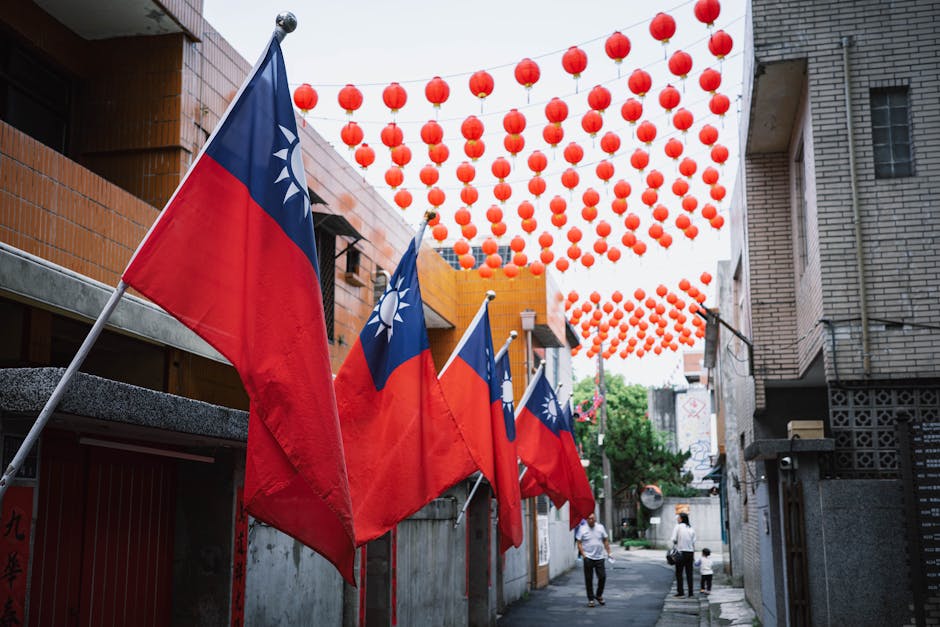
- Former U.S. President Donald Trump warned Taiwan against pursuing formal independence from China.
- Trump’s comments reignited debate over America’s unofficial support for Taiwan and its implications on China’s aggression.
- Taiwan’s foreign ministry rejected China’s sovereignty claims and asserted its democratic legitimacy in response to Trump’s warning.
- Trump’s intervention raises questions about the weight of a former leader’s diplomatic voice in international relations.
- Taiwan’s fragile security is under scrutiny as a result of Trump’s statements and their impact on U.S.-China relations.
What happens when a former U.S. president wades into one of the most sensitive geopolitical flashpoints of the 21st century? That question looms large after Donald Trump, during a recent public appearance, issued a pointed warning about Taiwan’s political status, suggesting the self-governing island should not pursue formal independence from China. His comments, while not official policy, have reignited debate over America’s unofficial support for Taiwan and how such rhetoric influences Beijing’s aggression. Taiwan’s foreign ministry swiftly responded, rejecting China’s sovereignty claims and asserting its own democratic legitimacy. With U.S.-China relations already strained, Trump’s intervention raises urgent questions: Does a former leader’s voice still carry diplomatic weight? And how do such statements impact Taiwan’s fragile security?
What Did Trump Say About Taiwan’s Independence?

Donald Trump, speaking at a campaign-style rally in New Hampshire in July 2024, warned that Taiwan should not declare independence, framing the issue as a potential trigger for conflict with China. “If Taiwan wants to survive, it shouldn’t push for independence,” Trump said, echoing a long-standing but delicate position in U.S. foreign policy that acknowledges Beijing’s stance without endorsing it. His remarks, however, diverged from the current Biden administration’s more assertive support for Taiwan’s de facto autonomy. While the U.S. officially adheres to the One-China Policy—recognizing Beijing’s position that Taiwan is part of China—it also maintains robust unofficial ties with Taipei under the Taiwan Relations Act of 1979. Trump’s comments were interpreted by many as a return to strategic ambiguity, but critics argue they risk emboldening Beijing while undermining Taiwan’s confidence in American backing.
How Did Taiwan Respond to Trump’s Warning?

Taiwan’s Ministry of Foreign Affairs issued a formal statement rejecting Trump’s framing, asserting that “Beijing has no right to claim jurisdiction over Taiwan.” The statement emphasized Taiwan’s separate democratic governance, elected leadership, and de facto sovereignty, calling such claims a misrepresentation of the island’s status. “Taiwan is an independent country in all but name,” said Foreign Minister Joseph Wu in a subsequent press briefing, stressing that cross-strait relations must be based on mutual respect, not coercion. Analysts at BBC News noted that Taipei’s unusually direct rebuttal reflects growing frustration with external figures—especially from the U.S.—defining Taiwan’s political future without consulting its people. The response also underscores a shift in Taiwan’s diplomatic tone, as younger generations increasingly identify as distinctly Taiwanese rather than Chinese.
What Are the Counterarguments to Taiwan’s Position?

Despite Taiwan’s assertions, the People’s Republic of China (PRC) maintains that Taiwan is an inalienable part of its territory under the “One-China Principle,” a stance supported by the United Nations and most member states. Beijing views any discussion of Taiwanese independence—even hypothetical—as a red line that could justify military action. Some international relations scholars argue that U.S. figures like Trump inadvertently escalate tensions by oversimplifying a complex issue. As Reuters reported, Chinese Foreign Ministry spokesperson Wang Wenbin reiterated that “the Taiwan question allows no external interference” and urged the U.S. to “handle the issue with caution.” Skeptics also caution that while democratic solidarity with Taiwan is important, former leaders making off-the-cuff remarks risk destabilizing carefully calibrated deterrence strategies. Moreover, some realists in foreign policy argue that prioritizing economic and strategic stability with China may outweigh symbolic support for Taiwanese sovereignty.
What Is the Real-World Impact of These Statements?

The immediate aftermath of Trump’s comments saw a spike in Chinese military activity near Taiwan, with the People’s Liberation Army conducting simulated blockade drills in the Taiwan Strait. In response, the U.S. Pacific Command confirmed it had deployed reconnaissance assets to monitor the situation. Meanwhile, Taiwan’s stock market saw mild volatility, particularly in defense and semiconductor sectors—key industries tied to both national security and global supply chains. The island’s semiconductor dominance, led by TSMC, makes it strategically vital, and any disruption could have worldwide economic consequences. Diplomatically, allies like Japan and Australia issued cautious statements reaffirming support for peace and stability in the region, signaling quiet concern over renewed rhetoric. These reactions illustrate how political statements—even from non-officeholders—can ripple across military, economic, and diplomatic domains in one of the world’s most volatile regions.
What This Means For You
For global citizens, the exchange between Trump, Taiwan, and Beijing is a reminder that geopolitical stability often hinges on careful language and diplomatic restraint. While the U.S. remains committed to Taiwan’s defense under current law, the return of rhetoric favoring appeasement over deterrence could shift strategic calculations in East Asia. Consumers, investors, and policymakers alike should monitor how such statements influence military posturing, supply chain resilience, and international alliances. Ultimately, the Taiwan question isn’t just a regional issue—it’s a cornerstone of the broader contest between democratic autonomy and authoritarian claims of territorial integrity.
As the 2024 U.S. presidential election approaches, how should Americans evaluate candidates’ foreign policy positions on Taiwan? And if a leader’s offhand remarks can trigger military drills and market shifts, what mechanisms exist to prevent unintended escalation in an era of hyper-visible political rhetoric?
Source: Euronews