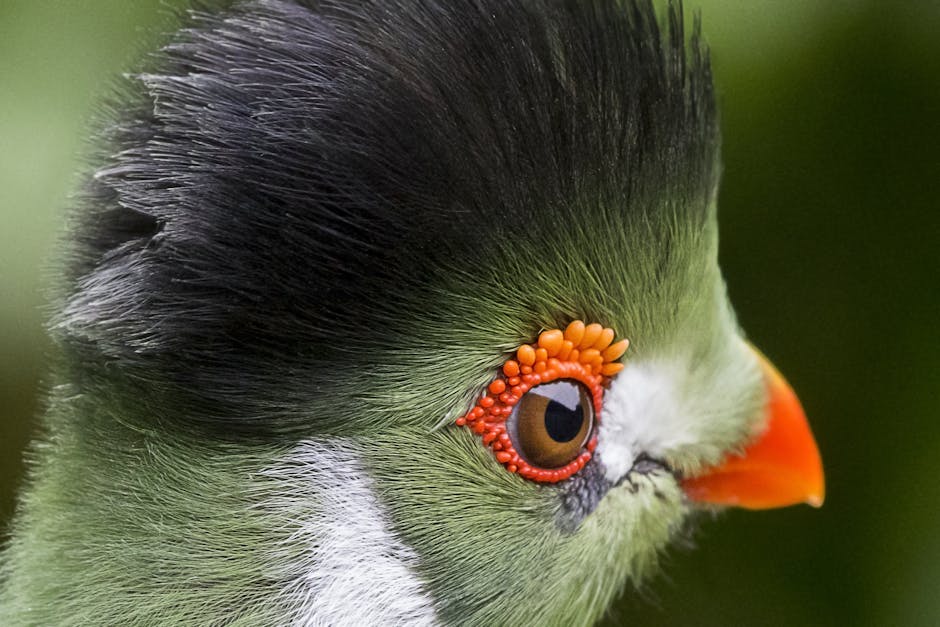
- Birds see the world at an incredible 120 frames per second, twice the rate of humans.
- Avian eyes operate near the theoretical maximum for photoreceptor density, processing speed, and spectral range.
- Birds can perceive ultraviolet light, invisible to humans, thanks to four types of cone cells in their eyes.
- The pecten oculi structure in bird eyes nourishes the retina and reduces glare, enhancing contrast.
- Bird vision has evolved over 150 million years to become an extraordinary and finely tuned system.
High above the Sonoran Desert, a peregrine falcon locks onto a dove in mid-flight, diving at over 200 miles per hour. To human eyes, the scene would blur into streaks of motion, but for the falcon, every feather, wingbeat, and shift in trajectory is rendered in hyper-clarity. Its retina processes images faster than any known vertebrate, capturing up to 120 frames per second — twice the rate of a human. This extraordinary visual system, honed over 150 million years, represents an evolutionary extreme: an eye so finely tuned that it pushes the very limits of biological possibility. Birds don’t just see the world differently — they see more of it, in ways that challenge our understanding of perception itself.
Bird Vision Operates at the Edge of Biological Limits

Recent studies in comparative ophthalmology reveal that avian eyes are not merely superior to those of mammals — they operate near the theoretical maximum for photoreceptor density, neural processing speed, and spectral range. Unlike humans, most birds possess four types of cone cells, allowing them to perceive ultraviolet light, a spectrum invisible to us. This expanded vision helps them detect UV-reflective patterns on feathers during mating rituals or track the urine trails of small rodents. Moreover, their eyes are equipped with a specialized structure called the pecten oculi, which nourishes the retina and reduces internal glare, enhancing contrast in bright daylight. Research published in Nature Ecology & Evolution demonstrates that some raptors can resolve details at 140 cycles per degree — more than double human acuity. These adaptations aren’t just incremental improvements; they represent a reengineering of the eye’s basic architecture to meet the demands of flight, predation, and navigation across vast distances.
From Dinosaurs to Doves: The Evolutionary Journey

The roots of avian vision trace back to theropod dinosaurs, the ancestors of modern birds. Fossil evidence from species like *Archaeopteryx* suggests that even early proto-birds had large eye sockets relative to skull size, indicating a reliance on vision. As birds diversified after the Cretaceous-Paleogene extinction, natural selection favored visual acuity as a survival mechanism. Flying requires split-second decisions — avoiding obstacles, judging distances, and spotting food from great heights — all of which demand exceptional sensory input. Over time, the avian eye evolved a flattened shape, a deep fovea (the region of sharpest vision), and a higher ratio of photoreceptors to ganglion cells. These features allowed birds to develop what scientists call “tunnel vision” with extreme focus, or in some species like the owl, a dual fovea for both frontal and lateral tracking. The result is a sensory organ optimized not just for survival, but for mastery of aerial environments.
The Scientists and Ornithologists Behind the Discoveries

Researchers like Dr. Estela Lorinha at the University of Lisbon and Dr. Thomas Cronin at the University of Maryland have dedicated decades to decoding avian vision. Using microspectrophotometry and high-speed eye-tracking, they’ve mapped how different species process light and motion. Lorinha’s team discovered that migratory birds use polarized light patterns during navigation, a skill tied to specialized photoreceptor alignment. Cronin’s work has shown how aquatic birds like kingfishers compensate for refraction when diving, thanks to a uniquely flexible cornea. These scientists are driven by more than curiosity — they seek to understand the upper bounds of biological design. Their findings not only illuminate avian biology but also inspire advancements in robotics and camera technology, where mimicking bird vision could revolutionize autonomous systems.
Implications for Ecology, Technology, and Human Health

The extraordinary capabilities of bird eyes have far-reaching consequences. Ecologically, disruptions in light environments — such as urban light pollution or atmospheric haze — can impair avian navigation and foraging. Conservationists now consider visual pollution as seriously as noise or habitat loss. In technology, engineers at institutions like MIT and ETH Zurich are developing cameras with avian-inspired sensors that detect UV and polarized light, potentially enhancing drone navigation. Meanwhile, medical researchers study bird retinas to understand degenerative eye diseases in humans. Because birds rarely suffer from age-related macular degeneration despite high metabolic demands on their eyes, their cellular repair mechanisms could hold clues for treating human blindness. The avian eye, in essence, serves as both a model of perfection and a roadmap for innovation.
The Bigger Picture
Bird vision exemplifies nature’s ability to optimize complex systems under relentless selective pressure. It challenges the assumption that human perception is the benchmark of sensory experience. Instead, it reveals a world rich with information that lies beyond our natural reach — a spectrum of light, a speed of processing, a depth of detail that evolution has made routine for creatures we often overlook. Understanding these capabilities forces a recalibration of how we define ‘seeing’ and reminds us that intelligence and adaptation manifest in forms we are only beginning to appreciate.
As climate change alters ecosystems and artificial light reshapes nocturnal environments, the future of avian vision hangs in the balance. Yet the very features that make bird eyes so remarkable — their sensitivity, speed, and adaptability — may also equip them to respond to new challenges. Ongoing research promises not only to safeguard these species but to deepen our grasp of biological possibility. The bird eye, perfected by eons of evolution, continues to open new windows into life’s potential.
Source: Quantamagazine