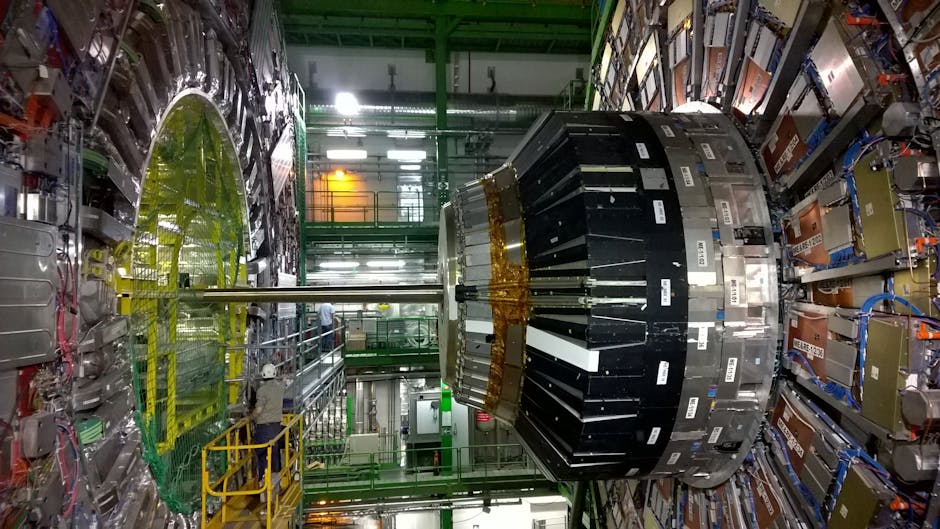
- Particle physicists study quantum fields, not just tiny particles, to understand the fundamental nature of the universe.
- In physics, a field is an invisible, all-pervading entity that fills space and time, influencing nearby particles.
- Classical fields like the electromagnetic field behave smoothly, but quantum field theory reveals fields as the building blocks of reality.
- Every fundamental particle is an excitation of a quantum field in quantum field theory.
- Quantum fields shape reality, governing the behavior of particles and influencing the fabric of space and time.
If you’ve ever wondered what the universe is truly made of, you’re not alone — and the answer might surprise you. Particle physicists don’t just study tiny beads of matter; they’re probing something far more fundamental: fields. Not agricultural fields, but invisible, all-pervading entities that fill the cosmos. The idea is so central that modern physics doesn’t describe electrons or photons as particles first, but as excitations in underlying quantum fields. So why do physicists spend so much time thinking about fields? What are they, where did they come from, and how do they shape reality as we know it? The journey begins not in a particle accelerator, but with a magnet.
What Is a Field in Physics?

A field, in physics, is a quantity that has a value at every point in space and time. Think of the magnetic field around a bar magnet: even in empty space, the field exists, ready to push or pull a nearby compass needle. This concept dates back to the 19th century, when Michael Faraday and James Clerk Maxwell revolutionized physics by showing that electricity and magnetism are governed by fields that propagate at the speed of light. These classical fields — like the electromagnetic field — behave smoothly and predictably. But in the 20th century, quantum mechanics transformed this picture. The universe, it turned out, is not just governed by fields — it is made of them. In quantum field theory (QFT), every fundamental particle is an excitation of a corresponding field. There’s an electron field, a photon field, a quark field — and each one extends throughout the entire universe. When we detect a particle, we’re seeing a localized ripple in its field, like a wave on an invisible ocean.
How Do Quantum Fields Create Particles?

The shift from particles to fields is profound. In classical physics, particles are like billiard balls; in quantum field theory, they’re more like notes played on a cosmic instrument. The Standard Model of particle physics describes 17 fundamental quantum fields, including those for matter (like electrons and quarks) and force carriers (like photons and gluons). These fields interact according to precise mathematical rules, and their excitations manifest as the particles detected in experiments like those at CERN’s Large Hadron Collider. The Higgs field, for instance, is responsible for giving mass to certain particles. Unlike other fields, it has a non-zero value even in empty space — a constant hum across the universe. When particles like electrons move through this field, they interact with it and gain inertia. As physicist David Tong explains in a widely cited lecture series from the University of Cambridge, quantum field theory is the language in which nature writes its laws. Without it, we couldn’t explain why atoms exist, how light travels, or how the sun shines.
Are Quantum Fields Real — Or Just Mathematical Tools?

Despite their success, some scientists and philosophers question whether quantum fields are physically real or just useful abstractions. After all, we never directly observe a field — only its effects. Critics like Nancy Cartwright, a philosopher of science, argue that models in physics are tools for prediction, not mirrors of reality. From this view, quantum fields are incredibly effective calculational devices, but may not correspond to something ‘out there’ in the world. Others point to the mathematical complexity of QFT — with its infinities, renormalization, and reliance on perturbation theory — as evidence that it’s incomplete. There’s also the puzzle of dark matter and dark energy, which make up 95% of the universe’s content but have no place in the Standard Model’s field framework. These gaps suggest that our current understanding of fields might be a stepping stone to something deeper, perhaps a theory of quantum gravity or a more fundamental structure underlying spacetime itself.
How Do Fields Shape the Universe We Live In?

The implications of quantum fields extend far beyond theory. The stability of atoms, the emission of light, and the functioning of semiconductors all depend on field interactions. Without the electromagnetic field, chemistry wouldn’t exist. Without the Higgs field, electrons would zip around at light speed and never form atoms. Even the vacuum of space isn’t truly empty — it seethes with quantum fluctuations, where particle-antiparticle pairs briefly pop in and out of existence due to the uncertainty principle. These vacuum fluctuations have measurable effects, such as the Casimir force and the Lamb shift in hydrogen energy levels. On a cosmic scale, fields may have driven the rapid expansion of the early universe during inflation — a period when a hypothetical ‘inflaton’ field released enormous energy. Today, cosmologists debate whether dark energy could be another field, subtly pushing galaxies apart. In every case, fields aren’t just background actors — they’re the lead performers in the drama of existence.
What This Means For You
You don’t need a PhD to appreciate that reality is far stranger than it appears. Quantum fields remind us that the solid, tangible world is built on invisible, dynamic foundations. Every time you turn on a light, feel the pull of gravity, or use a smartphone, you’re interacting with fields governed by quantum rules. Understanding them deepens our connection to the universe and highlights the power of human curiosity. While the math is complex, the core idea — that everything arises from underlying fields — is a profound shift in perspective, one that redefines what it means to be ‘real’.
But big questions remain: Are fields the final layer of reality, or is there something beneath them? Could all fields emerge from a more fundamental structure, like spacetime itself? And how do quantum fields reconcile with gravity, which resists integration into the quantum framework? As physicists probe deeper, the concept of the field may evolve once again — suggesting that our understanding of the universe is not fixed, but as dynamic as the fields we seek to understand.
Source: New Scientist