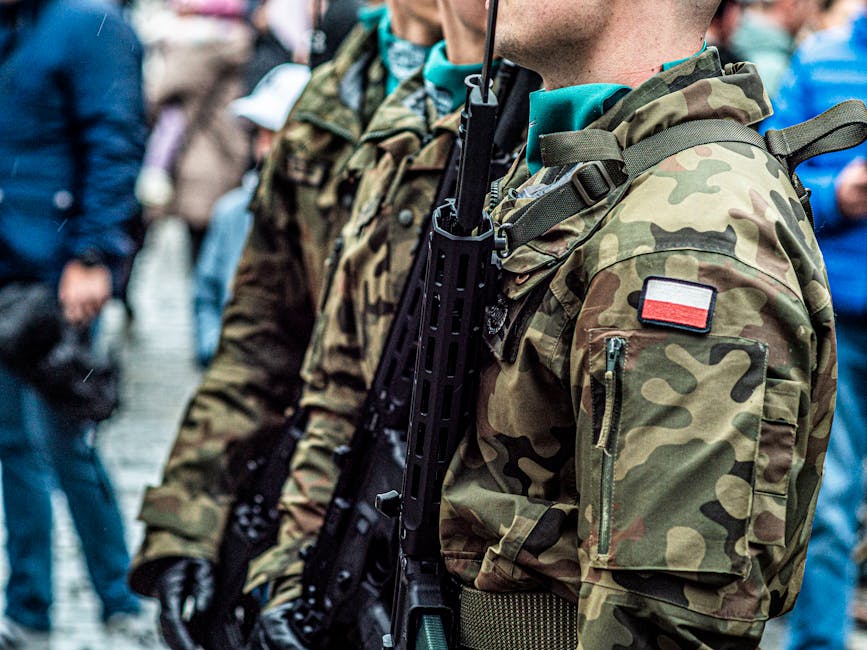
- The US has withdrawn approximately 1,500 troops from Poland, reducing its rotational combat presence from 5,500 to 4,000.
- The move marks a significant shift in the US military’s posture in Eastern Europe, sparking concerns about regional security.
- The withdrawal is attributed to internal assessments that the immediate threat of large-scale Russian incursion has diminished.
- The US has maintained that the move does not constitute a full withdrawal, but rather a recalibration of its military presence.
- The removal of a full armored brigade combat team has alarmed regional allies and raised questions about US commitment to Eastern Europe.
Under the gray sweep of a late autumn sky, soldiers at the Rotational Force Post in Rzeszów, Poland, packed Humvees and ammunition crates into flatbed trailers, their movements precise but hurried. Just weeks ago, the base buzzed with the routine of joint U.S.-Polish drills, the air thick with the scent of diesel and damp earth. Now, silence creeps in. The abrupt departure of approximately 1,500 American troops—along with key combat equipment—marks not just an operational shift but a symbolic recalibration. For Eastern Europe, long reliant on visible U.S. military backing as a deterrent against Russian aggression, the withdrawal feels less like a routine rotation and more like a retreat. In the villages nearby, farmers paused their work to watch convoys roll westward, unsure what the absence of American boots will mean for their sense of security.
US Forces Scale Back in Eastern Flank

The Pentagon has confirmed a significant reduction in its rotational combat presence in Poland, cutting troop levels from roughly 5,500 to around 4,000 by the end of the year. While officials stress this does not constitute a full withdrawal, the removal of a full armored brigade combat team—complete with tanks, artillery, and supporting aviation assets—has alarmed regional allies. The drawdown, initiated in October without prior public announcement, follows internal assessments that the immediate threat of large-scale Russian incursion has diminished. However, U.S. European Command maintains a continued rotational presence and access to key bases under the Enhanced Defense Cooperation Agreement. Despite these assurances, Polish defense officials have expressed concern, with Deputy Defense Minister Piotr Błaszczak calling the move “premature” in a recent interview with Reuters.
From Deterrence to Strategic Reallocation

This shift traces back to the 2014 annexation of Crimea, which triggered NATO’s Operation Atlantic Resolve—a rotating U.S. military presence in Eastern Europe designed to reassure nervous allies. By 2022, following Russia’s full-scale invasion of Ukraine, troop levels surged as Washington sought to project strength along the alliance’s vulnerable eastern flank. Poland, a frontline state, became home to the largest contingent of American forces in Europe. But as the war in Ukraine enters a grinding phase of attrition, U.S. defense planners are reassessing priorities. Strategic competition with China, particularly in the Indo-Pacific, has pushed the Pentagon to reconsider resource allocation. According to a 2023 Defense Department memo, the goal is to maintain “strategic agility” by reducing fixed footprints in Europe while preserving rapid deployment capabilities.
Leaders and Strategists Behind the Pivot

The decision reflects the influence of defense leaders like Deputy Secretary of Defense Kathleen Hicks and European Command head General Christopher Cavoli, who have championed a more flexible, scalable posture. Their vision prioritizes mobility over permanence, arguing that forward-deployed stocks and pre-positioned equipment can deter aggression without requiring large standing garrisons. In contrast, Eastern European leaders, including Polish President Andrzej Duda, have pushed for permanent U.S. basing, even offering to fund a “Fort Trump” in 2018. The Pentagon has resisted such moves, wary of provoking Russia and overcommitting to fixed infrastructure. The current drawdown suggests that Washington’s strategic calculus now weighs global threats more evenly, placing less emphasis on Europe’s immediate periphery.
Implications for NATO and Regional Security

The troop reduction risks undermining confidence in U.S. commitments, especially in countries like Poland, Lithuania, and Romania, which view American forces as a tripwire against Russian adventurism. While NATO’s collective defense clause remains intact, symbolic presence matters. A diminished U.S. footprint could embolden Moscow to test NATO’s cohesion through hybrid tactics or limited incursions. Moreover, it may accelerate national defense spending in Eastern Europe, as seen in Poland’s record-breaking military budget of over 4% of GDP in 2023. But without synchronized strategy, such efforts could lead to duplication or gaps in capability. The move also raises questions about burden-sharing within the alliance, particularly as European members still lag behind U.S. defense investment.
The Bigger Picture
This shift is not merely about troop numbers but reflects a deeper transformation in U.S. grand strategy. As the world moves toward multipolar competition, the Pentagon is forced to balance commitments across multiple theaters. The drawdown in Poland exemplifies a broader pivot from presence-based deterrence to rapid-response readiness. Yet, in doing so, Washington risks underestimating the psychological value of boots on the ground. Deterrence, after all, is as much about perception as capability. In Eastern Europe, where memories of Soviet domination remain vivid, the departure of American tanks echoes louder than Pentagon briefings.
What comes next may hinge on events in Ukraine. Should the front lines collapse or Russia escalate beyond current bounds, the U.S. could reverse course and surge forces back into Poland. For now, the reduced presence stands as a calculated gamble—one that assumes stability will hold and allies will adapt. But in the volatile calculus of geopolitics, assumptions are fragile. The silence left by departing engines may soon be filled by new demands, or worse, the sound of conflict returning to Europe’s doorstep.
Source: Yahoo