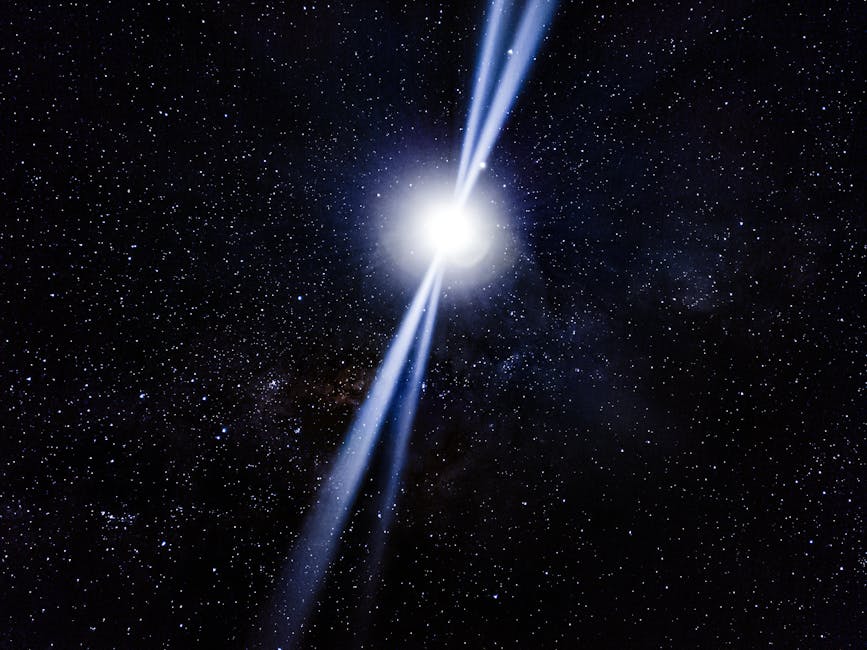
- The Roman Space Telescope is set to launch by 2027 and will use gravitational microlensing to detect invisible neutron stars.
- Neutron stars are ultra-dense remnants of exploded stars that emit little to no detectable radiation, making them difficult to observe.
- The telescope will detect isolated neutron stars by monitoring hundreds of millions of stars nightly for gravitational microlensing effects.
- The Roman Space Telescope’s high-resolution infrared imaging and broad field of view will increase the chances of catching rare alignments.
- The discovery of hidden neutron stars can reveal information about the violent end stages of stellar life.
What if the galaxy is teeming with dead stars we can’t see? Scientists have long suspected that millions of neutron stars—ultra-dense remnants of exploded stars—drift invisibly through the Milky Way, emitting little or no detectable radiation. Because they no longer shine brightly and often lack binary companions, these solitary neutron stars evade traditional observation methods. But a new mission could change that: NASA’s Nancy Grace Roman Space Telescope, set to launch by 2027, is poised to uncover this hidden population using an ingenious method rooted in Einstein’s theory of general relativity. The question now is not whether these ghostly objects exist, but how many we’ll find—and what they can tell us about the violent end stages of stellar life.
How Can Invisible Neutron Stars Be Detected?

The Roman Space Telescope will detect isolated neutron stars not by their light, but by their gravity. When a massive object passes in front of a distant star, its gravitational field bends and magnifies the background star’s light—a phenomenon known as gravitational microlensing. Because neutron stars are incredibly dense, packing more mass than the Sun into a sphere only 12 miles wide, they produce a measurable microlensing effect. Roman’s high-resolution infrared imaging and broad field of view will allow it to monitor hundreds of millions of stars nightly, dramatically increasing the chances of catching these rare alignments. Crucially, the duration and shape of the microlensing event can reveal the mass of the invisible object, enabling scientists to confirm whether it’s a neutron star or another type of compact remnant like a black hole.
What Evidence Supports This Approach?

Preliminary models suggest Roman could detect at least several hundred isolated neutron stars via microlensing, with some estimates reaching into the millions across its five-year mission. A 2023 study published in Nature Astronomy simulated galactic populations of neutron stars and projected detection rates based on Roman’s observational parameters. The results indicate that the telescope’s sensitivity to subtle brightness changes—down to parts per million—will allow it to spot events lasting days to weeks, typical of neutron star lensing. Additionally, follow-up parallax measurements from Earth-based observatories could help triangulate the distance and velocity of these objects. As Kailash Sahu of the Space Telescope Science Institute, who has pioneered microlensing searches for dark objects, explained: “Roman is the first telescope capable of systematically finding isolated neutron stars across the galaxy, not just the rare few near Earth.”
What Are the Skeptical Views?

Despite the promise, some astrophysicists urge caution. One concern is distinguishing neutron stars from other compact objects like low-mass black holes or even free-floating planets, which can produce similar microlensing signals. Without additional data—such as X-ray or radio emissions, which isolated neutron stars may not emit—definitive classification remains challenging. Others point out that the models predicting millions of detectable events rely on uncertain assumptions about the birth rate, spatial distribution, and velocity dispersion of neutron stars. For instance, if neutron stars are born with lower kicks than expected, they may remain clustered near the galactic plane, reducing the number of observable events. Furthermore, the microlensing method is inherently probabilistic—each event is unique and non-repeatable—making confirmation and follow-up extremely difficult.
What Are the Real-World Implications?

Successfully mapping the invisible neutron star population would revolutionize our understanding of stellar evolution and galactic structure. Neutron stars are created in supernova explosions, but the mechanisms that give them “natal kicks” of up to millions of miles per hour remain poorly understood. By measuring the speeds and trajectories of isolated neutron stars, Roman could help determine whether asymmetric neutrino emission or hydrodynamic instabilities during collapse are responsible. Moreover, knowing their distribution and mass could refine estimates of the Milky Way’s total stellar remnant population and test theories of dense matter physics. One exciting possibility is identifying candidates for future X-ray or radio studies, potentially leading to the discovery of new pulsars or even strange quark stars.
What This Means For You
While neutron stars may seem distant and abstract, their study helps us understand the fundamental forces that shape the universe—from gravity and nuclear physics to the life cycles of stars that seed galaxies with heavy elements. Discoveries enabled by the Roman Space Telescope could influence future technologies, much as Einstein’s relativity underpins GPS systems today. For space enthusiasts and science educators, this mission offers a compelling narrative of cosmic detective work, using invisible clues to map the unseen structure of our galaxy.
But a major question remains unanswered: Could some of these dark, fast-moving objects be primordial black holes or other exotic matter? If Roman detects lensing events too massive or too fast to be neutron stars, it might open the door to entirely new classes of astrophysical phenomena—pushing the boundaries of known physics and inviting deeper exploration of the universe’s most elusive components.
Source: ScienceDaily