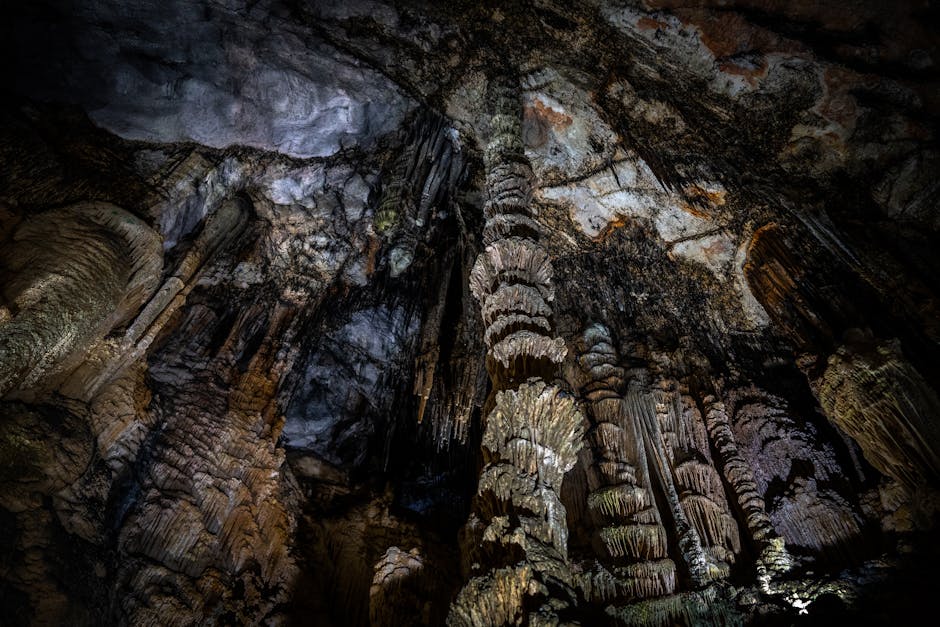
- A fossilized kneeprint found in Bruniquel Cave in south-west France is the oldest direct evidence of Neanderthal activity, dating back 175,000 years.
- The discovery of a circular structure made from broken stalagmites suggests Neanderthals engaged in complex behaviors, possibly symbolic or social.
- Neanderthals may have built the structure 175,000 years ago, long before modern humans arrived in Europe.
- The precision of the breaks and layout in the structure suggests intentional construction, not random accumulation.
- The find fundamentally alters our understanding of Neanderthal cognitive evolution and challenges previous assumptions about their behavior.
Deep within Bruniquel Cave in south-west France, a fossilized impression in clay may mark the physical presence of a Neanderthal nearly 175,000 years ago—possibly a builder of a mysterious circular structure made from broken stalagmites. This kneeprint, preserved in soft calcite-rich sediment, offers rare direct evidence of Neanderthal activity in a context previously seen only through stone tools or skeletal remains. Together with the enigmatic ring formations, the impression bolsters the argument that Neanderthals engaged in complex, possibly symbolic or social behaviors far earlier than once believed, fundamentally altering our understanding of their cognitive evolution.
Structural Evidence in the Depths of Bruniquel Cave

In 1990, explorers discovered two large annular structures composed of broken stalagmites deep inside Bruniquel Cave—over 300 meters from the entrance, in complete darkness. Measuring approximately 6.7 and 2.2 meters in diameter, the rings contained over 400 individual stalagmite segments, many deliberately broken and arranged in parallel lines, with some pieces stacked up to 40 centimeters high. Radiometric dating of calcite deposits forming on the broken ends revealed the structures were built around 176,500 years ago—long before modern humans arrived in Europe. The precision of the breaks and layout suggests intentional construction, not random accumulation. According to a study published in Nature in 2016, the energy and coordination required to transport materials and work in such an inaccessible environment point to organized group behavior. The recent discovery of a kneeprint nearby—depressed into the same ancient clay layer—adds a startlingly human dimension: a moment frozen in time, possibly from someone kneeling to assemble the structure.
Neanderthals as the Architects of Complexity

The only hominins in Europe at the time were Neanderthals (*Homo neanderthalensis*), making them the prime candidates for constructing the stalagmite rings. Until recently, Neanderthals were often portrayed as cognitively inferior to *Homo sapiens*, lacking symbolic thought, language, or advanced planning. But mounting archaeological evidence—from pigment use to intentional burials—has steadily dismantled that view. The Bruniquel structures, located so far from natural light, suggest not only the use of artificial lighting (likely torches) but also a purpose beyond mere shelter. Researchers speculate the site may have served a social, ritual, or even ceremonial function—an idea once considered exclusive to modern humans. The kneeprint, while not definitive proof of symbolic intent, aligns with other findings such as engraved bones and cave markings attributed to Neanderthals, reinforcing the image of a species capable of abstract thinking and cultural complexity.
Reassessing Costs and Cognitive Trade-Offs

Constructing the stalagmite circles would have required significant investment: time, energy, and coordination among multiple individuals. Working in total darkness, Neanderthals would have needed sustained light sources, likely from wood or fat-based torches, which would have consumed valuable fuel resources. The transportation of over two tons of stalagmite fragments—some weighing several kilograms—over uneven cave terrain implies advanced planning and division of labor. From an evolutionary standpoint, such behavior suggests cognitive trade-offs: energy diverted from immediate survival tasks (hunting, foraging) toward non-utilitarian projects may indicate the emergence of social cohesion, shared belief systems, or leadership structures. While the lack of associated artifacts like tools or hearths complicates interpretation, the very existence of the structures challenges the outdated notion that Neanderthals were purely reactive to their environment. Instead, they appear capable of transforming it for purposes beyond mere subsistence.
Why the Timing Changes Everything

The dating of the Bruniquel structures to 175,000 years ago is pivotal—it predates the arrival of *Homo sapiens* in Europe by over 100,000 years, eliminating any possibility of cultural influence. This timing forces a reevaluation of when complex behaviors emerged in the human lineage. Previously, such constructions were not documented until around 40,000 years ago, associated with the so-called ‘creative explosion’ of early modern humans. The kneeprint and its context suggest Neanderthals achieved comparable behavioral sophistication much earlier. Moreover, the cave’s inaccessibility implies these activities were deliberate and meaningful, not accidental. The convergence of precise dating, structural complexity, and now a potential bodily impression underscores that this is not an isolated anomaly but evidence of a broader, yet still poorly understood, Neanderthal cultural repertoire.
Where We Go From Here
In the next 6–12 months, researchers plan to conduct high-resolution 3D imaging of the kneeprint to analyze pressure distribution and match it with biomechanical models of Neanderthal posture. Additionally, sediment DNA analysis may reveal traces of hominin genetic material in the surrounding clay, potentially confirming Neanderthal presence. If successful, such methods could be applied to other cave sites across Europe, searching for similar traces of non-lithic activity. Three plausible scenarios emerge: first, that Bruniquel represents a rare, isolated ritual site; second, that such constructions were more widespread but have not survived or been discovered; and third, that Neanderthals developed regional cultural traditions akin to those of early modern humans—each with distinct symbolic systems. The implications extend beyond paleoanthropology, challenging the anthropocentric narrative of human uniqueness.
Bottom line — The discovery of a Neanderthal kneeprint at Bruniquel Cave provides tangible, intimate evidence that these early humans engaged in deliberate, complex construction deep underground over 175,000 years ago, reshaping our understanding of their cognitive and cultural capabilities.
Source: New Scientist