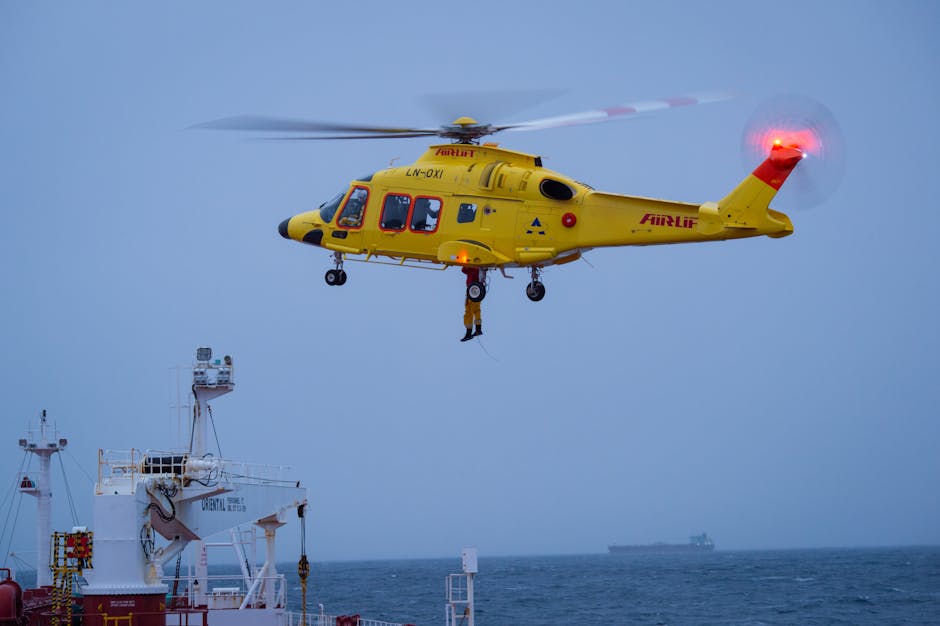
- US Air Force’s 920th Rescue Wing rescued 11 people from a downed private aircraft near the Florida coast.
- The rescue operation involved a joint effort between the US Air Force and the US Coast Guard.
- Night-vision technology and real-time satellite tracking were used to locate the wreckage in near-zero visibility.
- Pararescuemen, also known as PJs, deployed into 55-degree water with strong currents to rescue the occupants.
- The rescue mission was completed within 45 minutes, saving all 11 lives on board.
Dark clouds hung low over the Atlantic as churning waves slapped against the twisted fuselage of a downed private aircraft, its wings half-submerged and glinting under intermittent flashes of lightning. Just miles off the Florida coast, the wreckage bobbed in ten-foot swells, surrounded by life jackets and scattered debris. Inside the cockpit, voices shouted over the roar of wind and water—then fell silent. Minutes later, the distant thrum of rotor blades cut through the storm. A U.S. Air Force HH-60G Pave Hawk helicopter emerged from the cloud cover, lowering a pararescueman into the violent sea. This was not a training exercise. Eleven lives hung in the balance, and every second counted.
Immediate Rescue Amid Treacherous Conditions

The emergency call came in at 3:17 a.m. local time, when air traffic controllers lost contact with a Cessna Citation 550 en route from Naples, Florida, to Teterboro, New Jersey. Radar showed the plane descending rapidly before vanishing near the shoreline of Cape Canaveral. Within minutes, the U.S. Coast Guard issued a distress alert, triggering a joint response with the 920th Rescue Wing of the Air Force Reserve Command based at Patrick Space Force Base. Using night-vision technology and real-time satellite tracking, the Pave Hawk crew located the wreckage in near-zero visibility. Pararescuemen, known as PJs, were deployed into 55-degree water with currents exceeding three knots. Over the next 45 minutes, all 11 occupants—including two pilots and nine passengers—were hoisted to safety, treated for hypothermia and minor injuries, and flown to Orlando Regional Medical Center. Footage released by the Air Force shows one survivor waving weakly as he is lifted from the waves, his face streaked with salt and rain.
The Descent That Triggered the Emergency

Investigations are now underway to determine what caused the Citation to plunge into the Atlantic. Preliminary data from the Federal Aviation Administration (FAA) suggests the aircraft encountered severe turbulence associated with a fast-moving squall line that swept across the eastern seaboard that night. Weather reports confirm wind shear and microbursts in the area, conditions known to destabilize smaller jets during climb or descent. The plane, registered to a private charter firm based in Fort Lauderdale, had filed a routine flight plan and showed no prior mechanical anomalies. According to Reuters, the National Transportation Safety Board (NTSB) has dispatched a go-team to examine the wreckage, flight recorders, and maintenance logs. Early speculation points to possible engine failure or spatial disorientation due to the storm, but officials caution that conclusions are premature. What is clear is that the rapid response prevented a tragedy—had the rescue been delayed by even 20 minutes, survival odds would have plummeted in the cold, turbulent waters.
The Rescuers Behind the Mission

The success of the operation rests largely on the shoulders of the 920th Rescue Wing, one of the military’s most elite and specialized units. Comprised of Air Force Reserve personnel, these teams train relentlessly for maritime, mountain, and combat rescues, often operating in environments deemed too dangerous for civilian agencies. The pararescuemen involved in this mission had previously deployed to conflict zones in Afghanistan and Syria, where they recovered downed pilots under enemy fire. Their discipline, physical endurance, and medical expertise proved critical in the Florida operation. As one PJ later told commanders, “Conditions were worse than most warzone extractions—we had zero visibility, heavy current, and victims in shock. But the training kicked in.” Commanders emphasize that such readiness is not accidental: the 920th conducts over 150 real-world rescues annually, making them a vital but often unseen component of national emergency response.
Impact on Families, Aviation, and Policy

For the survivors and their families, the crash marks a harrowing brush with death—and a testament to modern rescue capabilities. Several passengers were business executives returning from a conference in Miami, while others were family members en route to a wedding in New Jersey. In the days following the rescue, emotional reunions unfolded at hospital bedsides, with one relative telling BBC News that “we were preparing for the worst when we got the call—they’re alive.” Beyond the personal level, the incident raises renewed scrutiny on private aviation safety, particularly during adverse weather. Industry analysts note that while commercial airlines benefit from advanced weather radar and strict flight protocols, private charters often operate under less stringent oversight. There are growing calls for mandatory real-time weather relays and enhanced pilot training for small jet operators, especially along high-traffic coastal corridors.
The Bigger Picture
This rescue is more than a story of survival—it reflects the quiet, constant vigilance of military units tasked with saving lives in peacetime. As climate change intensifies storm patterns and air traffic increases, the demand for rapid-response rescue forces will only grow. The 920th’s success underscores the value of investing in specialized personnel and equipment, even when the threats aren’t battlefield-related. In an era where disasters—natural and mechanical—seem increasingly unpredictable, such capabilities are not luxuries, but necessities.
As the NTSB continues its probe, the aircraft’s black boxes are being analyzed for final clues. Meanwhile, the survivors begin recovery, both physical and emotional. For the Air Force team, the mission is already logged, and training resumes. Another alert could come at any moment. In the vast, unforgiving expanse of ocean and sky, their readiness may be the only thing standing between life and loss.
Source: Al Jazeera