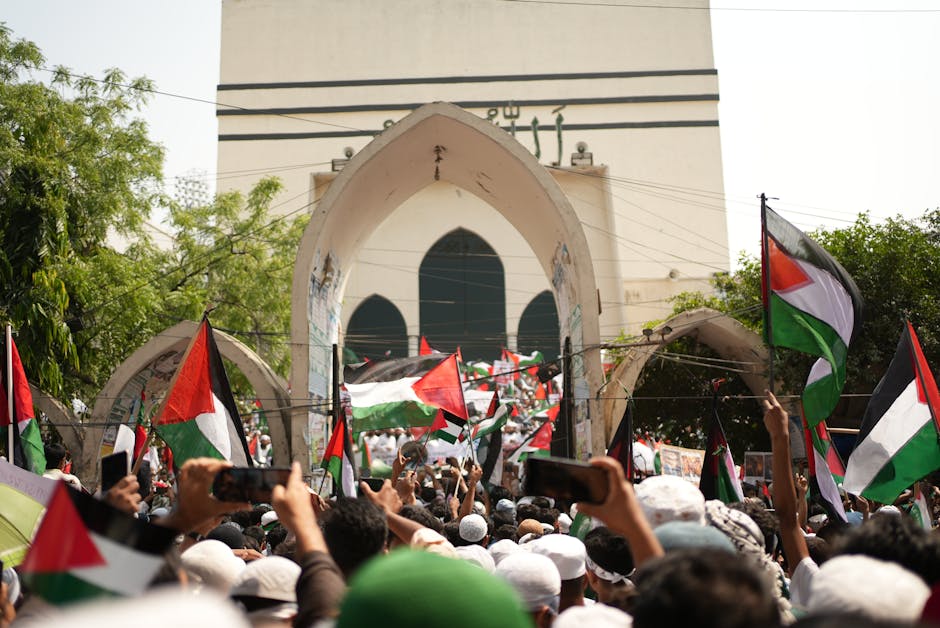
- The Eurovision Song Contest 2024 has sparked protests against Israel’s participation due to the ongoing conflict in Gaza.
- Protesters demand Israel’s exclusion from the contest, citing its military actions in Gaza as a reason.
- Eurovision organizers maintain that participation is based on membership in the European Broadcasting Union (EBU), not political alignment.
- Israel qualifies for the contest as a member of the EBU through its public broadcaster, Kan, but critics argue its presence is untenable.
- The controversy has raised questions about whether a song contest can remain neutral in the face of war and political conflict.
As the Eurovision Song Contest prepares for its glittering grand final in Malmö, Sweden, a different kind of performance is unfolding offstage: waves of protest against Israel’s participation. The annual music spectacle, long celebrated for its camp aesthetics and apolitical spirit, now finds itself entangled in one of the world’s most polarizing conflicts. With Israel’s entry advancing through the semifinals, demonstrators have gathered in growing numbers, demanding the country’s exclusion over its military actions in Gaza. The question on many lips is no longer just who will win Eurovision—but whether a song contest can remain neutral in the shadow of war.
Why Is Israel’s Participation So Controversial?

Eurovision organizers maintain that participation is based on membership in the European Broadcasting Union (EBU), not political alignment. Israel, represented this year by singer Eden Golan and her ballad “Hurricane,” qualifies under these rules as a long-standing EBU member through its public broadcaster, Kan. However, critics argue that the ongoing war in Gaza has made Israel’s presence untenable. Over 30,000 Palestinians have been killed since October 7, according to Gaza health authorities, a figure cited by protest groups calling for Israel’s removal from the contest. Organizers, including the EBU, have rejected calls for exclusion, stating that Eurovision is a cultural event meant to transcend politics. Yet, the decision has drawn criticism from human rights advocates and artists who believe the contest risks complicity by offering a platform to a nation under international scrutiny for alleged war crimes.
What Evidence Supports the Protests?

Protesters point to widespread demonstrations across Europe as evidence of deep public concern. In Malmö, where security has been heightened, thousands marched in mid-May under banners reading “Eurovision Complicit” and “Free Palestine.” The scale of dissent prompted the EBU to issue multiple statements reaffirming its neutrality. Meanwhile, Reuters reported that over 10,000 people took part in one of the largest rallies, with similar actions in London, Paris, and Barcelona. Artists have also voiced opposition: 430 musicians, including Roger Waters and Brian Eno, signed an open letter urging the EBU to ban Israel. Inside the arena, disruptions have occurred—audiences in several countries booed Israel’s entry during voting segments, reflecting broader geopolitical divides. Security forces in Malmö have detained individuals attempting to storm the venue, underscoring the intensity of sentiment.
Are There Counter-Perspectives to the Protests?

Many argue that excluding Israel would set a dangerous precedent, politicizing what has historically been a non-governmental cultural event. Supporters note that Eurovision has included countries during past conflicts—Russia participated until 2022 despite its invasion of Ukraine, and Israel itself has competed during previous Gaza wars. The EBU emphasizes that disqualification would require a breach of contest rules, not political pressure. Furthermore, some within the LGBTQ+ community, a long-time Eurovision fanbase, warn that weaponizing inclusion could backfire on marginalized groups in the future. Eden Golan, the Israeli contestant, has faced antisemitic threats online, prompting the EU’s safety chief to condemn the harassment. Organizers stress that security measures are in place not only for geopolitical reasons but to protect artists from hate speech and extremism—regardless of nationality.
What Is the Real-World Impact of This Controversy?

The Eurovision debate has spilled into diplomacy and public discourse. Sweden, hosting the event after Sweden’s Loreen won in 2023, has seen strained relations with pro-Palestinian communities, particularly in Malmö, where a large Palestinian diaspora resides. Local officials have expressed concern over the city’s image and safety. Broadcasters in several countries have reported technical issues during Israel’s performance—though unverified, many suspect deliberate signal drops. Meanwhile, Israel’s public broadcaster has accused the EBU of bias, citing restricted rehearsal times and online censorship of its promotional materials. The financial cost of security has soared, with Malmö spending millions on riot police and surveillance. Beyond logistics, the contest’s reputation as a unifying celebration is at stake—viewership remains high, but trust in its neutrality is eroding among younger, more politically engaged audiences.
What This Means For You
If you’re following Eurovision, you’re now also witnessing the collision of culture and geopolitics. The contest can no longer be viewed in isolation from global events—its platform carries weight. For viewers, this means grappling with complex questions: Can art be separated from politics? Should international events enforce ethical standards? And how do we balance freedom of expression with accountability? These aren’t just Eurovision issues—they reflect broader societal debates playing out in sports, film, and music.
As the final notes of “Hurricane” fade, one question lingers: in an age of instant global connection, can any major cultural event truly remain apolitical—or are we entering a new era where every stage is also a political one?
Source: Al Jazeera