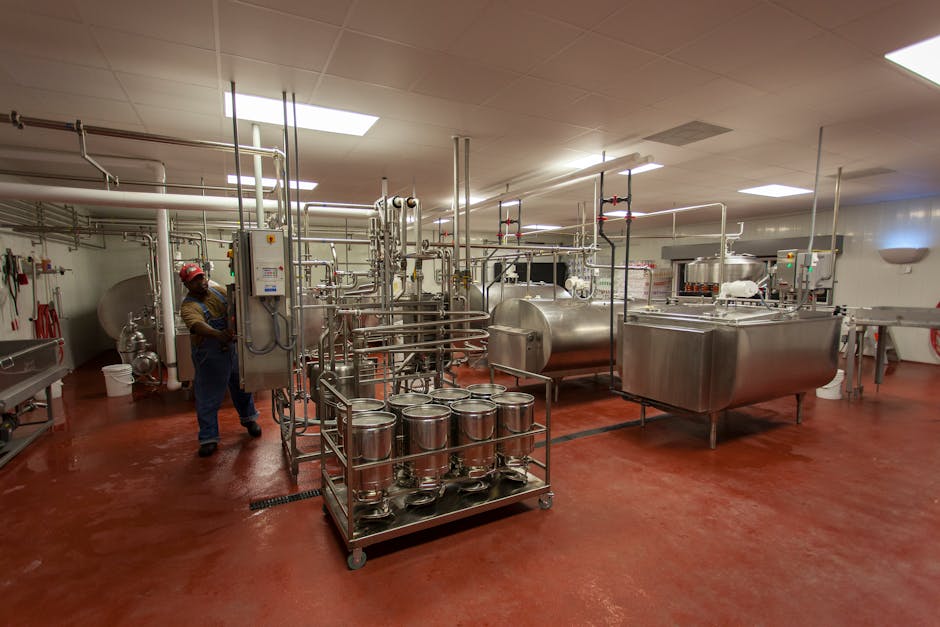
- Petaluma Creamery, a historic creamery in Sonoma County, nearly collapsed due to the pandemic, but AI intervention helped revive the business.
- The creamery’s partnership with Salesforce’s AI division utilized an adaptive agent system to reengineer their supply chain, saving the business.
- AI was trained on regional dairy trends, weather patterns, and consumer behavior to optimize production cycles and suggest new product lines.
- The AI system helped reroute deliveries, improving the creamery’s logistics and reducing losses.
- The successful AI intervention serves as a model for other small businesses to leverage technology and stay competitive.
Inside the fog-draped hills of Sonoma County, where redwood groves frame century-old barns, the scent of aged cheddar lingers in the air at Petaluma Creamery. For generations, the rhythmic churn of copper vats and the quiet hum of fermentation have marked time in this agricultural heartland. But in early 2021, the silence was deafening. Shelves stood empty, orders vanished, and the creamery’s aging workforce watched helplessly as decades of tradition teetered on collapse. The pandemic had severed supply chains, shuttered restaurants, and starved small dairies of their markets. Then, one desperate phone call changed everything. Larry Peter, the creamery’s fourth-generation steward, dialed his cousin in San Francisco—not for sympathy, but for salvation. That call set in motion an improbable alliance between legacy craftsmanship and cutting-edge artificial intelligence.
AI Steps In as Creamery Faces Closure

By March 2021, Petaluma Creamery had lost 78% of its revenue. With no digital infrastructure to pivot online and distribution networks in disarray, the creamery couldn’t adapt fast enough. Then Salesforce’s AI division, led by Larry’s cousin Marcus Chen, proposed an emergency intervention: deploy an adaptive agent system to reengineer the creamery’s entire supply chain in real time. The AI, trained on regional dairy trends, weather patterns, and consumer behavior, began rerouting deliveries, optimizing production cycles, and even suggesting new product lines based on shifting grocery data. Within six weeks, the creamery saw a 43% rebound in sales. By fall, it had surpassed pre-pandemic output, supplying over 200 stores across Northern California. The technology didn’t replace human labor—it augmented it, allowing cheesemakers to focus on quality while algorithms managed logistics.
From Horse-Drawn Wagons to Machine Learning

Founded in 1908 by Swiss immigrants, Petaluma Creamery began as a modest operation serving local ranchers. For decades, it relied on word-of-mouth and regional loyalty, resisting automation to preserve the artisanal character of its flagship Sonoma Jack and aged cheddars. But that resistance became a liability when modern crises demanded agility. The pandemic exposed deeper vulnerabilities: no e-commerce platform, paper-based inventory, and reliance on restaurant contracts that evaporated overnight. The creamery had survived the Great Depression, two world wars, and the rise of industrial dairy—but digital disruption nearly finished it. The intervention by Salesforce wasn’t just a tech upgrade; it was a cultural shift. Workers were trained to collaborate with AI dashboards, interpreting predictive alerts and adjusting curd temperatures in response to forecasted demand spikes.
The People Behind the Turnaround

Larry Peter, 62, grew up cutting cheese blocks beside his father and grandfather. He resisted change for years, fearing automation would erode the creamery’s soul. But as layoffs loomed and silos emptied, he made a radical choice: trust the code. Marcus Chen, a principal AI architect at Salesforce, saw more than a family business—he saw a test case for ethical tech deployment in legacy industries. Their collaboration was tense at first; cheesemakers viewed the AI as a threat, not a tool. But when the system accurately predicted a surge in demand for smoked gouda during a winter storm—leading to a sellout at farmers’ markets—skepticism gave way to partnership. Now, a hybrid team of dairymen and data scientists meets weekly to refine the AI’s models, blending intuition with insight.
Consequences for Small Producers Nationwide

The revival of Petaluma Creamery has sent ripples through America’s shrinking artisanal food sector. According to the New York Times, over 300 small creameries closed between 2020 and 2022. Petaluma’s success story offers a blueprint: integrate AI not to replace tradition, but to protect it. The economic model is already being replicated in Vermont and Wisconsin, where dairy cooperatives are piloting similar AI agents. Yet challenges remain—cost, data privacy, and the risk of over-reliance on corporate tech platforms. Still, the creamery’s survival proves that even the most analog industries can harness digital tools without losing their identity.
The Bigger Picture
This isn’t just about cheese. It’s about the survival of local economies in an age of disruption. As climate change, pandemics, and market volatility become常态, small businesses need resilient systems that blend heritage with innovation. Petaluma Creamery’s journey reflects a broader trend: the democratization of AI from Silicon Valley boardrooms to Main Street workshops. When used ethically, artificial intelligence can be a guardian of culture, not a force of erasure. The creamery’s copper vats still sing with the same rhythm as a century ago—but now, they’re guided by silent, invisible intelligence.
What comes next may redefine American craftsmanship. Petaluma Creamery is now developing an open-source AI module for other small producers, supported by a grant from the USDA. The goal: ensure that no family-run operation faces extinction simply because it lacks access to technology. As Larry Peter said in a recent Reuters interview, “We didn’t abandon our roots. We just gave them a new way to grow.”
Source: Fortune