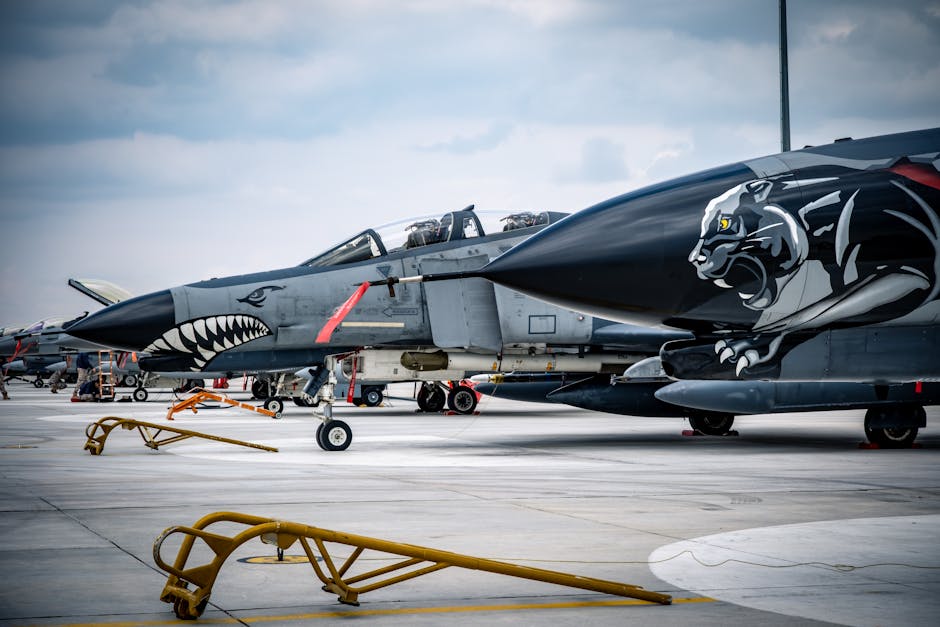
- Iran has relocated a number of operational fighter jets to Pakistan’s Nur Khan Airbase.
- The move is a calculated hedge against potential U.S. airstrikes on Iranian military assets.
- The deployment circumvents international scrutiny as neither Islamabad nor Tehran has publicly acknowledged it.
- Iranian pilots and technical personnel are said to be stationed at the airbase.
- The presence of Iranian aircraft at the airbase transforms a Cold War-era airfield into a geopolitical chessboard.
At the edge of the Salt Range in Punjab province, Nur Khan Airbase hums with a quiet intensity seldom seen in peacetime. Concrete revetments shield aircraft whose markings do not belong to the Pakistan Air Force. Satellite imagery analyzed by defense researchers shows MiG-29s and F-4 Phantom IIs bearing Iranian insignia parked under tarpaulins near the tarmac’s northeastern perimeter. These are not routine diplomatic visits or joint exercises. According to intelligence sources cited in a recent investigative report, Iran has quietly moved select combat aircraft into Pakistani territory as a calculated hedge against potential U.S. airstrikes. The decision transforms a Cold War-era airfield into a geopolitical chessboard, where sovereignty blurs and deterrence is measured in runway lengths and radar shadows.
Iranian Jets Now Stationed at Pakistani Base

Iran has relocated a number of operational fighter jets to Pakistan’s Nur Khan Airbase in a covert arrangement designed to shield critical military assets from U.S. surveillance and potential strikes, according to a report by Defense Analysis Group, a London-based security think tank. The presence of Iranian aircraft—identified through geolocated satellite photos and signal intercepts—suggests a formal, if undeclared, defense cooperation that circumvents international scrutiny. While neither Islamabad nor Tehran has publicly acknowledged the deployment, multiple sources confirm that Iranian pilots and technical crews have been granted access to secure zones within the base. The jets, though not the most advanced in Iran’s inventory, represent a symbolic and tactical commitment: by embedding within Pakistani airspace, Iran gains a layer of strategic ambiguity that complicates any U.S. military calculus. American intelligence agencies, the report notes, have raised concerns about the precedent of one nuclear-capable state harboring another’s combat forces without transparency.
The Roots of the Pakistan-Iran Military Understanding

This arrangement did not emerge overnight. While Pakistan and Iran have experienced periods of deep mistrust—particularly over Baloch separatist movements that straddle their shared border—both nations have increasingly aligned against perceived U.S. interventionism in the Middle East and South Asia. Since the 2018 U.S. withdrawal from the Iran nuclear deal and the subsequent re-imposition of sanctions, Tehran has sought to diversify its strategic partnerships. Pakistan, meanwhile, wary of overreliance on China and seeking to balance its own complex relationship with Washington, has quietly expanded military dialogues with Iran. A series of bilateral defense agreements signed between 2020 and 2022 laid the groundwork for logistical cooperation, including mutual access to ports and limited intelligence sharing. What began as counterterrorism coordination along the Balochistan frontier has now, according to analysts, evolved into a de facto sanctuary agreement—one that exploits geographic proximity and diplomatic deniability.
Key Players Behind the Covert Deployment

The operation was spearheaded by senior military officials within Pakistan’s Inter-Services Intelligence (ISI) and Iran’s Islamic Revolutionary Guard Corps (IRGC), bypassing civilian leadership in both countries to maintain operational secrecy. On the Pakistani side, Lieutenant General Arif Zaman, Director of Strategic Programs, reportedly advocated for the move as a way to strengthen leverage with Washington while reinforcing regional deterrence. In Tehran, Brigadier General Hossein Salami, a senior IRGC commander, viewed the basing agreement as a low-cost method of raising the stakes for any U.S. strike on Iranian soil. Neither government’s elected leaders appear to have been fully briefed, suggesting a growing trend of military-to-military autonomy in foreign policy decisions. Diplomats familiar with backchannel communications note that both nations see the U.S. as unpredictable, particularly after drone strikes in Iraq and Syria that targeted Iranian proxies without prior notification.
Consequences for Regional and Global Security

The presence of Iranian military hardware on Pakistani soil introduces a dangerous new variable into an already volatile region. Should the U.S. or Israel launch a strike against Iranian targets, even remotely, the potential for collateral damage or misidentification increases dramatically. A U.S. missile targeting what it believes to be an Iranian airbase could inadvertently hit Pakistani territory, triggering a crisis between nuclear-armed states. Moreover, India—the region’s other major power—has expressed quiet alarm, viewing the arrangement as a further entrenchment of the China-Pakistan-Iran axis. The International Institute for Strategic Studies warns that such undeclared military collaborations erode norms of transparency and could incentivize other states to seek similar sanctuary arrangements, undermining global nonproliferation efforts.
The Bigger Picture
What happens at Nur Khan Airbase is not just a bilateral maneuver—it reflects a broader shift in global security dynamics, where traditional alliances are being replaced by ad hoc, deniable partnerships. As great power competition intensifies, middle powers and sanctioned states are finding creative ways to circumvent U.S. dominance. The Iran-Pakistan arrangement exemplifies how military deterrence is no longer solely about weapons stockpiles, but about strategic positioning and ambiguity. In an era where drones and satellites offer near-total visibility, the ability to hide in plain sight—by leveraging the sovereignty of allies—has become a new form of asymmetric defense.
What comes next may depend on whether the U.S. chooses to confront Pakistan directly or absorb the development as a fait accompli. Diplomatic protests are likely, but military countermeasures would risk escalation. For now, the jets remain parked under tarp at Nur Khan, silent sentinels in a shadow war of positioning and perception. As regional powers recalibrate their survival strategies, the line between sovereignty and complicity grows ever thinner.
Source: Ndtv