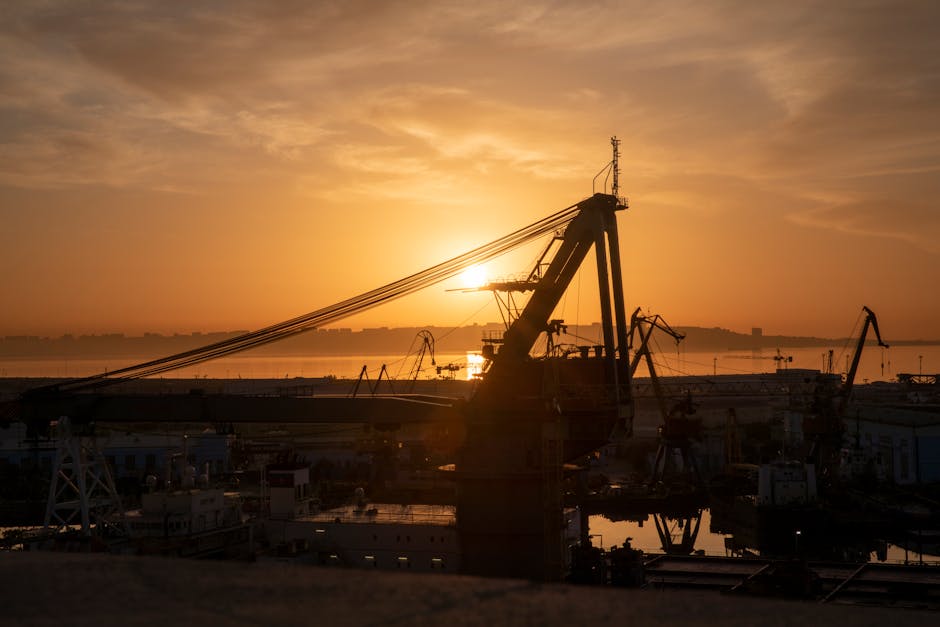
- The Caspian Sea has become a vital trade lifeline for Iran, driven by a surge in cargo volumes from Russia.
- The Caspian Marine Institute reports a 60% increase in cargo crossings from Russia to Iran over the past 18 months.
- Dual-use goods, including high-grade electronics and military equipment, are now being transported across the Caspian Sea.
- Iranian ports like Anzali and Nowshahr are key destinations for Russian freighters, allowing Iran to avoid U.S. naval patrols.
- The Caspian Sea has emerged as a crucial artery of resistance and reconnection for Iran, despite international sanctions.
On the wind-scraped shores of the Caspian Sea, where salt-laced air bites the skin and oil rigs dot the horizon like skeletal sentinels, a quiet revolution is unfolding. Once dismissed as a geopolitical backwater, this landlocked sea—larger than Germany—has become a clandestine artery of survival for Iran. At the port of Anzali, cranes groan under the weight of shipping containers arriving not from the Persian Gulf, but from Russia’s Volga coast. These vessels carry more than steel and machinery; they carry defiance. Under the shadow of international sanctions and the constant threat of surveillance, Iran is stitching together a new lifeline across shimmering, landbound waters, transforming a forgotten maritime zone into a fulcrum of resistance and reconnection.
Russia’s Resupply Corridor to Iran Takes Shape

Over the past 18 months, the volume of cargo crossing the Caspian Sea from Russia to Iran has surged by over 60%, according to shipping data compiled by the Caspian Marine Institute. These routes, once used primarily for energy and agricultural trade, now carry dual-use goods—high-grade electronics, aviation components, and reportedly, military equipment such as drone subsystems and radar technology. Russian freighters depart from Astrakhan and Makhachkala, traverse the northern Caspian, and dock at Iranian ports like Anzali and Nowshahr, avoiding the Strait of Hormuz and U.S. naval patrols entirely. Satellite imagery analyzed by Reuters reveals a steady rhythm of nighttime unloading, often under minimal port lighting, suggesting efforts to evade detection. Crucially, these shipments exploit regulatory gaps: the Caspian’s legal status as neither fully sea nor lake allows littoral states to restrict third-party monitoring, making oversight nearly impossible.
How Decades of Isolation Forged a New Lifeline

The strategic pivot to the Caspian did not emerge overnight. For years, Iran faced tightening sanctions following nuclear program revelations in the early 2000s, culminating in the U.S. withdrawal from the JCPOA in 2018 and the re-imposition of crippling economic measures. Cut off from traditional banking channels and maritime routes patrolled by American and allied forces, Tehran began diversifying its logistics. The 2018 signing of the Convention on the Legal Status of the Caspian Sea—a five-party agreement between Iran, Russia, Azerbaijan, Kazakhstan, and Turkmenistan—was pivotal. It affirmed that only littoral nations could deploy military vessels, effectively excluding NATO or U.S. presence. This diplomatic breakthrough, coupled with growing Sino-Russian influence, created a security envelope within which Iran could operate. By 2022, joint Russian-Iranian military exercises in the Caspian signaled not just cooperation, but strategic alignment, laying the groundwork for today’s supply surge.
The Architects of the Caspian Corridor

Behind this logistical transformation are a network of state actors and shadow operators. On the Russian side, Rosmorrechflot, the federal agency overseeing inland waterways, has quietly expanded its Caspian fleet capacity, while state-owned Transneft has rerouted rail cargo to Caspian terminals. In Iran, the Islamic Revolutionary Guard Corps (IRGC) oversees key port operations and logistics, ensuring that sensitive shipments bypass civilian oversight. Figures like IRGC logistics commander Brigadier General Mohammad Reza Naghdi have been instrumental in integrating Russian deliveries into Iran’s domestic supply chains. Meanwhile, Azerbaijani and Kazakh officials, though officially neutral, tolerate the flow, wary of antagonizing Moscow or Tehran. Private shipping firms registered in Turkmenbashi—many with ties to Russian oligarchs—serve as intermediaries, laundering the provenance of goods through multiple transshipments, making tracking nearly futile for Western intelligence.
Escalating Stakes for Regional and Global Powers

The implications of this emerging corridor extend far beyond trade statistics. For the United States and its allies, the Caspian route undermines the effectiveness of sanctions, allowing Iran to sustain both its economy and military modernization. This includes supporting proxy forces in Yemen, Syria, and Iraq with newly acquired drone technology assembled from Russian-supplied parts. European nations, already grappling with energy instability post-Ukraine war, now face a more assertive Iran less dependent on Gulf chokepoints. For regional actors, the shift alters balance of power: Saudi Arabia and Israel view the Caspian link as a threat, potentially prompting new surveillance or cyber operations targeting the supply chain. Even China watches closely, eyeing the corridor as a potential extension of its Belt and Road Initiative, though Beijing publicly urges restraint.
The Bigger Picture
The Caspian Sea’s rise as a strategic conduit reflects a broader realignment: a world where sanctioned states forge parallel systems to circumvent Western-dominated institutions. It underscores the limits of maritime interdiction when landlocked routes and regional complicity fill the gaps. More than a trade shift, it is a symptom of a fragmenting global order, where geography is being reinterpreted through the lens of resistance and resilience. As climate change alters shipping patterns and new infrastructure projects take root, the Caspian may become not an exception, but a blueprint for sanctioned nations seeking autonomy.
What comes next is likely further entrenchment. Iran and Russia are reportedly negotiating a joint Caspian logistics authority, which would formalize and expand the corridor. Western responses remain uncertain—diplomatic protests have had little effect, and military intervention is politically untenable. The sea, long overlooked, has become a mirror: reflecting power, secrecy, and the quiet persistence of those determined to survive beyond surveillance.
Source: The New York Times