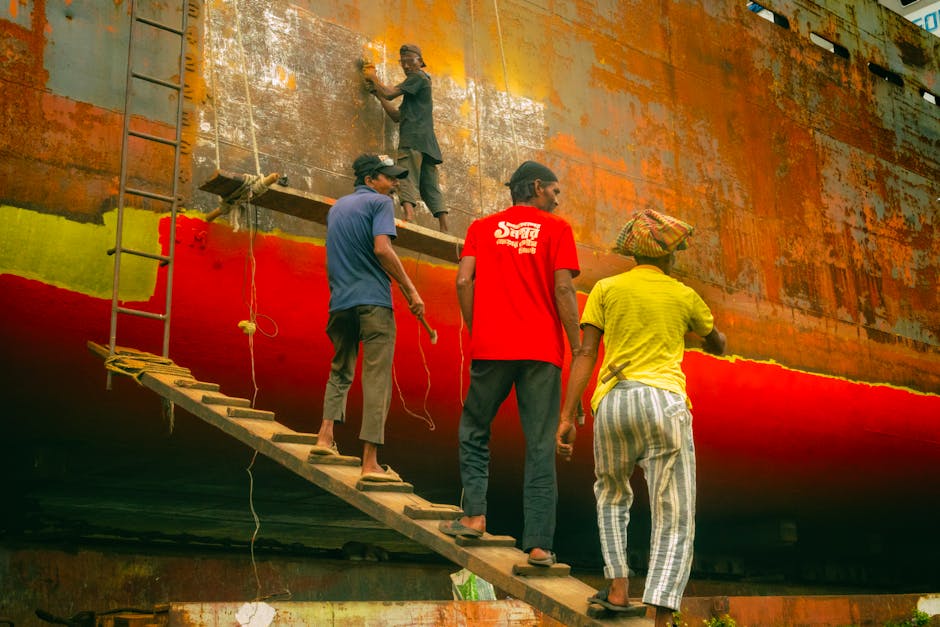
- The US and South Korea signed a trade deal to revitalize their shipbuilding industries.
- The deal aims to counter China’s dominance in global ship production.
- South Korea will collaborate with US firms to modernize US shipyards and improve production efficiency.
- The partnership will also focus on workforce development and supply chain integration.
- President Trump expressed strong support for South Korea in the signing ceremony.
Under the steel-gray skies of the Washington Navy Yard, where the Potomac whispers past century-old drydocks, diplomats and defense contractors gathered for a ceremony that felt equal parts economic summit and geopolitical theater. Cameras flashed as U.S. and South Korean officials exchanged signed documents, their faces lit by the glow of national flags. The air hummed not just with diplomatic niceties, but with the unspoken weight of maritime power, industrial resilience, and a shifting balance in global trade. President Donald Trump, sleeves rolled up and tie slightly askew, stood at the podium and declared, ‘I love South Korea.’ The remark, at once casual and calculated, rippled through the crowd — a signal that, despite years of tense negotiations over defense spending and trade imbalances, a new chapter in U.S.-Korea industrial cooperation had begun.
U.S.-South Korea Pact Targets Shipbuilding Revival

The memorandum of understanding (MOU) signed between the United States and South Korea focuses on revitalizing commercial and defense-related shipbuilding through technology sharing, workforce development, and supply chain integration. The agreement aims to counter China’s dominance in global ship production, where it currently controls over 40% of new vessel construction. South Korea, long a leader in high-tech maritime engineering, will collaborate with American firms to modernize U.S. shipyards, improve production efficiency, and accelerate the development of next-generation vessels, including LNG carriers and offshore wind installation ships. According to the U.S. Department of Transportation, only 1% of the global commercial fleet is built in American shipyards, a stark decline from its mid-20th century peak. This MOU marks the first formal industrial partnership of its kind since the Cold War, signaling a strategic pivot to align technological strengths against shared economic and security concerns. Reuters reported that the initiative includes joint research grants and reciprocal workforce training programs set to launch by early next year.
Decades of Trade Tension and Strategic Alignment

The roots of this agreement stretch back to the 1980s, when South Korea emerged as a shipbuilding powerhouse, surpassing Japan and challenging European dominance. At the same time, American shipyards — once the envy of the industrial world — began a slow decline, undercut by cheaper foreign labor and outdated infrastructure. By the 1990s, the U.S. had largely ceded commercial shipbuilding to Asian rivals, focusing instead on military vessels. Tensions flared in 2018 when the Trump administration threatened tariffs on South Korean steel under Section 232 of the Trade Expansion Act, citing national security concerns. Seoul responded by offering voluntary export restraints, narrowly avoiding punitive measures. Despite these frictions, both nations remained key allies through the Korea-U.S. Mutual Defense Treaty. Over time, shared anxieties about China’s Belt and Road Initiative, its growing naval presence, and its state-subsidized shipbuilding sector created common ground. The current MOU is less a sudden breakthrough than the culmination of years of quiet diplomacy, technical exchanges, and mutual reassessment of industrial sovereignty.
Key Figures Driving the Maritime Alliance

On the American side, the initiative was championed by Secretary of Transportation Pete Buttigieg, who framed the partnership as essential to rebuilding domestic manufacturing and securing critical supply chains. Buttigieg, working closely with the Department of Defense and the Maritime Administration (MARAD), emphasized that modern shipbuilding is not just about hulls and engines, but about cybersecurity, automation, and green propulsion systems. In Seoul, Minister of Oceans and Fisheries Cho Tong-hyung led negotiations, advocating for a balanced agreement that protects South Korea’s competitive edge while expanding access to U.S. markets. Behind the scenes, executives from Hyundai Heavy Industries and Hanwha Ocean pushed for provisions that allow joint ventures without mandatory technology transfer. Meanwhile, President Trump’s vocal support — including his now-famous ‘I love South Korea’ remark — served as both a diplomatic olive branch and a political signal to his base that ‘American jobs’ could be revived through strategic alliances rather than isolation. His administration’s ‘America First’ doctrine, often interpreted as protectionist, finds an exception in partnerships that promise tangible industrial returns.
Geopolitical and Economic Consequences Unfold

The MOU has immediate implications for global shipping, defense logistics, and regional stability. By enhancing South Korea’s role as a high-value maritime technology partner, the U.S. gains a critical ally in reducing dependence on Chinese shipyards, which now dominate repairs and construction for both commercial and naval fleets. For American workers, the agreement could lead to thousands of new jobs in coastal industrial zones, particularly in Virginia, Mississippi, and Maine. However, critics warn that without sustained investment and regulatory reform, U.S. shipyards may still struggle to compete on cost and scale. China has already responded with subtle countermeasures, including tightened export controls on rare earth elements used in marine electronics. The BBC noted that Beijing views the pact as part of a broader U.S. effort to encircle its maritime ambitions, potentially escalating trade friction in the Indo-Pacific. Meanwhile, European shipbuilders, particularly in Italy and Germany, fear being sidelined in transatlantic defense contracts.
The Bigger Picture
This shipbuilding agreement is not merely about ships — it’s about sovereignty in an age of great power competition. As global trade routes grow more contested, the ability to build, maintain, and deploy vessels becomes a strategic imperative. The U.S.-South Korea MOU reflects a broader trend: the re-nationalization of critical industries once deemed obsolete. From semiconductors to batteries, nations are reasserting control over supply chains that underpin both economic resilience and military readiness. In this context, shipbuilding is both a symbol and a substance of national power.
What comes next will test the durability of this alliance. Pilot projects are expected to begin in 2024, with the first jointly constructed vessel slated for launch by 2026. Success will depend not just on political will, but on the ability to navigate labor regulations, environmental standards, and technological integration. If it works, the Potomac may once again echo with the clang of hammers on steel — not just as a nostalgic revival, but as a declaration of industrial rebirth in a fractured world.
Source: M-en