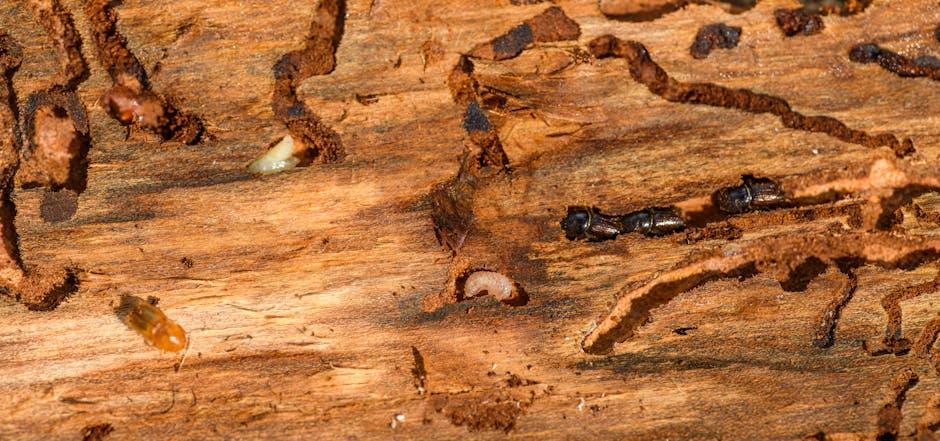
- Bistrifluron is a new chemical that can eliminate 95% of drywood termites without toxic fumes.
- Unlike traditional fumigants, bistrifluron targets termites specifically and doesn’t harm humans, pets, or beneficial insects.
- Bistrifluron works by disrupting the molting process in termites, inhibiting chitin synthesis and causing dehydration and death.
- This new chemical has shown promising results in controlled laboratory trials and early field studies.
- Bistrifluron offers a more targeted and safer approach to termite control compared to traditional methods.
In the dim silence of a suburban attic, where wood beams sweat under the weight of decades, an invisible war is being waged. Inside the grain, drywood termites gnaw through floor joists and support beams, their colonies thriving in darkness. For homeowners, the first sign of infestation is often too late—a hollow knock, a crumbling sill plate, a structure weakened from within. But now, scientists are deploying a silent assassin of their own: a compound so precisely targeted it dismantles termite colonies from the inside out, leaving humans and pets unharmed. This is not the acrid fog of sulfuryl fluoride that once forced families to flee their homes for days. This is bistrifluron—a chemical assassin with a singular mission and a microscopic blade.
Bistrifluron’s Precision Strike on Termite Colonies

In controlled laboratory trials and early field studies, bistrifluron has demonstrated the ability to eliminate approximately 95% of drywood termite populations without resorting to broad-spectrum toxins. Unlike traditional fumigants that permeate entire structures and pose health risks to humans, pets, and beneficial insects, bistrifluron works selectively by disrupting the molting process in termites. Specifically, it inhibits chitin synthesis—the biological mechanism responsible for forming new exoskeletons during growth. When termites attempt to molt, they fail to develop a protective outer shell, leading to dehydration and death. Because mammals do not produce chitin, the compound is biologically inert in humans and other vertebrates, making it a dramatically safer alternative. Researchers have embedded the chemical in bait matrices placed directly into infested wood, allowing worker termites to carry it back into the colony, spreading lethality like a silent contagion.
The Long Road from Fumigation to Targeted Toxins

For over a century, termite control has relied heavily on chemical warfare. The widespread use of fumigants like methyl bromide and, later, sulfuryl fluoride transformed pest management but came with steep environmental and health costs. Sulfuryl fluoride, long considered the gold standard for drywood termite eradication, is a potent greenhouse gas with a global warming potential thousands of times greater than carbon dioxide. It also lingers in the atmosphere for decades and has raised concerns over fluoride accumulation in soil and food. Regulatory pressure mounted, particularly after reports linked post-fumigation exposure to neurological symptoms in sensitive individuals. These risks spurred the search for alternatives. The development of insect growth regulators (IGRs) marked a turning point, shifting focus from brute-force poisoning to precision interference with insect biology. Bistrifluron, a member of the benzoylurea class of IGRs, represents the latest evolution—designed not to poison, but to prevent development.
The Scientists Behind the Silent Killer

The breakthrough emerged from collaborative work between entomologists at the University of California, Riverside, and pest control researchers at the USDA Agricultural Research Service. Dr. Elena Marquez, a leading urban entomologist, described the goal as “fighting invisibility with intelligence.” Her team focused on exploiting the biological vulnerabilities unique to insects, particularly hemimetabolous species like termites that undergo gradual metamorphosis. “We’re not trying to kill everything that moves,” she explained in a recent interview with ScienceDaily. “We’re targeting a single, essential process that only insects rely on.” The research was driven by both public health concerns and the expanding footprint of invasive termite species, such as the Asian subterranean termite, which has established colonies in Florida, Texas, and Hawaii. With climate change enabling termites to survive in regions once too cold, the urgency for scalable, eco-friendly solutions has never been greater.
Implications for Homeowners, Ecosystems, and Industry

If bistrifluron-based treatments gain regulatory approval and widespread adoption, the implications extend far beyond individual homes. For homeowners, the shift could mean faster, cheaper, and safer interventions—no evacuation, no tenting, no lingering chemical odors. For the pest control industry, it signals a move toward more sustainable, evidence-based practices. Municipalities in termite-prone areas may adopt preventive baiting programs similar to those used for fire ant suppression. Ecologically, replacing broad-spectrum fumigants with targeted compounds reduces collateral damage to non-target species, including pollinators and soil microbes. However, challenges remain. Bistrifluron must prove effective in diverse structural environments and against multiple termite species. There is also the risk of resistance development, a common pitfall in insecticide use. Ongoing monitoring and integrated pest management strategies will be essential to preserve its long-term efficacy.
The Bigger Picture
This advance is part of a broader transformation in how humanity manages its relationship with insects. As urbanization accelerates and climate zones shift, the line between coexistence and conflict blurs. Bistrifluron exemplifies a new paradigm: one that leverages deep biological understanding to design interventions that are both effective and minimally disruptive. It reflects a maturing approach to pest control—one rooted not in domination, but in precision. The success of such tools may determine whether future generations inherit cities that stand firm, or crumble quietly from within.
What comes next is not just regulatory review, but a reimagining of home maintenance itself. Scientists are already exploring delivery systems—micro-injectable gels, drone-assisted baiting, even genetically tuned microbes—that could make treatments seamless and preemptive. If bistrifluron clears the final hurdles, it may mark the beginning of the end for one of homeowners’ oldest and most insidious foes.
Source: ScienceDaily