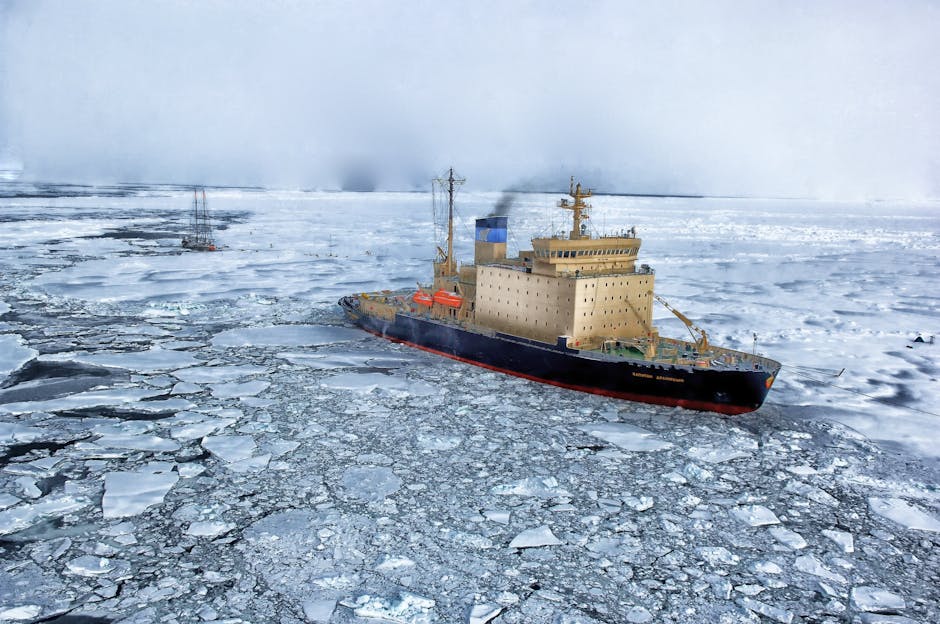
- A Bering Strait dam could potentially prevent a climate catastrophe in Europe by preserving the Atlantic Meridional Overturning Circulation.
- The AMOC has weakened by 15% since the mid-20th century, contributing to a potential European deep freeze.
- A massive barrier across the Bering Strait could manipulate one of Earth’s most powerful ocean systems.
- The AMOC transports warm tropical waters northward, moderating Europe’s climate and making a Bering Strait dam a possible solution.
- A Bering Strait dam is a radical geoengineering solution that could be considered to prevent climate collapse.
What if the key to preventing a climate catastrophe in Europe lies beneath the icy waters of the Bering Strait? As the Atlantic Meridional Overturning Circulation (AMOC) shows signs of weakening, some scientists are asking whether a radical geoengineering solution—a dam stretching 130 kilometres between Alaska and Russia—could prevent a dramatic cooling in northern Europe. The idea sounds like science fiction, but with new models suggesting the AMOC could collapse as early as mid-century, researchers are treating the proposal with increasing seriousness. Could humanity build a structure larger than any existing dam to manipulate one of Earth’s most powerful ocean systems, and should we?
Can a Mega-Dam Prevent a European Deep Freeze?

Yes—according to a controversial 2017 study published in Scientific Reports, a massive barrier across the Bering Strait could help preserve the Atlantic Meridional Overturning Circulation, the ocean conveyor belt responsible for transporting warm tropical waters northward and moderating Europe’s climate. The AMOC has weakened by an estimated 15% since the mid-20th century, and continued melting of the Greenland ice sheet is injecting vast amounts of freshwater into the North Atlantic, disrupting the salinity-driven circulation. By blocking additional Pacific water from entering the Arctic via the Bering Strait, the dam would reduce freshwater influx and help maintain the density gradients needed for the AMOC to function. While not a cure-all, the dam could buy time—decades, perhaps—while global emissions are reduced.
What Evidence Supports the Bering Strait Dam?

Computer simulations from the Proceedings of the National Academy of Sciences show that increased freshwater flow through the Bering Strait contributes to Arctic stratification, inhibiting the deep-water formation that powers the AMOC. Researchers from the Potsdam Institute for Climate Impact Research modeled a scenario where a Bering Strait dam reduced heat loss in the Labrador Sea, a critical AMOC formation zone, by stabilizing salinity levels. In one simulation, the intervention delayed AMOC collapse by up to 150 years. Additionally, historical evidence from paleoclimatology suggests that natural blockages in the Bering Strait during glacial periods coincided with stronger Atlantic circulation. While these models are theoretical, they provide a scientific basis for considering large-scale Arctic hydrological interventions. The dam would not stop Greenland’s melt, but it could prevent that meltwater from mixing with Pacific inflows to further destabilize the system.
What Are the Risks and Skeptical Views?

Many climate scientists argue that such a project is dangerously overambitious and could trigger unforeseen ecological and geopolitical consequences. Dr. Stefan Rahmstorf of the Potsdam Institute, while acknowledging the theoretical merit, warns that “deliberately manipulating ocean circulation is playing with fire.” The Bering Strait is a critical migratory route for marine mammals and a delicate ecosystem supporting indigenous communities. Blocking it could alter Arctic salinity, ice formation, and weather patterns across the Northern Hemisphere. Others question the feasibility: a 130-kilometre dam in one of Earth’s most remote and storm-prone regions would cost hundreds of billions, require decades of construction, and face insurmountable political hurdles between the US and Russia. Some experts also argue that focusing on adaptation and emissions reduction is more practical than investing in speculative megaprojects that may distract from root causes.
What Would This Mean for the Real World?

If the AMOC collapses, northern Europe could experience significantly colder winters, disrupted agriculture, and extreme weather shifts—despite global warming. Coastal cities might face altered sea levels, while marine ecosystems could collapse due to shifting temperatures and nutrient flows. The dam, while hypothetical, underscores the growing desperation in climate engineering circles. Smaller-scale versions, such as underwater sills or partial barriers, are being discussed as testable alternatives. In Alaska and Chukotka, indigenous leaders have expressed concern about disruptions to traditional fishing and hunting. Meanwhile, countries like the UK and Norway, heavily dependent on the AMOC’s warming effect, may begin funding research into such interventions as insurance policies. The mere discussion of the Bering Strait dam signals a shift: climate solutions are no longer just about solar panels and carbon taxes, but potentially planet-scale engineering.
What This Means For You
For most people, the Bering Strait dam remains a distant, theoretical idea—but it reflects a growing reality: climate change may soon force us to consider extreme measures. While the dam itself may never be built, its proposal highlights the urgency of stabilizing the AMOC through emissions reductions and international cooperation. Citizens should support policies that prioritize climate resilience and scientific research, while remaining critical of techno-fixes that could create new problems. The future of Europe’s climate may depend not just on what we emit, but on how boldly—and wisely—we choose to intervene.
Could humanity responsibly manage a project that reshapes ocean currents and alters global climate patterns? And if not, what happens when the AMOC begins to fail without a backup plan?
Source: New Scientist