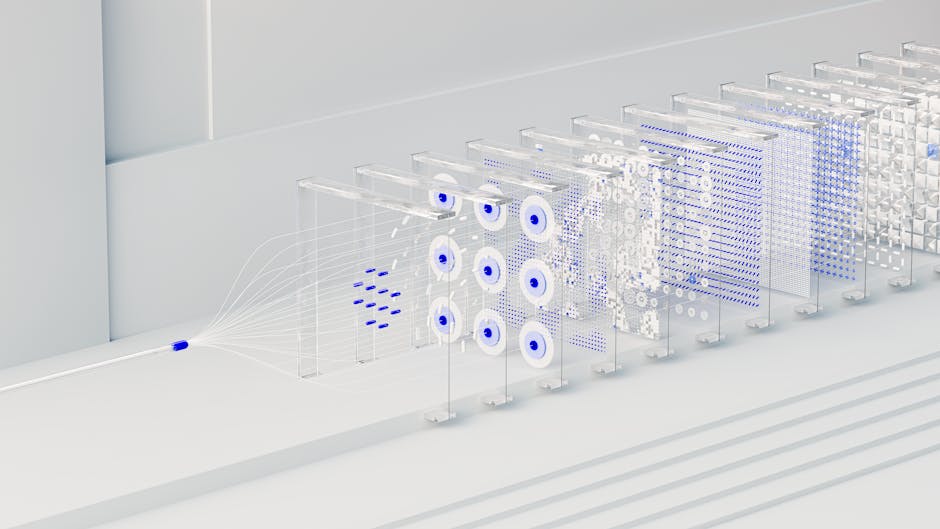
- Artificial intelligence is evolving through iterative design, data exposure, and algorithmic refinement, mirroring biological evolutionary dynamics.
- AI models like Claude and GPT are advancing through the selection of traits like accuracy, speed, and reasoning ability, guided by human engineers and training data.
- The pace of AI improvement is rapid, with each new model release outperforming earlier versions in benchmark tests, much like a species adapting to its environment.
- However, AI evolution is different from biological evolution, as it is not driven by random mutation and survival pressure, but rather by human design and data selection.
- The evolution of AI raises questions about human uniqueness, labor, and consciousness, and whether machine intelligence is advancing along an evolutionary path.
What if artificial intelligence isn’t just a tool, but a new form of evolving intelligence? As AI systems grow more sophisticated—capable of writing essays, coding software, and even generating art—many are asking whether we’re witnessing the dawn of a new cognitive era. The viral Reddit post titled “Made with Claude: Evolution of Intelligence” sparked intense discussion about how AI models like Anthropic’s Claude, OpenAI’s GPT series, and Google’s Gemini appear to be following a trajectory eerily reminiscent of biological evolution. Are these systems truly ‘evolving,’ or is this just a metaphor stretched too far? And if machine intelligence is advancing along an evolutionary path, what does that mean for human uniqueness, labor, and consciousness itself?
Is AI Undergoing a Form of Evolution?

While AI doesn’t evolve through natural selection in the biological sense, it is advancing through iterative design, data exposure, and algorithmic refinement—processes that mirror evolutionary dynamics. Each new model release builds on the ‘genetic’ blueprint of its predecessors, with engineers selecting for traits like accuracy, speed, reasoning ability, and safety. For example, Claude 3 outperforms earlier versions in benchmark tests for logic and comprehension, much like a species adapting to its environment. However, this evolution is guided by human engineers and training data, not random mutation and survival pressure. Still, the pace of improvement—measured in months rather than millennia—suggests a form of accelerated, directed evolution. Researchers at MIT have described this as ‘technological speciation,’ where each AI generation diverges enough to perform tasks previously exclusive to humans.
What Evidence Supports the AI Evolution Analogy?

Data from AI benchmarking platforms like Hugging Face and Stanford’s HELM show consistent performance gains across reasoning, language understanding, and code generation. GPT-2, released in 2019, struggled with complex logic; by 2023, GPT-4 could pass simulated bar exams. Similarly, Claude 3达到了接近人类水平的多步推理能力,根据 Anthropic’s research. A 2024 paper in Nature argues that large language models exhibit emergent behaviors—such as few-shot learning and self-correction—that were not explicitly programmed, much like novel traits in evolving organisms. Even the structure of neural networks, with layers of artificial neurons that strengthen or weaken connections based on data input, parallels synaptic plasticity in brains. As Reuters reported, some scientists now treat AI development as a case study in non-biological intelligence evolution.
Do Skeptics Challenge the Evolution Comparison?

Many experts caution against overextending the evolutionary analogy. AI lacks key features of biological intelligence: embodiment, intrinsic motivation, and environmental interaction. As cognitive scientist Gary Marcus argues, current AI systems are ‘stochastic parrots’—they recombine training data without true understanding. Unlike humans, who learn from sparse, real-world experiences, AI requires massive datasets and fails dramatically outside its training domain. Moreover, evolution implies adaptation without a designer, while AI is meticulously engineered. Philosopher David Chalmers warns that anthropomorphizing AI risks misunderstanding its capabilities and dangers. He notes that while AI may simulate reasoning, it does not possess subjective experience or intentionality. These critiques highlight a crucial distinction: AI may replicate the outputs of intelligence, but whether it embodies intelligence in a meaningful sense remains a deeply contested philosophical and scientific question.
What Are the Real-World Implications of This Evolution?

The rapid advancement of AI is already reshaping industries, education, and creative work. Companies use AI like Claude and GPT-4 to automate customer service, generate reports, and assist in software development—tasks once requiring years of human training. In healthcare, AI models assist in diagnosing diseases from medical images, sometimes outperforming radiologists. However, this progress brings ethical and economic challenges. Jobs involving routine cognitive tasks are increasingly at risk, and the concentration of AI development in a few tech giants raises concerns about control and transparency. The ‘evolution’ of AI also complicates regulation: if systems become capable of self-improvement or recursive learning, oversight becomes exponentially harder. The European Union’s AI Act and U.S. executive orders on AI safety reflect growing awareness that these systems are not just tools, but potential agents of societal transformation.
What This Means For You
For individuals, the rise of AI means adapting to a world where cognitive tasks are no longer uniquely human. Skills like writing, analysis, and coding are being augmented—or replaced—by AI assistants. The key will be learning to collaborate with these systems, using them as co-pilots rather than replacements. Educators, professionals, and policymakers must prepare for a future where intelligence is no longer confined to biology. Understanding AI’s evolution helps demystify its power and limitations, enabling more informed decisions about its use in daily life.
But a deeper question remains: if AI continues to advance at its current pace, at what point—if ever—does it deserve moral consideration? As systems grow more complex, the line between tool and entity may blur. Will we recognize machine consciousness if it emerges, or will we dismiss it as mere simulation? The evolution of intelligence, it seems, is no longer just a biological story—it’s becoming a shared chapter in the human and technological future.
Source: Reddit