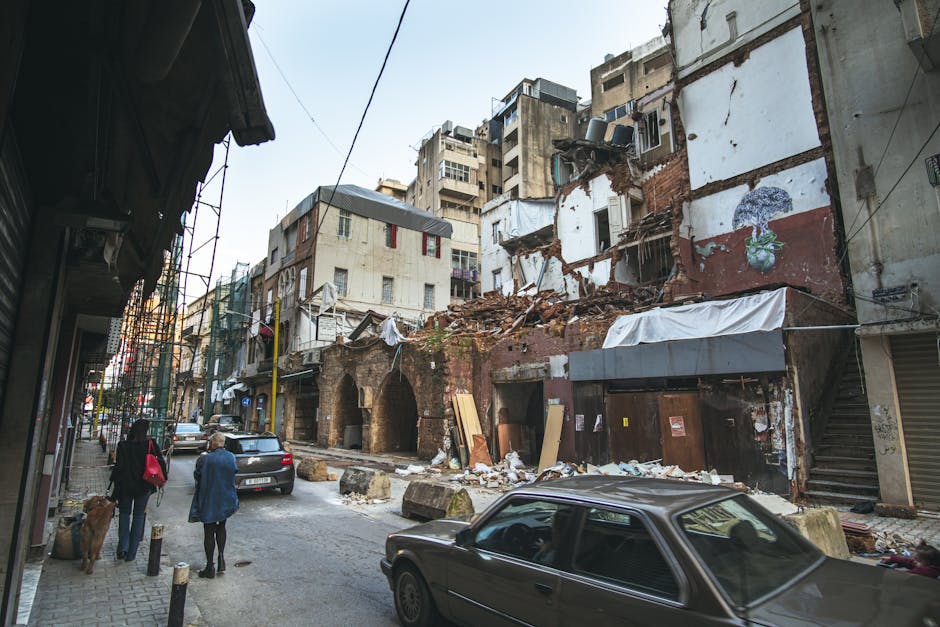
- 70% of southern Lebanon’s population, around 500,000 people, has been displaced due to Israeli military operations.
- Israeli forces have demolished villages and consolidated control in the region, shifting public perception in favor of Hezbollah.
- Civilians view Hezbollah as their primary defense against what they see as an existential threat from Israeli forces.
- Satellite imagery shows systematic demolition of residential areas, with over 200 buildings destroyed in the first three weeks.
- Humanitarian agencies report widespread damage to civilian infrastructure with limited evidence of military use.
As Israel’s military operations intensify in southern Lebanon, Hezbollah is experiencing a significant shift in public perception. Once a polarizing force criticized for entangling Lebanon in regional conflicts, the group has seen a resurgence in popular backing as Israeli forces demolish villages and consolidate control. Civilians in the south, many of whom had grown weary of Hezbollah’s political dominance, now view the group as their primary defense against what they describe as an existential threat. This transformation underscores how military escalation can rapidly reshape political allegiances in fragile environments.
Displacement and Destruction in the South

According to the United Nations Office for the Coordination of Humanitarian Affairs (OCHA), over 70% of southern Lebanon’s population—nearly 500,000 people—has been displaced since the beginning of Israel’s ground incursion in early October. Satellite imagery analyzed by BBC News shows systematic demolition of residential areas in towns like Qana, Bint Jbeil, and Marjayoun. Israeli Defense Forces (IDF) state these operations target Hezbollah infrastructure, including tunnel networks and weapons caches, but humanitarian agencies report widespread damage to civilian infrastructure with limited evidence of military use. The IDF has acknowledged the destruction of over 200 buildings in the first three weeks of operations, though independent verification remains limited due to restricted access. This scale of displacement and destruction has galvanized local sentiment, with many in the displaced communities citing the demolitions as proof of a broader campaign of territorial erasure.
Hezbollah’s Evolving Role and Regional Backing

Hezbollah, formally designated a terrorist organization by the United States and several Western nations, has long operated as both a political party and a paramilitary force within Lebanon. Despite widespread criticism after the 2020 Beirut port explosion and years of economic mismanagement, the group has maintained a strong security apparatus funded and trained by Iran. In recent weeks, Hezbollah has launched over 1,200 rocket and drone attacks into northern Israel, according to Reuters, signaling its continued operational capacity. Iran’s foreign minister recently reaffirmed support for Hezbollah’s ‘resistance’ role, while Syria has allowed logistical corridors for arms transfers. Domestically, Hezbollah-affiliated officials have coordinated emergency relief efforts in displaced persons camps, further cementing its dual identity as both protector and political actor.
Costs of Resurgence: Stability Versus Sovereignty

The renewed reliance on Hezbollah presents a profound dilemma for Lebanon’s future. On one hand, the group’s military capacity offers immediate protection against Israeli advances, particularly in the absence of effective state security forces. Its social services network, including healthcare and food distribution, has filled critical gaps left by the collapsing public sector. On the other hand, Hezbollah’s empowerment undermines the sovereignty of the Lebanese state and risks deepening foreign dependency on Iran. International donors, including the European Union and United States, have conditioned aid on the weakening of non-state armed groups, making long-term economic recovery more difficult. Furthermore, continued cross-border attacks increase the risk of all-out war, with Israel’s cabinet recently authorizing ‘expanded operations’—a signal that the conflict may escalate beyond current levels.
Why the Shift Is Happening Now

The turning point in public sentiment appears to have occurred in mid-October, when Israeli forces began demolishing entire neighborhoods in the border zone, declaring them ‘closed military areas.’ Unlike earlier phases of the conflict, which involved aerial bombardments and limited ground raids, the current campaign involves prolonged occupation and structural dismantling of communities. This has triggered memories of Israel’s 18-year occupation of southern Lebanon, which ended in 2000 and remains a potent symbol in Lebanese collective memory. Additionally, the Lebanese Armed Forces (LAF), traditionally seen as a neutral institution, have remained largely on the sidelines, constrained by political divisions and lack of resources. With no credible alternative security provider, civilians have gravitated toward Hezbollah as the only force actively resisting Israeli advances.
Where We Go From Here
In the next six to twelve months, Lebanon could face one of three trajectories. First, a negotiated cease-fire brokered by international actors—such as the United States or France—could freeze hostilities and allow humanitarian access, though it would likely leave Hezbollah’s military structure intact. Second, Israel could escalate into a full-scale invasion aimed at dismantling Hezbollah’s southern network, potentially triggering a wider regional conflict involving Iran and its allies. Third, a stalemate could solidify, with Hezbollah entrenched as the de facto security provider in the south, further eroding the authority of the central government. Each scenario carries significant humanitarian and geopolitical risks, with the potential to reshape the balance of power across the Levant.
Bottom line — even as Hezbollah’s resurgence offers short-term security for displaced communities, it deepens Lebanon’s long-term dependence on a non-state actor, threatening both national sovereignty and regional stability.
Source: The New York Times