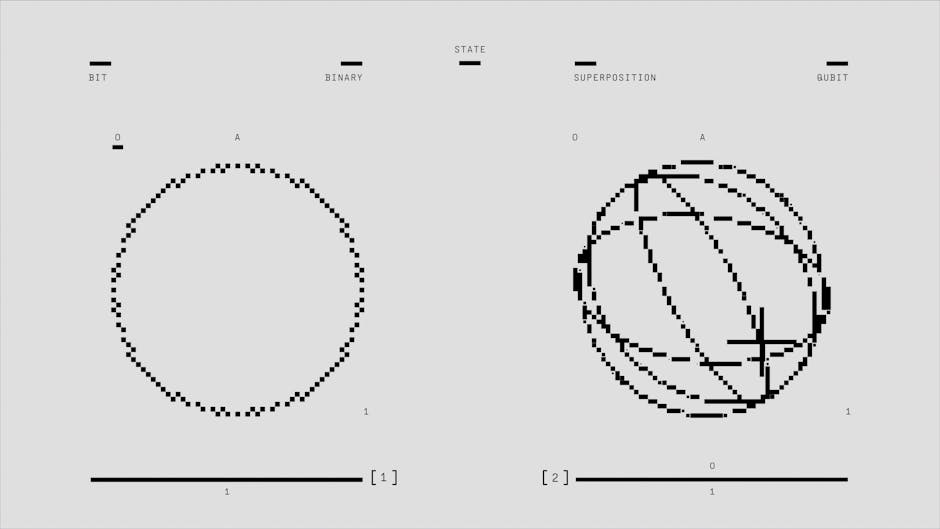
- Physicist David Bohm proposed Bohmian mechanics, an unorthodox version of quantum theory that restores reality to a more tangible state.
- Bohmian mechanics proposes that particles have definite positions, even when unobserved, unlike the Copenhagen interpretation.
- This theory introduces a hidden variable, the pilot wave, which guides the motion of particles and determines their trajectory.
- Bohmian mechanics offers an alternative to conventional Copenhagen interpretation of quantum mechanics.
- The implications of Bohmian mechanics have the potential to resolve some of the paradoxes associated with quantum mechanics.
The principles of quantum mechanics have long suggested that reality is not as solid as we think it is. However, physicist David Bohm proposed an unorthodox version of quantum theory, known as Bohmian mechanics, which restores reality to a more tangible state. This theory, although not widely accepted, has garnered significant attention in recent years due to its potential to resolve some of the paradoxes associated with quantum mechanics. With the implications of quantum mechanics continuing to intrigue scientists and philosophers alike, the exploration of Bohmian mechanics has become an increasingly important area of study. As researchers delve deeper into the mysteries of quantum mechanics, the possibility of a new perspective on reality emerges, one that challenges our current understanding of the physical world.
Introduction to Bohmian Mechanics

Bohmian mechanics, developed by David Bohm in the 1950s, offers an alternative to the conventional Copenhagen interpretation of quantum mechanics. While the Copenhagen interpretation suggests that particles can exist in multiple states simultaneously, Bohmian mechanics proposes that particles have definite positions, even when unobserved. This theory introduces a hidden variable, known as the pilot wave, which guides the motion of particles. The pilot wave is a deterministic function that determines the trajectory of particles, effectively restoring reality to a more predictable state. By reintroducing determinism into the quantum realm, Bohmian mechanics provides a more intuitive understanding of quantum phenomena, one that resonates with our classical perception of reality.
Key Principles of Bohmian Mechanics

The key to Bohmian mechanics lies in its ability to explain quantum phenomena without resorting to randomness and uncertainty. By introducing the pilot wave, Bohmian mechanics provides a deterministic framework for understanding quantum mechanics. This theory also resolves the paradox of wave function collapse, which has long been a topic of debate among physicists. According to Bohmian mechanics, the wave function never collapses; instead, the pilot wave guides the particle to its desired position, effectively selecting the outcome of a measurement. With its deterministic approach, Bohmian mechanics offers a more comprehensive understanding of quantum mechanics, one that has the potential to unify the principles of quantum and classical physics.
Testing Bohmian Mechanics
Despite its potential, Bohmian mechanics remains a topic of debate among physicists, with many questioning its validity and testability. However, recent advances in experimental techniques have made it possible to test the principles of Bohmian mechanics. Researchers have proposed several experiments, including those involving quantum entanglement and non-locality, to verify the predictions of Bohmian mechanics. These experiments aim to determine whether the pilot wave can be detected and whether it plays a role in guiding the motion of particles. As scientists continue to explore the implications of Bohmian mechanics, the possibility of a new era in quantum research emerges, one that could revolutionize our understanding of the physical world.
Implications of Bohmian Mechanics
The implications of Bohmian mechanics are far-reaching, with the potential to impact our understanding of reality and the nature of quantum mechanics. If proven correct, Bohmian mechanics could restore reality to a more tangible state, one that is more in line with our classical perception of the world. This, in turn, could have significant implications for our understanding of the universe, from the behavior of subatomic particles to the nature of space and time. Furthermore, Bohmian mechanics could provide a new framework for understanding complex quantum phenomena, such as quantum computing and quantum cryptography, and could potentially lead to breakthroughs in these fields.
Expert Perspectives
Physicists and philosophers have long debated the merits of Bohmian mechanics, with some hailing it as a revolutionary theory and others dismissing it as a fringe idea. According to Dr. Sheldon Goldstein, a physicist at Rutgers University, “Bohmian mechanics offers a unique perspective on quantum mechanics, one that has the potential to resolve some of the paradoxes associated with the theory.” On the other hand, Dr. Sean Carroll, a physicist at Caltech, argues that “Bohmian mechanics is an interesting idea, but it remains to be seen whether it can be experimentally verified.” As experts continue to weigh in on the debate, the discussion surrounding Bohmian mechanics remains a lively and thought-provoking one, with the potential to shape our understanding of quantum mechanics and reality.
As researchers continue to explore the implications of Bohmian mechanics, the question remains: will this theory ever become more widely accepted? While it is difficult to predict the future of scientific research, one thing is certain – the exploration of Bohmian mechanics has the potential to revolutionize our understanding of quantum mechanics and reality. As scientists push the boundaries of human knowledge, the possibility of a new era in quantum research emerges, one that could challenge our current understanding of the physical world and reveal new insights into the nature of reality. With its deterministic approach and potential to resolve quantum paradoxes, Bohmian mechanics remains an intriguing theory, one that warrants further exploration and debate.