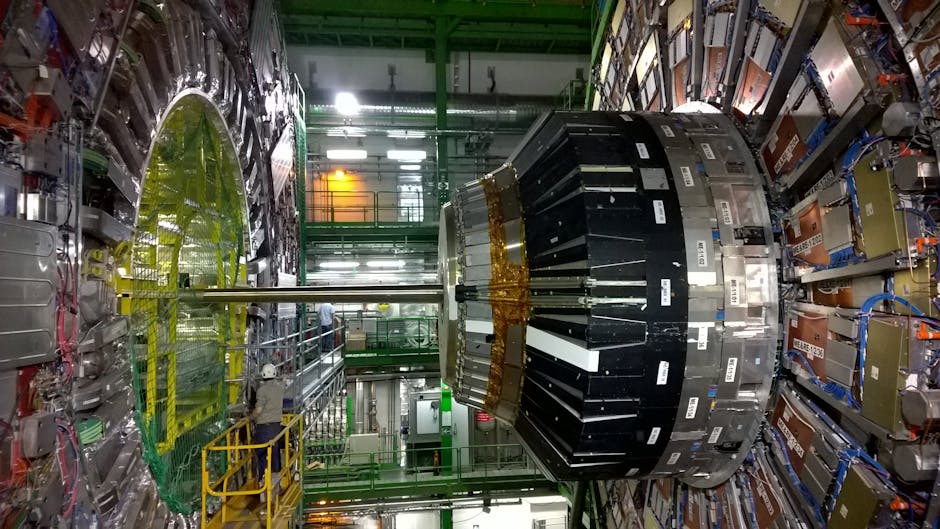
- Physicists have discovered ‘penguin’ decays, a rare particle decay, at CERN’s Large Hadron Collider, hinting at exotic particles beyond the Standard Model.
- The discovery has significant implications for our understanding of the universe and could revolutionize our understanding of fundamental particles and forces.
- The Standard Model of particle physics has limitations and fails to explain certain phenomena, such as dark matter and dark energy.
- The Large Hadron Collider is a powerful tool for searching for new physics beyond the Standard Model, creating new particles at incredibly high energies.
- The discovery of exotic particles could lead to a new era of scientific discovery and a deeper understanding of the universe’s mysteries.
The Standard Model of particle physics, which describes the behavior of fundamental particles and forces, has been incredibly successful in explaining a wide range of phenomena. However, it has limitations, and physicists have long suspected that there may be new physics beyond the Standard Model. Recently, a team of scientists at CERN’s Large Hadron Collider (LHC) has made a groundbreaking discovery that could finally break the Standard Model. The discovery of ‘penguin’ decays, a type of rare particle decay, has hinted at the existence of exotic particles that could revolutionize our understanding of the universe. This finding has sent shockwaves through the scientific community, with many hailing it as one of the most significant discoveries in recent years.
The Search for New Physics

The search for new physics beyond the Standard Model has been an ongoing effort for decades. Physicists have long known that the Standard Model is incomplete, as it fails to explain certain phenomena, such as dark matter and dark energy. The LHC, which is the most powerful particle accelerator in the world, has been at the forefront of this search. By colliding protons at incredibly high energies, scientists can create new particles that may hold the key to unlocking the secrets of the universe. The latest experiment at the LHC has been no exception, with scientists using advanced detectors to search for rare particle decays that could hint at new physics.
The ‘Penguin’ Decays

The ‘penguin’ decays, which are named after the penguin-like shape of the decay diagram, are a type of rare particle decay that involves the decay of a B-meson into a kaon and a pair of muons. This decay is particularly interesting because it is sensitive to the effects of new physics, such as the existence of exotic particles. The latest experiment at the LHC has seen a significant excess of ‘penguin’ decays, which has led scientists to speculate that new physics may be at play. The discovery of these decays has been hailed as a major breakthrough, as it provides the first direct evidence of new physics beyond the Standard Model.
Analysis and Implications
The analysis of the ‘penguin’ decays has been ongoing, with scientists working to understand the implications of the discovery. The excess of ‘penguin’ decays has been found to be consistent with the existence of exotic particles, such as leptoquarks or Z’ bosons. These particles are predicted by certain theories, such as supersymmetry or extra dimensions, and could provide a new understanding of the universe. The discovery of these particles could also have significant implications for our understanding of the universe, including the possibility of new forces or interactions that could explain phenomena such as dark matter and dark energy.
Impact on the Scientific Community
The discovery of the ‘penguin’ decays has sent shockwaves through the scientific community, with many hailing it as one of the most significant discoveries in recent years. The finding has significant implications for our understanding of the universe, and could potentially lead to a new understanding of the fundamental laws of physics. The discovery has also sparked a flurry of activity, with scientists around the world working to confirm the finding and understand its implications. As the analysis continues, it is clear that the discovery of the ‘penguin’ decays will be a major milestone in the search for new physics beyond the Standard Model.
Expert Perspectives
Experts in the field have been quick to comment on the discovery, with many hailing it as a major breakthrough. ‘The discovery of the ‘penguin’ decays is a significant step forward in our understanding of the universe,’ said Dr. Maria Spiropulu, a physicist at Caltech. ‘It provides the first direct evidence of new physics beyond the Standard Model, and could potentially lead to a new understanding of the fundamental laws of physics.’ Others have cautioned that more work is needed to confirm the finding, but the excitement is palpable. ‘This is a very exciting time for physics,’ said Dr. Nima Arkani-Hamed, a physicist at the Institute for Advanced Study. ‘The discovery of the ‘penguin’ decays has the potential to revolutionize our understanding of the universe, and we are eager to see where it will lead.’
As the scientific community continues to analyze the data and understand the implications of the discovery, one thing is clear: the search for new physics beyond the Standard Model has entered a new era. With the discovery of the ‘penguin’ decays, scientists have been given a new tool to explore the universe, and the possibilities are endless. As scientists look to the future, they will be watching closely to see how the discovery of the ‘penguin’ decays will shape our understanding of the universe, and what new discoveries it may lead to. One question on everyone’s mind is: what’s next? Will the discovery of the ‘penguin’ decays lead to a new understanding of the universe, or will it raise more questions than answers? Only time will tell, but one thing is certain: the discovery of the ‘penguin’ decays is just the beginning of an exciting new chapter in the search for new physics.