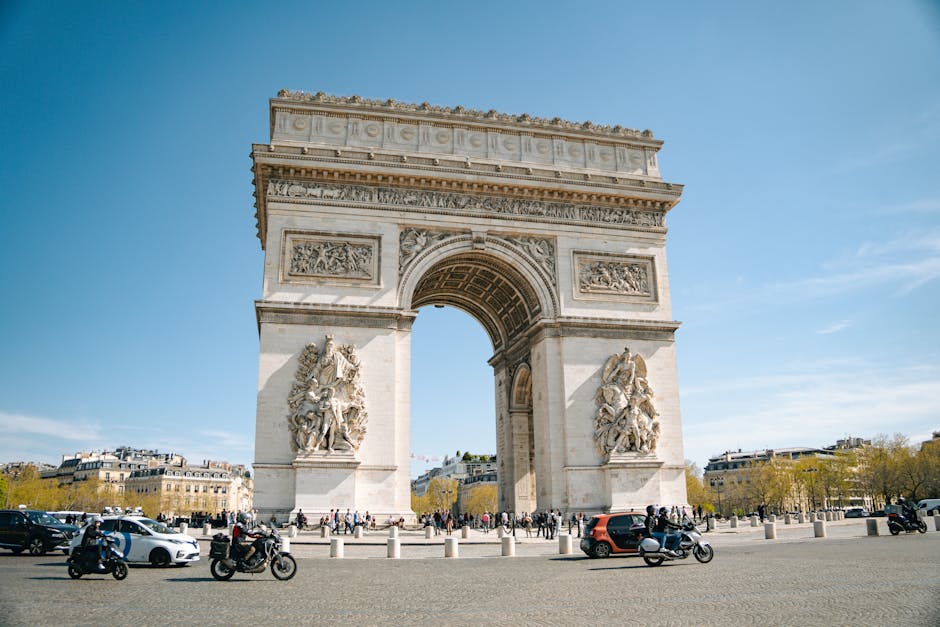
- The Arc de Triomphe in Paris is a symbol of French national identity and a complex historical monument.
- Donald Trump’s plan to build a monument in Washington that surpasses the Arc de Triomphe has sparked ridicule and concern.
- The Arc de Triomphe stands at 164 feet tall and 148 feet wide, making it a significant physical structure.
- Trump’s ambition to build a larger monument in Washington has been met with widespread skepticism.
- The Arc de Triomphe’s history is marked by controversy, including glorifying military conquests and political tension.
President Donald Trump’s vow to build a monument in Washington that surpasses the iconic Arc de Triomphe in Paris has sparked both ridicule and concern. The Arc de Triomphe, standing at 164 feet tall and 148 feet wide, is not just a physical structure but a symbol of French national identity and a testament to the country’s complex history. Trump’s ambition, while grandiose, has been met with widespread skepticism, especially given the historical and cultural significance of the Parisian landmark.
The Arc de Triomphe: A Symbol of French National Pride

The Arc de Triomphe, completed in 1836 under the reign of King Louis-Philippe, was initially commissioned by Napoleon Bonaparte in 1806 to honor his military victories. It stands at the western end of the Champs-Élysées and is the focal point of one of the world’s most famous avenues. The monument is adorned with intricate sculptures and reliefs, including the famous La Marseillaise by François Rude, and serves as a reminder of France’s rich cultural and political heritage. However, its history is not without controversy, as it has been used to glorify military conquests and has been a site of political tension over the years.
Trump’s Vision: A Bigger, Better Monument

During a visit to Paris in 2018, Trump expressed his admiration for the Arc de Triomphe and declared his intention to build a similar, but larger, structure in Washington, D.C. The president’s statement, made during a press conference, has since been a subject of ridicule and debate. Critics argue that the proposal is not only impractical but also fails to understand the nuanced history and cultural significance of the French monument. The plan has also raised questions about the purpose and design of such a monument in the modern American context, where public opinion on grandiose memorials is divided.
The Complex History of Monuments

Monuments are more than just architectural feats; they are powerful symbols that reflect the values, aspirations, and historical narratives of a nation. The Arc de Triomphe, for instance, has played a significant role in French history, from serving as a site for national celebrations to becoming a symbol of resistance during World War II. According to historian Antoine Picon, the monument’s enduring appeal lies in its ability to adapt to changing times and contexts. Trump’s proposal, on the other hand, has been criticized for its lack of historical context and its potential to become a divisive symbol rather than a unifying one.
Implications for Washington, D.C.

The potential construction of a monument larger than the Arc de Triomphe in Washington, D.C., raises significant implications for the city’s landscape and for American public discourse. Washington, D.C., is already home to numerous monuments and memorials, each with its own historical and cultural significance. Adding another grandiose structure could shift the focus away from existing landmarks and potentially alienate segments of the population. Moreover, the cost and logistical challenges of such a project are substantial, and it is unclear whether it would receive the necessary public and political support.
Expert Perspectives
Historians and urban planners have offered contrasting views on Trump’s proposal. While some see it as a continuation of a long tradition of monumental architecture, others warn of the risks of creating a symbol that may not resonate with the American public. “Monuments are not just about size; they are about the stories they tell and the values they represent,” said urban planner Sarah Williams Goldhagen. “Building a larger arch without a deep understanding of its purpose could be seen as an empty gesture.”
As the debate over Trump’s proposed monument continues, it is essential to consider the broader implications of such a project. Will it enhance the cultural and historical fabric of Washington, D.C., or will it become a source of division? The answer lies in how well the new monument can capture the spirit and values of the American people, a task that is far more complex than simply building a larger structure.
Source: The New York Times