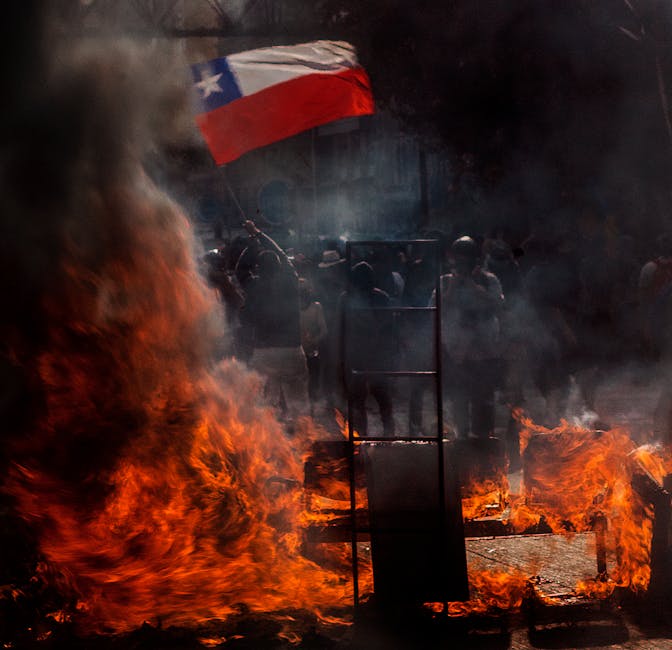
- Chilean students protest against proposals to limit free higher education, citing disproportionate impact on low-income students.
- The government plans to introduce tuition fees for higher education, a move that has sparked widespread outrage among students.
- At least 20 students were injured in clashes with riot police, with several others detained by authorities during the protests.
- Students demand the government abandon its plans and increase funding for public universities instead.
- Protests highlight deep-seated inequalities in Chile’s education system, exacerbating existing social and economic disparities.
Chile has witnessed a fresh wave of student protests against the government’s proposals to limit free higher education, with the police responding with water cannons and tear gas. The demonstrations, which have been ongoing for weeks, turned violent as students clashed with riot police in the capital city of Santiago. The use of water cannons and tear gas has sparked widespread criticism, with many arguing that the police response was excessive and disproportionate to the threat posed by the protesters. According to reports, at least 20 students were injured in the clashes, with several others detained by the authorities.
The Fight for Free Education

The current wave of protests in Chile is centered around the government’s plans to introduce tuition fees for higher education, which has been free for many students since 2016. The proposal has sparked widespread outrage among students, who argue that it will disproportionately affect those from low-income backgrounds and undermine the country’s efforts to increase access to education. The students are demanding that the government abandon its plans and instead increase funding for public universities. The protests have also highlighted the deep-seated inequalities in Chile’s education system, with many arguing that the proposed changes will only serve to exacerbate existing social and economic disparities.
A History of Student Protests

Chile has a long history of student protests, with many previous demonstrations having led to significant reforms in the country’s education system. In 2011, a wave of student protests led to the introduction of free higher education for many students, and since then, there have been ongoing demands for further reforms. The current protests are seen as a continuation of this movement, with students arguing that the government’s proposals threaten to undermine the progress that has been made. The protests have also drawn support from other sectors of society, including teachers, workers, and community groups, who are all opposed to the government’s plans to introduce tuition fees.
Government Response
The government has defended its proposals, arguing that they are necessary to ensure the long-term sustainability of the education system. According to the government, the introduction of tuition fees will help to increase funding for public universities and improve the quality of education. However, the students and their supporters argue that this is a misguided approach, and that the government should instead be increasing funding for public education and reducing inequality. The government’s response to the protests has been widely criticized, with many arguing that the use of water cannons and tear gas is a heavy-handed approach that only serves to inflame tensions. The United Nations has also weighed in on the issue, calling on the government to respect the rights of protesters and to engage in dialogue with the students.
Broader Implications
The protests in Chile have significant implications for the country’s education system and its wider society. If the government’s proposals are implemented, it is likely that many students from low-income backgrounds will be priced out of higher education, which could have long-term consequences for social mobility and economic growth. The protests have also highlighted the need for greater investment in public education and for more equitable funding models that do not disproportionately affect the poor. As the situation continues to unfold, it remains to be seen whether the government will be willing to listen to the demands of the students and to reconsider its proposals.
Expert Perspectives
Experts are divided on the issue, with some arguing that the government’s proposals are necessary to ensure the long-term sustainability of the education system. Others, however, argue that the introduction of tuition fees will only serve to exacerbate existing inequalities and undermine the country’s efforts to increase access to education. According to Dr. Maria Rodriguez, a leading expert on education policy, “the government’s proposals are a step in the wrong direction and will only serve to widen the gap between the rich and the poor.” In contrast, Dr. Juan Hernandez, a former education minister, argues that “the introduction of tuition fees is a necessary measure to ensure the quality of education and to increase funding for public universities.”
As the protests continue, it remains to be seen how the situation will unfold. The students are demanding that the government abandon its plans and engage in dialogue, while the government is insisting that its proposals are necessary to ensure the long-term sustainability of the education system. One thing is certain, however: the outcome of this dispute will have significant implications for Chile’s education system and its wider society. The question on everyone’s mind is: what will happen next? Will the government be willing to listen to the demands of the students, or will the protests continue to escalate? Only time will tell.